| Piú votate - Saturn: the "Ringed Beauty" and His Moons |

Saturn-W00016667.jpgSaturn in the Night...57 visiteCaption NASA originale:"W00016667.jpg was taken on July 26, 2006 and received on Earth July 26, 2006. The camera was pointing toward Saturn that, at the time, was approximately 1.492.885 Km away.
The image was taken using the MT3 and IRP0 filters.
This image has not been validated or calibrated". 
(3 voti)
|
|

Dione-N00064207.jpgCrescent Dione76 visiteCaption originale:"N00064207.jpg was taken on July 24, 2006 and was received on Earth on July 24, 2006. The camera was pointing toward Dione that, at the time, was approximately 262.021 Km away.
The image was taken using the P120 and GRN filters".
(3 voti)
|
|
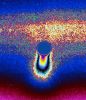
Enceladus-PIA08226.jpgThe "Fountains" of Enceladus57 visiteCaption NASA originale:"The ice-jets of Enceladus send particles streaming into space hundreds of kilometers above the South Pole of this spectacularly active moon. Some of the particles escape to form the diffuse E-Ring around Saturn.
This color-coded image was processed to enhance faint signals, making the contours and extent of the fainter, larger-scale component of the plume easier to see.
The bright strip behind and above Enceladus is the E-Ring, in which this intriguing body resides. The small round object at far left is a background star.
The image was taken in visible light with the Cassini spacecraft narrow-angle camera on March 24, 2006 at a distance of approx. 1,9 MKM (sucg as about 1,2 MMs) from Enceladus and at a Sun-Enceladus-spacecraft, or phase, angle of 162°. Image scale is about 11 Km (approx. 7 miles) per pixel".
(3 voti)
|
|

Mimas-PIA08223.jpgLand of Darkness...57 visiteCaption NASA originale:"The narrow and twisted F-Ring lights up this scene, which features Mimas against the unlit side of Saturn's Ring-Plane.
The F-Ring contains a great deal of fine, icy particles that are quite effective at scattering Sunlight at "high phase" angles.
Mimas (about 397 Km - approx. 247 miles - across) is seen as a mere crescent in the center of this haunting view.
The image was taken in visible light with the Cassini spacecraft narrow-angle camera on June 13, 2006 at a distance of approx. 3,9 MKM (such as about 2,4 MMs) from Mimas and at a Sun-Mimas-spacecraft, or phase, angle of 156°. Image scale is roughly 23 Km (about 15 miles) per pixel".
(3 voti)
|
|

Tethys-N00063453.jpgBright Tethys and "Dark" Janus (2)55 visiteCaption originale:"N00063453.jpg was taken on July 04, 2006 and received on Earth July 04, 2006. The camera was pointing toward Tethys that, at the time, was approximately 1.577.917 Km away. The image was taken using the CL1 and CL2 filters".
(3 voti)
|
|

Tethys-N00063452.jpgBright Tethys and "Dark" Janus (1)55 visiteCaption originale:"N00063452.jpg was taken on July 04, 2006 and received on Earth July 04, 2006. The camera was pointing toward Tethys that, at the time, was approximately 1.578.048 Km away. The image was taken using the CL1 and CL2 filters".
(3 voti)
|
|

Rhea-N00063467.jpgVoyagers... (1)59 visiteDue frames che ritraggono Rhea e, molto probabilmente, Tethys (ma non ne siamo affatto certi), mentre si "rincorrono" attraverso lo Spazio di Saturno.
Frames bellissimi e suggestivi che ci aiutano, se non altro, ad immaginare che cosa vuol dire "vivere" in uno Spazio popolato non da una sola Luna, ma da decine di Corpi Celesti che si rincorrono e si incrociano in una sorta di Carosello senza fine.
Caption originale:"N00063467.jpg was taken on July 04, 2006 and received on Earth July 04, 2006. The camera was pointing toward Rhea that, at the time, was approximately 1.358.319 Km away. The image was taken using the CL1 and CL2 filters".
(3 voti)
|
|
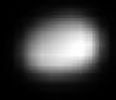
Polydeuces-PIA08209.jpgPolydeuces (extra detail mgnf)57 visiteThis magnified view shows tiny Polydeuces, a moon that was discovered by the Cassini spacecraft and is a mere 3 Km (a little less than 2 miles) across. Along with much larger Helene (32 Km, or 20 miles across), Polydeuces orbits Saturn at the same distance as large, icy Dione (which is 1.126 Km, or 700 miles across).
Because this body was only recently discovered and is so small, scientists presently know precious little about it. Further observations by Cassini may yield additional insights about its nature and composition.
The image was taken with the Cassini spacecraft narrow-angle camera on May 22, 2006 at a distance of approx. 73.000 Km (about 45.000 miles) from Polydeuces and at a phase angle of 41°. The image was obtained using a spectral filter sensitive to wavelengths of infrared light centered at 752 nanometers. Scale in the original image was about 434 mt (appx. 1423 feet) per pixel. The image has been magnified by a factor of 4 and contrast-enhanced to aid visibility.
(3 voti)
|
|

Pan-PIA08320.jpgPan through the Rings55 visiteCaption originale:"Saturn's small, walnut-shaped moon, Pan, embedded in the Planet's Rings.
This image was taken in visible light with the Cassini spacecraft narrow-angle camera on April 29, 2006, at a distance of approximately 209.000 Km (about 130,000 miles) from Pan.
The image scale is approx. 1 Km per pixel".
(3 voti)
|
|
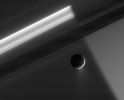
Enceladus-PIA08199.jpgEnceladus' "Jets"!56 visiteCaption NASA originale:"An enhanced close-up view shows at least two distinct jets spraying a mist of fine particles from the South Polar Region of Enceladus. The particles in the plume scatter Sunlight most effectively at high Sun-Enceladus-spacecraft angles, or phase angles, making the plumes appear bright.
This image shows the night side of Saturn and the active moon against dark sky.
Some artifacts due to image compression and cosmic rays striking the camera's detector remain as "noise" in the image.
The image was acquired in polarized green light with the Cassini spacecraft narrow-angle camera on May 4, 2006 at a distance of approx. 2,1 MKM (about 1,3 MMs) from Enceladus and 2,3 MKM (about 1,4 MMs) from Saturn. The image was taken at a Sun-Enceladus-spacecraft, or phase, angle of 159°. Image scale is roughly 13 Km (about 8 miles) per pixel".
(3 voti)
|
|

Rhea-PIA08189.jpgBright "Splat", Bright "Ice"...57 visiteCaption originale:"Rhea's crater-saturated surface shows a large bright blotch, which was likely created when a geologically recent impact sprayed bright, fresh ice ejecta over the moon's surface. The rim of the great Tirawa impact basin can be seen near the top of the image. The giant feature is approx. 360 Km (about 220 miles) across.
This equatorial view captures Rhea's Leading Hemisphere. North is up and rotated 40° to the right.
The image was taken in visible red light with the Cassini spacecraft narrow-angle camera on April 28, 2006 at a distance of approx. 481.000 Km (about 299.000 miles) from Rhea and at a Sun-Rhea-spacecraft, or phase, angle of 23°.
Image scale is approx. 3 Km (about 2 miles) per pixel".
(3 voti)
|
|

Saturn-W00015420.jpgSea of Clouds (4)58 visiteCaption NASA:"W00015420.jpg was taken on May 22, 2006 and received on Earth on May 23, 2006. The camera was pointing toward Saturn that, at the time, was approximately 270.920 Km away.
The image was taken using the CB2 and CL2 filters".
(3 voti)
|
|
| 2244 immagini su 187 pagina(e) |
 |
|
|
|
|
139 | |
|
|
|
|





