| Piú votate - Saturn: the "Ringed Beauty" and His Moons |

The Rings-PIA08255.jpg"Penumbral fade" on Saturn's Rings58 visiteCaption NASA:"As the particles comprising Saturn's A-Ring slip into the Planet's shadow, they find themselves briefly in the penumbra of Saturn's shadow. In this very narrow region along the edge of the shadow, part (but not all) of the Sun is still visible around the side of the Planet, creating only a partial shadow there and making the shadow edge look fuzzy.
The image was taken in visible light with the Cassini spacecraft narrow-angle camera on July 26, 2006 at a distance of approx. 1,5 MKM (such as about 900.000 miles) from Saturn. Image scale is roughly 9 Km (about 5 miles) per pixel".
(3 voti)
|
|

Tethys-PIA08254-0.jpgMelanthius Crater (context image)55 visitenessun commento
(3 voti)
|
|

Tethys-PIA08254-1.jpgMelanthius Crater (detail mgnf)55 visiteCaption NASA:"Cassini looks into the 245-Km (150-mile) wide crater Melanthius in this view of the Southern Terrain on Tethys. The crater possesses a prominent cluster of peaks in its center which are relics of its formation.
Notable here is a distinct boundary in crater abundance -- the cratering density is much higher in the farthest Western Terrain (left side of the image) than elsewhere.
North on Tethys is up and rotated 45° to the left.
The image was taken in visible light with the Cassini spacecraft narrow-angle camera on July 23, 2006 at a distance of approx. 120.000 Km (such as about 75.000 miles) from Tethys and at a Sun-Tethys-spacecraft, or phase, angle of 29°.
Image scale is roughly 715 mt (such as about 2,345 feet) per pixel".
(3 voti)
|
|

Saturn-PIA08253.jpgThe "Ring-Masters"58 visiteCaption NASA:"This view looks down onto the unlit side of Saturn's Ringplane. It nicely shows a near-arm/far-arm brightness asymmetry in the B-Ring: The near arm of the B-Ring (in the lower half of the image) is notably darker from this viewing geometry than is the far arm (above).
Imaging scientists believe this to be a manifestation of the reflection of light from the disk of Saturn falling predominantly on the far arm of the Rings. (At the time this image was taken, Cassini was more or less on the dark side of the Planet.) As the B-Ring is the thickest part of Saturn's Rings, it scatters less sunlight from below, and reflects more Saturnshine from above, than either the A or C-Rings, making the effect look more dramatic in the B-Ring. Two small moons appear in this scene as well: Atlas and Pandora (32 and 84 Km across, respectively); between the two moons lie multiple clumps of material in the F-Ring.
The image was taken in visible light with the Cassini spacecraft wide-angle camera on July 25, 2006 at a distance of approximately 1 million kilometers (600,000 miles) from Saturn and at a Sun-Saturn-spacecraft, or phase, angle of 128 degrees. Image scale is 58 kilometers (36 miles) per pixel.
(3 voti)
|
|
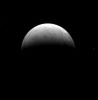
Enceladus-PIA08249.jpgEnceladus58 visiteCaption NASA:"Few large craters are to be found in the wrinkled terrain of Enceladus, where the surface has been reworked by geologic processes presumably resulting from the moon's inner warmth.
Cassini spied the bright crescent of Enceladus on July 23, 2006 at a distance of approx. 628.000 Km (about 391.000 miles).
The image was taken in visible light with the Cassini spacecraft narrow-angle camera at a Sun-Enceladus-spacecraft, or phase, angle of 103°. Image scale is roughly 4 Km (about 2 miles) per pixel".
(3 voti)
|
|
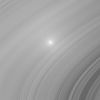
The Rings-PIA08248.jpgOpposition "Surge" on the B-Ring71 visiteBoth images ("A" and "B" Ring) were taken in visible light with the Cassini spacecraft wide-angle camera on July 23, 2006 at a distance of approxi. 262.000 Km (about 163.000 miles) from Saturn.
Image scale in the radial, or outward from Saturn, direction is roughly 13 Km (such as about 8 miles) per pixel.
(3 voti)
|
|
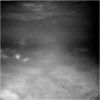
Saturn-W00016810.jpgTurbulence (4)58 visiteCaption NASA:"W00016810.jpg was taken on August 16, 2006 and received on Earth August 18, 2006. The camera was pointing toward Saturn that, at the time, was approximately 191.791 Km away.
This image was taken using the CB2 and CL2 filters".
(3 voti)
|
|

Dione-N00064763.jpgThe "Night" of Dione (3)55 visiteCaption NASA:"N00064763.jpg was taken on August 16, 2006 and received on Earth August 18, 2006.
The camera was pointing toward Dione that, at the time, was approximately 155.433 Km away.
This image was taken using the CL1 and CL2 filters".
(3 voti)
|
|

Dione-N00064760.jpgThe "Night" of Dione (2)56 visiteCaption NASA:"N00064760.jpg was taken on August 16, 2006 and received on Earth August 18, 2006.
The camera was pointing toward Dione that, at the time, was approximately 155.801 Km away.
This image was taken using the CL1 and CL2 filters".
(3 voti)
|
|

Dione-N00064757.jpgThe "Night" of Dione (1)58 visiteDalla "modesta" distanza di circa 158.000 Km, Cassini fotografa Dione e, sovraesponendone le regioni su cui splende il Sole, è capace di regalarci una incredibile e suggestiva visione dei rilievi Dioniani immersi nella notte e vagamente rischiarati, con ogni probabilità, dal solo "Saturnshine", o "Chiaro di Saturno".
(3 voti)
|
|

Rhea-PIA08239.jpgRhea behind the Rings (natural colors)92 visiteCaption NASA originale:"The Rings cannot hide the ragged, icy crescent of Rhea, here imaged in color by the Cassini spacecraft: The second-largest moon of Saturn shines brightly through gaps in the Rings.
Rhea lies beyond the dim, unlit side of the Rings. A diffuse clump of material lies in the F-Ring, on the side nearest to Cassini.
Images taken using red, green and blue spectral filters were combined to create this natural color view, which approximates the scene as it might appear to human eyes. The view was acquired with the Cassini spacecraft narrow-angle camera on July 1, 2006 at a distance of approx. 1,2 MKM (about 700.000 miles) from Rhea and at a Sun-Rhea-spacecraft, or phase, angle of 118°. Image scale is roughly 7 Km (about 4 miles) per pixel".
(3 voti)
|
|
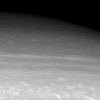
Saturn-PIA08232.jpgHigh Northern Latitudes57 visiteCaption NASA originale:"This infrared view looks toward middle to High Northern Latitudes on Saturn, revealing entrancing meanders in the clouds. The cloud patterns transition from puffier looking in the South - possibly a region of shear - to smoother oval shapes in the North.
Cassini's view of high latitudes will improve beginning in late July 2006 as the spacecraft's orbit leaves the Ring-Plane and is cranked up to higher inclinations.
The image was taken with the Cassini spacecraft wide-angle camera using a spectral filter sensitive to wavelengths of infrared light centered at 939 nanometers. The view was obtained on June 30, 2006 at a distance of approx. 336.000 Km (about 209.000 miles) from Saturn. Image scale is roughly 16 Km (about 10 miles) per pixel".
(3 voti)
|
|
| 2244 immagini su 187 pagina(e) |
 |
|
|
|
|
138 | |
|
|
|
|





