| Piú votate - Saturn: the "Ringed Beauty" and His Moons |

Mimas-N00070754.jpgMimas (2)57 visiteCaption NASA:"N00070754.jpg was taken on November 20, 2006 and received on Earth November 23, 2006. The camera was pointing toward Mimas that, at the time, was approximately 152.344 Km away.
The image was taken using the P120 and MT2 filters and has not been validated or calibrated".
(3 voti)
|
|

The Rings-PIA08295.jpgWhat's inside the Rings?56 visiteThe 2 prominent dark gaps in Saturn's A-Ring contain small embedded moons and a host of other intriguing features. Here, 3 unique ringlets are visible in the Encke Gap (about 325 Km wide). The innermost ringlet (topmost here) is faint but continuous. The center ringlet brightens substantially toward upper left and displays a few slight kinks. This ringlet is coincident with the orbit of Pan (about 26 Km across). The outermost ringlet is discontinuous, with two bright regions visible.
The narrower Keeler Gap (about 42 Km wide) hosts the moon Daphnis (7 Km across - not visible in this image), which raises waves in the Gap edges as it orbits Saturn. At lower left, faint ringlets flanking the bright F-Ring core are visible. These features were found by the Cassini spacecraft to be arranged into a spiral arm structure that winds around the Planet like a spring. The spiral may be caused by tiny moonlets or clumps of material that have smashed through the F-Ring core and liberated material.
This view looks toward the unlit side of the rings from about 23 degrees above the ringplane.
The image was taken in visible red light with the Cassini spacecraft narrow-angle camera on Sept. 11, 2006 at a distance of approximately 1.1 million kilometers (700,000 miles) from Saturn and at a Sun-Saturn-spacecraft, or phase, angle of 151 degrees. Image scale is about 6 kilometers (4 miles) per pixel.
(3 voti)
|
|

Streamers-PIA08292.jpgThe "F-Ring Streamers" (detail mgnf - HR)59 visiteCaption NASA originale:"Multiple faint, streamer-like objects can be seen in this HR Cassini spacecraft view of the F-Ring's bright core. The regular spacing of some of the features extending from the core indicates that they could all be produced by the perturbing effect of a single body as it passes close by. Scientists are examining Cassini images closely in an attempt to determine whether there are tiny moonlets - or perhaps transient clumps of material - orbiting Saturn near the F-Ring core. The researchers believe the streamer features seen here could be caused by a related phenomenon to that by which Prometheus produces streamers in the F-Ring.
This image was taken in visible light with the Cassini spacecraft narrow-angle camera on Sept. 25, 2006 at a distance of approx. 339.000 Km (about 211.000 miles) from Saturn and at a phase angle of 69°. Image scale is roughly 2 Km (a little more than 1 mile) per pixel".
Nota: quanto scommetete che, in un prossimo futuro, il Prof. Hoagland (o anche qualcun altro della Sua Scuola) ci verrà a raccontare che gli Streamers (---> corpi fluttuanti) non sono altro che minuscole astronavi le quali hanno il compito di bilanciare gravitazionalmente la porzione più esterna degli Anelli di Saturno e che l'intero "Impianto degli Anelli" non è altro - in fondo - che una gigantesca opera di Ingegneria Planetaria, creata per mero "piacere visivo" e lasciataci da chissà quale Civilità a testimonianza del suo glorioso passato? Insomma, dopo la Sfinge e le Piramidi, perchè non dirigere il prossimo business interplanetario verso l'"Architettura Cosmica", di cui gli Anelli di Saturno non rappresentano altro che un timido preliminare?!?...
(3 voti)
|
|

Tethys-PIA08284-1.jpgTethys' transition (false colors)56 visiteCaption NASA originale:"An extreme false-color view of Tethys reveals a surface detail not visible in a monochrome view taken at the same time. The false-color view shows a color transition from the moon's Saturn-facing side (left) to a region its trailing side (bottom).
Near the top of the images, the central-peaked crater Telemachus lies in the deeply grooved terrain that marks the northern reaches of Ithaca Chasma.
To create the false-color view, ultraviolet, green and infrared images were combined into a single picture that isolates and maps regional color differences. This "color map" was then superposed over a clear-filter image that preserves the relative brightness across the body.
The combination of color map and brightness image shows how colors vary across Tethys' surface. The origin of the color differences is not yet understood, but may be caused by subtle differences in the surface composition or the sizes of grains making up the icy surface material".
(3 voti)
|
|

The Rings-PIA08287.jpgNot the Sun, but Aldebaran!56 visiteCaption NASA originale:"Cassini took a series of images on Sept. 9, 2006 as it watched the bright red giant star Aldebaran slip behind Saturn's Rings.
This type of observation is known as a "stellar occultation" and uses a star whose brightness is well known. As Cassini watches the rings pass in front, the star's light fluctuates, providing information about the concentrations of ring particles within the various radial features in the Rings.
Here, Cassini watches the star through the part of the Rings masked by Saturn's shadow. The view looks toward the sunlit side of the Rings from about 20° below the Ring-Plane. Bright Aldebaran is over exposed, creating thin vertical lines ("effetto goccia") on its image.
The image was taken in visible light with the Cassini spacecraft narrow-angle camera on Sept. 9, 2006 at a distance of approx. 351.000 Km (such as about 218.000 miles) from Saturn. Image scale on the sky at the distance of Saturn is 2 Km (a little more than 1 mile) per pixel".
(3 voti)
|
|
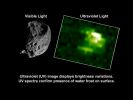
Phoebe-PIA06401.jpgFrozen water on Phoebe55 visiteCaption NASA originale:"On the right, the ultraviolet image of Saturn's moon Phoebe, taken from a distance of approx. 31.000 Km (such as about 19.263 miles) shows an irregular surface and bright crater region (white area). The bright areas indicate water frost on Phoebe's surface.
The image was taken by Cassini's UltraViolet Imaging Spectrograph during the spacecraft's closest approach to Phoebe, on June 11, 2004.
The large crater shows clearly in the image on the left".
(3 voti)
|
|

The Rings-PIA08331.jpgNew "Ringlets" (2)82 visiteCaption NASA:"HR Cassini images show an astonishing level of structure in Saturn's Cassini Division, including two ringlets that were not seen in NASA Voyager spacecraft images 25 years ago.
This view was taken with the Sun almost directly behind Saturn and its Rings, a viewing geometry in which microscopic ring particles brighten substantially. The image shows the diffuse new ringlet in the Cassini Division as the brightest feature in that Region.
This image was taken in visible light with the Cassini spacecraft narrow-angle camera on Sept. 15, 2006, at a distance of approx. 2,2 MKM (such as about 1,4 MMs) from Saturn. This view looks toward the unlit side of the Rings from about 15° above the ringplane. The phase angle, or Sun-Saturn-spacecraft angle, was 179°. Image scale on the sky at the distance of Saturn is roughly 13 Km (such as about 8 miles) per pixel".
(3 voti)
|
|

The Rings-PIA08330.jpgNew "Ringlets" (1)101 visiteCaption NASA:"HR Cassini images show an astonishing level of structure in Saturn's Cassini Division, including two ringlets that were not seen in NASA Voyager spacecraft images 25 years ago.
This image shows a new ringlet at right, just interior to the bright outer edge of the Cassini Division. This diffuse structure is about 50 Km (approx. 31 miles) wide.
The second new ringlet is roughly at center in this view. It is a very narrow feature, about 6 Km (apprx. 4 miles) wide, between the familiar broad bands of material in the Cassini Division, and displays a great deal of variation in brightness along its length.
This image was taken in visible light with the Cassini spacecraft narrow-angle camera on Sept. 9, 2006, at a distance of approx. 414.000 Km (such as about 257.000 miles) from Saturn. This view looks toward the lit side of the Rings from about 17° below the Ring-Plane. The phase angle, or Sun-Saturn-spacecraft angle, was 96°.
Image scale on the sky at the distance of Saturn is roughly 2 Km (a little more than 1 mile) per pixel".
This image was taken in visible light with the Cassini spacecraft narrow-angle camera on Sept. 9, 2006, at a distance of approximately 414,000 kilometers (257,000 miles) from Saturn. This view looks toward the lit side of the rings from about 17 degrees below the ringplane. The phase angle, or sun-Saturn-space
(3 voti)
|
|

The Rings-PIA08283.jpgNot the Sun, but Aldebaran!54 visiteCaption NASA:"The Cassini spacecraft took a series of images on Sept. 9, 2006 as it watched the bright red giant star Aldebaran slip behind Saturn's Rings.
This type of observation is known as a stellar occultation and uses a star whose brightness is well known. As Cassini watches the rings pass in front of the star, the star's light fluctuates, providing information about the concentrations of ring particles within the various radial features in the Rings.
This view shows the Encke Gap (325 Km, or approx. 200 miles wide) and the faint ringlets which share the gap with the embedded moon Pan. The view looks toward the sunlit side of the Rings from about 19° below the Ring-Plane.
Bright Aldebaran is overexposed, creating thin vertical lines on its image.
The image was taken in visible light with the Cassini spacecraft narrow-angle camera on Sept. 9, 2006 at a distance of approx. 359,000 Km (about 233.000 miles) from Saturn. Image scale on the sky at the distance of Saturn is 2 Km per pixel".
Nota: la NASA - finalmente - ci fornisce un'informazione contestuale utile e ci permette di correggere un nostro errore interpretativo (del quale ci scusiamo con Voi). Non è dunque il Sole, l'astro che viene occultato dagli Anelli di Saturno, bensì la super-gigante Rossa "Aldebaran". Ottimo: non finiamo mai di stupirci per quello che Cassini riesce a mostrarci!
(3 voti)
|
|

Saturn-PIA08732.jpgThe clouds of Saturn59 visiteThis false-color mosaic of Saturn shows deep-level clouds silhouetted against Saturn's glowing interior. The image was made with data from Cassini's VIMS, which can image the Planet at 352 different wavelengths. This mosaic shows the entire Planet, including features like Saturn's Ring shadows and the Terminator, the boundary between day and night.
The data were obtained in February 2006 at a distance of 1,6 MKM (about 1 MMs) from directly over the plane of Saturn's Rings, which appear here as a thin, blue line over the equator. The image was constructed from images taken at wavelengths of 1,07 microns (blue), 2,71 microns (green) and 5,02 microns (red).
The blue-green color (lower right) is Sunlight scattered off clouds high in Saturn's atmosphere and the red color (upper left) is the glow of thermal radiation from Saturn's warm interior, easily seen on Saturn's night side (top left), within the shadow of the Rings and with somewhat less contrast on Saturn's day side (bottom right). The darker areas within Saturn show the strongest thermal radiation. The bright red color indicates areas where Saturn's atmosphere is relatively clear. The great variety of cloud shapes and sizes reveals a surprisingly active planet below the overlying sun-scattering haze.
The brighter glow of the northern hemisphere versus the southern indicates that the clouds and hazes there are noticeably thinner than those in the south. Scientists speculate that this is a seasonal effect, and if so, it will change as the northern hemisphere enters springtime during the next few years.
(3 voti)
|
|

The Rings-PIA08277.jpgThe "Encke Gap" in detail57 visiteCaption NASA:"Although the embedded moon Pan is nowhere to be seen, there is a bright clump-like feature visible here, within the Encke Division.
Also discernable are periodic brightness variations along the outer (right side) gap edge. (...)
The view looks toward the sunlit side of the rings from about 17° below the Ring-Plane.
The image was taken in visible light with the Cassini spacecraft narrow-angle camera on Sept. 9, 2006 at a distance of approx. 421.000 Km (about 261.000 miles) from Saturn. Image scale on the sky at the distance of Saturn is roughly 2 Km (1,4 miles) per pixel".
(3 voti)
|
|

The Rings-PIA08275.jpgThe Rings55 visiteCaption NASA originale:"This wide and sweeping view of the sunlit Rings of Saturn takes in the impressive variety in their structure -- from the clumpy and perennially intriguing F-Ring to the many waves, ringlets and gaps in the A and B Rings and the Cassini Division in between.
The image was taken in visible light with the Cassini spacecraft wide-angle camera on Sept. 9, 2006 at a distance of approx. 640.000 Km (about 397.000 miles) from Saturn. The view was acquired from about 10° below the Ring-Plane. Image scale on the sky at the distance of Saturn is approx. 35 Km (about 22 miles) per pixel".
(3 voti)
|
|
| 2244 immagini su 187 pagina(e) |
 |
|
|
|
|
136 | |
|
|
|
|





