| Piú votate - Saturn: the "Ringed Beauty" and His Moons |

Saturn-PIA08896.jpgThe Southern Latitudes and the South Pole of Saturn (Extremely Enhanced Natural Colors - elab. Lunexit)56 visiteCaption NASA:"Rippling with detail, the Southern Hemisphere of Saturn comes to life in this view from the Cassini spacecraft. Long, flowing streamers and bands of great contrast soften toward the Pole, where a great hurricane-like storm resides.
The image was taken with the Cassini spacecraft wide-angle camera using a spectral filter sensitive to wavelengths of infrared light centered at 890 nanometers.
The image was taken on Feb. 1, 2007 at a distance of approx. 945.000 Km (about 587.000 miles) from Saturn.
Image scale is roughly 53 Km (approx. 33 miles) per pixel".
(3 voti)
|
|

Streak-W00026015.jpgA new "Streak" in the Sky of Saturn (original NASA image)61 visiteCaption NASA:"W00026015.jpg was taken on March 06, 2007 and received on Earth March 07, 2007. The camera was pointing toward Saturn-Rings that, at the time, were approx. 808.714 Km away.
The image was taken using the CL1 and VIO filters and has not been validated or calibrated".
Nota: volevamo commentare, ma...è fiato sprecato. Qualunque ipotesi facessimo, dalla più logica e razionale (tipo: "è una luna di Saturno che è venuta "mossa), alla più esotica (tipo: dato che le stelle sullo sfondo sono - quasi - puntiformi, si può dedurre che lo Streak rapprsenta un oggetto luminoso che SI STAVA MUOVENDO MOLTO RAPIDAMENTE rispetto a Cassini), sarebbero comunque ipotesi inutili, in quanto non sostanziabili.
Dunque...decidete Voi che cosa Vi piace immaginare di più!
(3 voti)
|
|

The_Rings-PIA08882.jpgDisturbances...56 visiteCaption NASA:"Daphnis cruises through the Keeler Gap, raising edge waves in the ring material as it passes.
As is characteristic of waves raised by a moon on the edges of a very narrow gap like Keeler, the wave begins as a coherent form near Daphnis and becomes less so with increasing orbital distance from the moon. Daphnis is about 7 Km (4,3 miles) across.
This view looks upon the lit side of the Rings from about 31° below the Ring-Plane.
The image was taken in visible light with the Cassini spacecraft narrow-angle camera on Jan. 17, 2007 at a distance of approx. 768.000 Km (about 477.000 miles) from Daphnis. Image scale is roughly 5 Km (about 3 miles) per pixel".MareKromium
(3 voti)
|
|

The_Rings-PIA08878.jpgThe "F-Ring", sinking in the shadows... (elab. Lunexit)69 visiteCaption NASA:"The strands of Saturn's F-Ring disappear into the darkness of the Planet's shadow.
Background stars make trails across the sky during the long exposure. This view looks toward the unlit side of the Rings from about 55° above the Ring-Plane.
The image was taken in visible light with the Cassini spacecraft narrow-angle camera on Jan. 3, 2007 at a distance of approx. 1,4 MKM (such as about 900.000 miles) from Saturn and at a Sun-Saturn-spacecraft, or phase, angle of 108°.
Image scale is roughly 8 Km (about 5 miles) per pixel".
(3 voti)
|
|

Mimas-N00077782.jpgOccultation? (1)57 visiteLa cosa più semplice da dire in sede di interpretazione di questo frame è che si dovrebbe trattare di una - davvero splendida - "occultazione", ossìa del transito di un Corpo Celeste sulla medesima linea visuale in cui si trova Mimas (dal punto di vista della Sonda Cassini) ed il susseguente verificarsi di una mini-eclisse.
Ma che cos'è il Corpo Celeste che viene "occultato" da Mimas? E' una stella? Secondo noi no, poichè le stelle, anche adoperando elevatissimi detail mgnf, non vengono risolte in maniera tale da mostrare dei dettagli superficiali.
Questo oggetto, invece, anche senza usare uno stretch eccessivo, si risolve in un disco e "sembra" evidenziare lievi/tenui dettagli superficiali.
Si tratta dunque di un Corpo Celeste molto più vicino all'Osservatore di quanto non lo sarebbe una stella. Che cosa sarà?
Con ogni probabilità, si tratta di un altra Luna Saturniana che, come già è accaduto tante volte in passato, viene colta in transito ravvicinato (un transito ravvicinato, come ovvio, solo apparente e determinato dal particolare movimento e relativo angolo visuale di Cassini) presso un'altra Luna del Gigante Anellato (pensate al bellissimo passaggio ravvicinato - con relativa occultazione - fra Rhea e Dione).
Oppure, se volete, si può anche pensare a qualcosa di più "esotico"...Vedete Voi!
Caption NASA:"(...) The camera was pointing toward Mimas that, at the time, was at approximately 1.345.535 Km away. and the image was taken using the CL1 and CL2 filters (...)".
(3 voti)
|
|

Mimas-N00077783.jpgOccultation? (2)57 visiteCaption NASA:"(...) The camera was pointing toward Mimas that, at the time, was at approximately 1.345.325 Km away, and the image was taken using the CL1 and CL2 filters (...)".
(3 voti)
|
|

Mimas-N00077786.jpgOccultation? (5)57 visiteCaption NASA:"(...) The camera was pointing toward Mimas that, at the time, was at approximately 1.344.677 Km away, and the image was taken using the CL1 and CL2 filters (...)".
(3 voti)
|
|

Saturn-PIA08864.jpgTurbulences... (False Colors; credits: Lunexit)58 visiteCaption NASA:"The Cassini spacecraft captures the ripples, loops and storms that swirl in Saturn's East-West flowing cloud bands.
The image was taken with the Cassini spacecraft wide-angle camera using a spectral filter sensitive to wavelengths of infrared light centered at 728 nanometers. The view was obtained on Dec. 13, 2006 at a distance of approx. 775.000 Km (about 482.000 miles) from Saturn. Image scale is roughly 43 Km (about 27 miles) per pixel".
(3 voti)
|
|
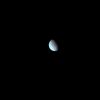
Enceladus-N00075253.jpgThe light colors of Enceladus (elab. Lunexit)64 visitenessun commentoMareKromium
(3 voti)
|
|
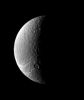
Rhea-PIA08851.jpgRhea75 visiteCaption NASA:"This view looks toward Rhea's North Polar Region, where icy fractures slither away toward the South. The lit terrain in this view is on the Saturn-facing Hemisphere of Rhea.
The image was taken in visible light with the Cassini spacecraft narrow-angle camera on Dec. 4, 2006 at a distance of approx. 773.000 Km (about 480000 miles) from Rhea and at a Sun-Rhea-spacecraft, or phase, angle of 105°.
Image scale is 5 Km (a little more than 3 miles) per pixel".MareKromium
(3 voti)
|
|
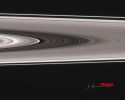
The_Rings-PIA08827.jpgMimas and the Rings57 visiteCaption NASA:"A recently discovered diffuse ringlet shines brightly in the Cassini Division as Mimas cruises past at bottom. Most of the main Rings are comprised of particles ranging from marble-size to house-size. In contrast, the brightness of this ringlet (seen right of center) when viewed at a high phase angle (the Sun-Saturn-Spacecraft angle) indicates it contains a large quantity of microscopic particles, which were likely generated by the disruption of a larger body. Such an event was probably recent, since this ringlet was not observed by the Voyager spacecraft in 1980 and 1981.
This view looks toward the lit side of the Rings from about 1° below the Ring-Plane. Mimas, which is in the foreground between Cassini and the Rings, is 397 Km (about 247 miles) wide. See PIA08330 and PIA08331 for other views of the new ringlet.
The image was taken in visible light with the Cassini spacecraft wide-angle camera on Nov. 18, 2006 and from a phase angle of 140°. Cassini was then at a distance of about 1,2 MKM (about 800.000 miles) from Saturn. Image scale is roughly 7 Km per pixel".MareKromium
(3 voti)
|
|

Pan-PIA08317.jpgA "Bright Pearl" in the Darkness: Pan in the Gap57 visiteCaption NASA originale:"This Cassini spacecraft view of Pan in the Encke Gap shows hints of detail on the moon's dark side, which is lit by Saturnshine -- sunlight reflected off Saturn.
Pan (26 Km, or 16 miles across) cruises the Encke Gap (325 Km, or 200 miles wide) with several faint ringlets.
This view looks toward the lit side of the Rings from about 52° below the Ring-Plane. The sunlit portion of Pan is partly overexposed.
The image was taken in visible light with the Cassini spacecraft narrow-angle camera on Oct. 27, 2006 at a distance of approx. 385.000 Km (about 239.000 miles) from Pan and at a Sun-Pan-spacecraft, or phase, angle of 86°. Image scale is roughly 2 Km (1,4 miles) per pixel".
(3 voti)
|
|
| 2244 immagini su 187 pagina(e) |
 |
|
|
|
|
135 | |
|
|
|
|





