| Piú votate - Saturn: the "Ringed Beauty" and His Moons |

Helene-N00086694.jpgJust like Phobos: Helene (3)58 visitenessun commentoMareKromium
(3 voti)
|
|

Saturn-PIA08982.jpgIn the Night...67 visiteCaption NASA:"Graceful giant Saturn poses with a few of the small Worlds it holds close. From this viewpoint the Cassini Spacecraft can see across the entirety of the Planet's shadow on the Rings, to where the Ring-Plane emerges once again into Sunlight.
Tethys shines large and bright near the bottom of the scene. Pandora sits outside the F-Ring, below center. Epimetheus is a speck on the far side of the Ring-Plane, immediately to the right of Saturn's limb. Most of the other bright specks near the Rings are background stars.
This view looks toward the unilluminated side of the Rings from about 8° above the Ring-Plane. The image has been brightened to enhance the appearance of the small moons.
The image was taken with the Cassini spacecraft wide-angle camera on June 2, 2007 using a spectral filter sensitive to wavelengths of infrared light centered at 918 nanometers.
The view was obtained at a distance of approx. 2,2 MKM (such as about 1,4 MMs) from Saturn.
Image scale is roughly 131 Km (about miles) per pixel".MareKromium
(3 voti)
|
|

Saturn-PIA08973.jpgIR Saturn57 visiteCaption NASA:"Cassini looks toward Northern Latitudes on Saturn and out across the Ring-Plane.
This InfraRed (IR) view probes clouds beneath the hazes that obscure the Planet's depths in natural color views.
This image looks toward the unilluminated side of the Rings from about 24° above the Ring-Plane. The Rings' shadow drapes across the region North of the Planet's bright Equatorial Band.
The image was taken with the Cassini spacecraft wide-angle camera using a spectral filter sensitive to wavelengths of light centered at 890 nanometers. The view was acquired on May 24, 2007 at a distance of approx. 1,5 MKM (such as about 1 MMs) from Saturn.
Image scale is roughly 89 Km (55 miles) per pixel".MareKromium
(3 voti)
|
|

Enceladus-N00085267.jpgEnceladus (2) - (natural colors - elab. Lunexit)56 visiteCaption NASA:"N00085267.jpg was taken on June 28, 2007 and received on Earth June 29, 2007. The camera was pointing toward Enceladus that, at the time, was approx. 293.113 Km away. The image was taken using the CL1 and IR1 filters.
This image has not been validated or calibrated".MareKromium
(3 voti)
|
|

Mimas-N00085241.jpgMimas is looking away...57 visiteCaption NASA:"N00085241.jpg was taken on June 28, 2007 and received on Earth June 28, 2007. The camera was pointing toward Mimas that, at the time, was approx. 181.809 Km away. The image was taken using the P0 and GRN filters.
This image has not been validated or calibrated".MareKromium
(3 voti)
|
|

Tethys-N00085204.jpgTethys' surface, in the Saturn-shine (1 - natural colors - elab. Lunexit)59 visiteCaption NASA:"N00085204.jpg was taken on June 27, 2007 and received on Earth June 28, 2007. The camera was pointing toward Tethys that, at the time, was approx. 15.851 Km away. The image was taken using the CL1 and CL2 filters.
This image has not been validated or calibrated".MareKromium
(3 voti)
|
|
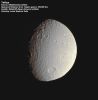
Tethys-PIA08967.jpgTethys (natural colors - elab. Lunexit)56 visiteCaption NASA:"The Cassini spacecraft surveys the battered surface of icy Tethys. The great impact basin straddling the Terminator is itself overprinted by many smaller impact sites.
The view in this image is toward the Southern Hemisphere on the moon's Saturn-facing side. North on Tethys is up and rotated 7° to the right.
The image was taken in visible light with the Cassini spacecraft narrow-angle camera on May 11, 2007. The view was obtained at a distance of approx. 559.000 Km (such as about 347.000 miles) from Tethys and at a phase angle of 60°.
Image scale is roughly 3 Km (about 2 miles) per pixel".MareKromium
(3 voti)
|
|

Daphnis-PIA08924.jpgDaphnis is there...somewhere!58 visiteCaption NASA:"The presence of the tiny ring moon Daphnis is betrayed by the edge waves it creates in the Keeler Gap.
The Gap is a narrow lane, about 42 Km (26 miles) wide, in Saturn's outer A-Ring. Daphnis (7 Km, or 4,3 miles across) was discovered in Cassini spacecraft images at the same time that scientists spotted the edge waves. Researchers had suspected the presence of a moon in this gap after Pan was discovered in Voyager spacecraft images taken 25 years earlier.
This view looks toward the unilluminated side of the Rings from about 54° above the Ring-Plane.
The image was taken in visible light with the Cassini spacecraft narrow-angle camera on March 17, 2007 at a distance of approx.y 1,8 MKM (1,1 MMs) from Saturn.
Image scale is roughly 10 Km (about 6 miles) per pixel".MareKromium
(3 voti)
|
|

The_Rings-PIA08908.jpgA huge clump in the F-Ring56 visiteCaption NASA:"The F-Ring dissolves into a fuzzy stream of particles -- rather different from its usual appearance of a narrow, bright core flanked by dimmer ringlets.
Also notable here is the bright clump of material that flanks the Ring's core.
This view looks toward the unlit side of the rings from about 58° above the Ring-Plane.
The image was taken in visible light with the Cassini spacecraft narrow-angle camera on Feb. 10, 2007 at a distance of approx. 1,7 MKM (such about 1,1 MMs) from Saturn. Image scale is roughly 10 Km (about 6 miles) per pixel".
(3 voti)
|
|

The_Rings-PIA08905.jpgClumps in the F-Ring55 visiteCaption NASA:"The brilliant core of the F-Ring displays a breakaway clump of material, possibly related to the other objects the Cassini spacecraft has witnessed in this dynamic Ring in the past few years of observations.
This view looks toward the unlit side of the Rings from about 58° above the Ring-Plane.
The image was taken in visible light with the Cassini spacecraft narrow-angle camera on Feb. 10, 2007 at a distance of approx. 1,7 MKM (1,1 MMs) from Saturn.
Image scale is roughly 10 Km (about 6 miles) per pixel".MareKromium
(3 voti)
|
|

The_Rings-PIA08903.jpgF-Ring or just "Saturnian Neon-Lights"?...56 visiteCaption NASA:"Bright strands in Saturn's ever changing F-Ring emerge from the Planet's shadow. The F-Ring usually has a single bright core, about 50 Km (31 miles) across, but the section of the ring seen here appears to have a second bright strand.
Several background stars are visible by the trails they created while the image was being exposed.
This view looks toward the unlit side of the Rings from about 59° above the Ring-Plane.
The image was taken in visible light with the Cassini spacecraft narrow-angle camera on Feb. 9, 2007 at a distance of approx. 1,7 MKM (about 1,1 MMs) from Saturn.
Image scale is roughly 10 Km (about 6 miles) per pixel".
(3 voti)
|
|

Saturn-HST.jpgMoments of the "Lord of the Rings"57 visitenessun commento
(3 voti)
|
|
| 2244 immagini su 187 pagina(e) |
 |
|
|
|
|
134 | |
|
|
|
|





