| Piú votate - Saturn: the "Ringed Beauty" and His Moons |

Enceladus-PIA08386.jpgThe Blue Fountains of Enceladus (false colors; elab. NASA)65 visiteThis false-color view was created by combining 3 clear filter images taken at nearly the same time of PIA07759. This image product was then specially processed to enhance the individual jets that compose the plume (while PIA07759 was instead processed to reveal subtleties in the brightness of the overall plume that comprises the jets).
Some artifacts due to the processing are present in the image. The final product was colored as blue for dramatic effect.
The images were acquired with the Cassini spacecraft narrow-angle camera on Nov. 27, 2005 at a distance of approx. 148.000 Km (about 92.000 miles) from Enceladus and at a Sun-Enceladus-Spacecraft, or phase, angle of 161°.
Scale in the original images is about 880 meters (0,5 mile) per pixel.
This view has been magnified by a factor of two from the original images".MareKromium
(3 voti)
|
|

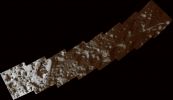
Japetus-PIA08378.jpgSo close, and yet so far...58 visiteThis mosaic of Cassini images shows the smallest details ever observed on Saturn's moon Japetus.
Visible here are small craters as well as the base of a large mountain ridge located just South of the mosaic. At several places, bright spots about 20 to 50 meters (66 to 164 feet) across are visible. At these locations, more recent impactors have punched through the overlying blanket of dark material to reveal brighter, cleaner ice beneath.
Since the bright craters are relatively small and very shallow, it is likely that the dark blanket is rather thin in this area; it is assumed that its actual average thickness might be on the order of a foot.
The small crater at the upper left edge of the mosaic has a diameter of about 50 meters (164 feet) and shows a distinct ray pattern from excavated ice. This feature is so bright in comparison to the dark surrounding terrain that it had to be darkened manually so as not to look overexposed in this mosaic.
The mosaic consists of 8 image footprints across the surface of Japetus, presented here in simple cylindrical projection. The view is centered on terrain near 0° North Latitude, 164,9° West Longitude, within the dark Leading Hemisphere of Japetus. Image scale is approx. 10 meters (33 feet) per pixel.
The clear spectral filter images in this mosaic were obtained with the Cassini spacecraft narrow-angle camera on Sept. 10, 2007, at distances ranging from 1.627 to 2.040 Km (such as from about 1.011 to 1.268 miles) from Japetus.MareKromium
(3 voti)
|
|
Japetus-PIA08380.jpgThe "Transition Region of Japetus" (possible natural colors - elab. Lunexit)56 visiteSoaring above the alien, icy wastelands of Saturn's moon Japetus, NASA's Cassini spacecraft captured a series of HR images of the Transition Region from dark to bright terrain at Southern Middle Latitudes that have been mosaicked together in this view.
An important characteristic of the terrain in the boundary region is that the isolated bright patches are mainly found on slopes facing toward the bright Trailing Hemisphere or toward the South Pole. The same polarity is found within the bright terrain, where the dark material can be seen at the bottom of craters and on Equator-facing slopes. These indicate that thermal effects are at play in painting the surface of Japetus.
The mosaic consists of 8 image footprints across the surface of Japetus. The view is centered on terrain near 38,6° South Latitude, 171,3° West Longitude. Image scale is approx. 52 meters (171 feet) per pixel.
The clear spectral filter images in this mosaic were obtained with the Cassini spacecraft narrow- angle camera on Sept. 10, 2007, at a distance of approx. 5,000 Km (about 3.100 miles) from Japetus.
MareKromium
(3 voti)
|
|

Japetus-PIA08382.jpgJapetus' Spots (HR - possible natural colors; elab. Lunexit)58 visiteAt high resolution, terrain in the Transition Region between bright and dark Hemispheres on Saturn's moon Japetus reveals a spotty appearance reminiscent of a Dalmatian. The bright material on the frozen surface of Iapetus is water ice, and the dark material is likely carbonaceous in composition.
The dark material is preferentially found at the bottoms of craters. Bright water ice forms the "bed rock" on Japetus, while the dark, presumably loose material apparently lies on top of the ice (the terrain seen here is also visible in PIA08383, but it is viewed here at higher resolution).
The mosaic consists of 2 image footprints across the surface of Japetus. The view is centered on terrain near 42° South Latitude and 209,3° West Longitude, on the anti-Saturn facing Hemisphere. Image scale is approx. 32 meters (105 feet) per pixel.
The clear spectral filter images in this mosaic were obtained with the Cassini spacecraft narrow-angle camera on Sept. 10, 2007, at distances ranging from 5.363 to 5.884 Km from Japetus.MareKromium
(3 voti)
|
|

Japetus-PIA08381.jpgThe "Transition Region of Japetus" (possible natural colors - elab. Lunexit)59 visiteThe Transition Region from Saturn's moon Japetus' dark Leading Hemisphere to its bright Trailing Hemisphere is a complicated patchwork of craters and highlands, with low elevations filled in by dark material.
An explanation of the pattern visible here might be key to a full understanding of the bright/dark dichotomy on Japetus (about 1468 Km across).
The view is centered on the Equator and covers an area 711 Km wide by 417 Km tall (such as about 442 x 259 miles).
The giant Equatorial Ridge visible on the dark Leading Hemisphere is not present anymore in this Region. Instead, large, isolated mountains more than 10 Km tall are spread along the Equator. These mountains show bright western flanks, while the surrounding lowlands are generally dark.
This mosaic is an orthographic projection consisting of 21 image footprints across the surface of Japetus. The view is centered on terrain near 0,1° North Latitude and 199° West Longitude, in the quadrant of Japetus that faces away from Saturn. Image scale is approx. 83 meters (272 feet) per pixel. An orthographic view is most like the view seen by a distant observer looking through a telescope.
The clear spectral filter images in this mosaic were obtained with the Cassini spacecraft narrow- angle camera on Sept. 10, 2007, at distances ranging from 13.857 to 21.846 Km (such as about 8.610 to 13.574 miles) from Japetus.
MareKromium
(3 voti)
|
|
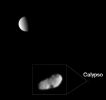
Tethys_and_Calypso-PIA09735.jpgTethys and Calypso56 visiteCaption NASA:"Two companion moons share the sky before the Cassini Spacecraft. Tethys is seen here with one of its two Trojan moons. Calypso, which trails the larger moon in its orbit by 60°, is a couple of pixels across near lower right. Telesto (not pictured) is the other Tethys co-orbital moon, leading Tethys by 60°.
The image was taken in visible light with the Cassini spacecraft narrow-angle camera on Aug. 25, 2007. The view was obtained at a distance of approx. 2,2 MKM (about 1,4 MMs) from Tethys.
Image scale is roughly 13 Km (about 8 miles) per pixel on Tethys".MareKromium
(3 voti)
|
|

Japetus-N00092235.jpgRough Terrain and Canyons of Japetus (possible natural colors - elab. Lunexit)60 visiteCaption NASA:"N00092235.jpg was taken on September 10, 2007 and received on Earth September 12, 2007. The camera was pointing toward Japetus that, at the time, was approximately 22.704 Km away, and the image was taken using the CL1 and CL2 filters. This image has not been validated or calibrated".MareKromium
(3 voti)
|
|

Japetus-N00092066.jpgJapetus' Northern Limb (1) - possible natural colors; elab. Lunexit55 visiteCaption NASA:"N00092066.jpg was taken on September 10, 2007 and received on Earth September 12, 2007. The camera was pointing toward Japetus that, at the time, was approximately 72.717 Km away, and the image was taken using the CL1 and CL2 filters. This image has not been validated or calibrated".MareKromium
(3 voti)
|
|
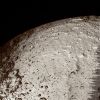
Japetus-N00092070.jpgJapetus' Northern Limb (2) - possible natural colors; elab. Lunexit57 visiteCaption NASA:"N00092070.jpg was taken on September 10, 2007 and received on Earth September 12, 2007. The camera was pointing toward Japetus that, at the time, was approximately 72.998 Km away, and the image was taken using the CL1 and CL2 filters. This image has not been validated or calibrated".MareKromium
(3 voti)
|
|
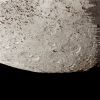
Japetus-N00092090.jpgJapetus' Southern Limb (1) - possible natural colors; elab. Lunexit56 visiteCaption NASA:"N00092090.jpg was taken on September 10, 2007 and received on Earth September 12, 2007. The camera was pointing toward Japetus that, at the time, was approximately 74.967 Km away, and the image was taken using the CL1 and CL2 filters. This image has not been validated or calibrated".MareKromium
(3 voti)
|
|

Japetus-N00092000.jpgThe "Cassini Regio" of Japetus (1) - possible natural colors; elab. Lunexit74 visiteCaption NASA:"Iapetus, Saturn's third largest moon, is a candidate for the strangest moon of Saturn. Tidally locked in its orbit around the Ringed Gas Giant, Iapetus is sometimes called the "Yin-Yang Moon" because its Leading Hemisphere is very dark, reflecting about 5% of the Sun's light, while its Trailing Hemisphere is almost as bright as snow. This recent Cassini spacecraft flyby image is one of the closest views ever and spans about 35 Km across a cratered transition zone between bright and dark terrain. Iapetus itself has a density close to that of water ice, but the detailed reflective properties of the dark material suggest an organic composition.
Honoring the moon's discoverer, the dark terrain is called Cassini Regio".MareKromium
(3 voti)
|
|

Japetus-N00091570.jpgJust a "Slice" of Japetus...58 visiteCaption NASA:"N00091570.jpg was taken on September 05, 2007 and received on Earth September 05, 2007. The camera was pointing toward Japetus that, at the time, was approx. 1.025.448 Km away, and the image was taken using the CL1 and IR1 filters.
This image has not been validated or calibrated".MareKromium
(3 voti)
|
|
| 2244 immagini su 187 pagina(e) |
 |
|
|
|
|
132 | |
|
|
|
|





