| Piú votate - Saturn: the "Ringed Beauty" and His Moons |

Enceladus-PIA11112.jpgThe (possible) True Colors of Enceladus (credits: Lunexit)58 visiteQuesta colorizzazione in possibili Colori Veri è la risposta ad un quesito postoci dal nostro Amico "Alby56", il quale ci domanda - appunto - quali sìano (possano essere) i colori di Encelado.
Come ovvio, una risposta che abbia valore assoluto non possiamo darla, però possiamo provare a ragionarci sopra e vedere che cosa si riesce a stabilire...Dunque:
1) Encelado, a quanto pare, è completamente ricoperto da uno (spesso) strato di ghiaccio d'acqua ed esso - per motivi ancora non noti, ma che potremmo rinvenire, ad esempio, in un "riscaldamento periodico" dell'intero globo causato da "frizionamento mareale" con Saturno, si rinnova, nel tempo, rimuovendo i segni classici che dimostrano l'invecchiamento di un Corpo Celeste (su tutti: i crateri da impatto, i quali vengono - letteralmente - "cancellati", se sono piccoli, oppure "riempiti e parzialmente nascosti", se di medio-grandi dimensioni);
2) il ghiaccio d'acqua, allorchè illuminato dal Sole, risplende di color bianco, con riflessi azzurri;
3) il Sole, visto da Encelado, dovrebbe apparire non molto più grande di una qualsiasi delle altre stelle visibili dalla sua superficie e questo ci spinge a ritenere che la sua capacità di illuminare questo piccolo mondo sia trascurabile;
4) su Encelado, non esistendo un'atmosfera e dunque non sussistendo le condizioni per la diffusione della luce solare (anche se ci è possibile ipotizzare una diffusione minima e meramente stagionale - grazie alle particelle di ghiaccio e di vapore acqueo che restano, per un certo tempo, in sospensione nello spazio circum-Enceladiano), riteniamo che il panorama visibile ad occhi umani risulti, globalmente, piuttosto buio.
Ma attenzione: potrebbe essere ragionevole ipotizzare una dominante bianca (provocata dal Sole e dal ghiaccio) durante il "Giorno" di Encelado - ed a cielo sgombro - oppure, allorchè Saturno splende nel cielo di Encelado in tutta la sua pienezza, si potrebbe ipotizzare, sempre per una visione "umana", un paesaggio illuminato da una colorazione dominante giallo-arancio, la quale - al suolo - potrebbe tradursi in un colorito giallo pallido dei rilievi maggiori, con riflessi bianchi, azzurri e, forse - in alcune zone - anche verdastri.
Conclusioni: da una certa distanza (supponiamo tra i 500 ed i 25000 Km), Encelado - ad occhi umani - dovrebbe apparire, allorchè illuminato congiuntamente dal Sole e da Saturno (come in questo frame), di color giallo pallido, con riflessi bianchi ed azzurri (e quindi, in alcune regioni ed in determinate ore del giorno, non è assurdo ipotizzare la visione/percezione di delicate sfumature di color grigio e rosa).
Oltre i 25000/30000 Km di distanza, infine, Encelado dovrebbe apparire, ad un Osservatore che lo scrutasse "ad occhio nudo", di color bianco brillante, con debolissime (diremmo quasi impercettibili) sfumature di colore giallo e rosa.MareKromium
(3 voti)
|
|

The_Rings-PIA10446.jpgIn the Sunlight... (natural colors; credits: NASA)58 visiteCaption NASA:"Saturn's icy Rings shine in scattered sunlight in this view, which looks toward the unilluminated northern side of the Rings from about 15° above the Ring-Plane. The Sun currently illuminates the Rings from the South. Some of the sunlight not reflected from the Rings' southern face is scattered through the countless particles, setting the Rings aglow. The inner F-Ring shepherd moon Prometheus (86 Km, or about 53 miles across at its widest point) appears at lower left.
Images taken using red, green and blue spectral filters were combined to create this natural color view. Bright clumps of material in the narrow F-Ring moved in their orbits between each of the color exposures, creating a chromatic misalignment in several places that provides some sense of the continuous motion within the Ring System.
The images were obtained with the Spacecraft wide-angle camera on July 4, 2008 at a distance of approx. 1,2 MKM (about 770.000 miles) from Saturn. The Phase Angle was 28°.
Image scale is roughly 70 Km per pixel".MareKromium
(3 voti)
|
|

The_Rings-PIA10442.jpgModern Art? (natural colors; credits: Lunexit)59 visiteCaption NASA:"This bizarre scene shows the cloud-streaked limb of Saturn in front of the Planet's B-Ring. The Ring's image is warped near the limb by the diffuse gas in Saturn's Upper Atmosphere.
For additional examples of this effect, see PIA09810, PIA07521 and PIA06656.
This view looks toward the sunlit side of the Rings, from about 31° below the Ring-Plane. North on Saturn is up.
The image was taken with the Cassini spacecraft narrow-angle camera on June 24, 2008 using a spectral filter sensitive to wavelengths of infrared light centered at 750 nanometers. The view was acquired at a distance of approx. 657.000 Km (about 408,000 miles) from Saturn.
Image scale is roughly 4 Km (about 2,5 miles) per pixel".MareKromium
(3 voti)
|
|

The_Rings-PIA10426.jpgThe C-Ring and the Upper Atmosphere of Saturn (MULTISPECTRUM-2; credits: Lunexit)60 visiteCaption NASA:"Saturn's C-Ring emerges from behind the Planet's hazy limb. This view looks toward the sunlit side of the Rings from about 15° below the Ring-Plane.
The image was taken in visible light with the Cassini Spacecraft narrow-angle camera on June 17, 2008. The view was obtained at a distance of approx. 937.000 Km (such as about 582.000 miles) from Saturn.
Image scale is roughly 5 Km (a little more than 3 miles) per pixel".MareKromium
(3 voti)
|
|

The_Rings-PIA10423.jpgSpooky Spokes! (MULTISPECTRUM; credits: Lunexit)58 visiteCaption NASA:"As they wheel about the Planet, Saturn's sunlit Rings often exhibit dark, radial markings called "spokes". Spokes are seen only in the broad B-Ring, and can also appear bright in certain viewing geometries.
This view looks toward the sunlit side of the Rings from about 11° below the Ring-Plane.
Pandora (about 81 kilometers, or approx. 50 miles across) is a speck above the Rings at left. The Planet's shadow darkens the Ring-Plane at lower right.
The image was taken in visible light with the Cassini Spacecraft wide-angle camera on June 3, 2008. The view was acquired at a distance of approx. 1 MKM (about 636.000 miles) from Saturn and at a Sun-Saturn-Spacecraft, or Phase, Angle of 19°.
Image scale is roughly 61 Km (approx. 38 miles) per pixel".MareKromium
(3 voti)
|
|
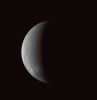
Enceladus-PIA10422.jpgCrescent Enceladus (MULTISPECTRUM-2; credits: Lunexit)82 visiteCaption NASA:"The Cassini Spacecraft observes the wrinkled surface of Enceladus.
The geologically active South Polar Region is visible at bottom.
This view looks toward the Saturn-facing side of Enceladus (about 504 Km, or 313 miles across). Lit terrain is on the moon's Leading Hemisphere. North is up and rotated 16° to the right.
The image was taken in visible green light with the Cassini Spacecraft narrow-angle camera on June 2, 2008. The view was obtained at a distance of approx. 285.000 Km (such as about 177.000 miles) from Enceladus and at a Sun-Enceladus-Spacecraft, or Phase, Angle of 108°.
Image scale is roughly 2 Km (a little more than 1 mile) per pixel".MareKromium
(3 voti)
|
|

Mimas-PIA09806.jpgMimas through the Rings (MULTISPECTRUM-2; credits: Lunexit)89 visitenessun commentoMareKromium
(3 voti)
|
|
Tethys-W00047018.jpgTethys and the Stars beyond...58 visitenessun commentoMareKromium
(3 voti)
|
|

Sky-W00041674.jpgSaturnian Sky58 visitenessun commentoMareKromium
(3 voti)
|
|

Sky-W00047012.jpg"?"91 visiteUn ovvio tentativo di messa a fuoco, riuscito proprio male, su un oggetto particolarmente luminoso (riteniamo che si tratti di una delle maggiori lune di Saturno). Comunque un'immagine intrigante ed interessante.MareKromium
(3 voti)
|
|

Sky-W00047013.jpg"?"58 visitenessun commentoMareKromium
(3 voti)
|
|

Janus-N00114756.jpgRugged Janus and various image-artifacts (MULTISPECTRUM-2; credits: Lunexit)57 visiteCaption NASA:"N00114756.jpg was taken on June 30, 2008 and received on Earth July 01, 2008.
The camera was pointing toward JANUS that, at the time, was approx. 32.994 Km away and the image was taken using the CL1 and CL2 filters.
This image has not been validated or calibrated".MareKromium
(3 voti)
|
|
| 2244 immagini su 187 pagina(e) |
 |
|
|
|
|
129 | |
|
|
|
|





