| Piú votate - Saturn: the "Ringed Beauty" and His Moons |

Enceladus-PIA11120.jpgEnceladus Oct. 9, 2008 Flyby58 visiteCaption NASA:"This image was taken with the Cassini Spacecraft narrow-angle camera on Oct. 9, 2008, from a distance of approx. 26.000 Km (16,000 miles) from Enceladus. Image scale is 312 meters (1024 feet) per pixel".MareKromium
(3 voti)
|
|

Enceladus-PIA11121.jpgEnceladus Oct. 9, 2008 Flyby60 visiteCaption NASA:"The image was taken with the Cassini Spacecraft narrow-angle camera on Oct. 9, 2008, a distance of approx. 42.000 Km (about 26.000 miles) from Enceladus.
Image scale is 503 meters (1650 feet) per pixel".MareKromium
(3 voti)
|
|
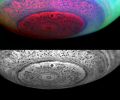
Saturn-SouthPole_cassini_big.jpgBeneath the South Pole of Saturn59 visiteCaption NASA:"What clouds lurk beneath Saturn's unusual South Pole?
To help find out, the robotic Cassini Spacecraft currently orbiting Saturn imaged the nether region of the gigantic ringed orb in infrared light.
There thick clouds appear dark as they mask much of the Infrared Light emitted from warmer regions below, while relatively thin clouds appear much lighter. Bands of clouds circle Saturn at several latitudes, while dark ovals indicate many dark swirling storm systems. Surprisingly, a haze of upper level clouds visible towards Saturn's Equator disappears near the Pole, including over Saturn's strange Polar Vortex.
Cassini entered orbit around Saturn in 2004, and recorded the above image last year (2007)". MareKromium
(3 voti)
|
|
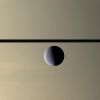
Rhea-IMG003277.jpgSliding Away... (natural colors; credits: NASA)58 visiteCaption NASA:"The Cassini Spacecraft looks toward Rhea's cratered, icy landscape with the dark line of Saturn's Ring-Plane and the Planet's murky atmosphere as a background.
Rhea is Saturn's second-largest moon, at about 1528 Km (approx. 949 miles) across.
This view looks toward the unilluminated side of the Rings from less than 1° above the Ring-Plane.
Images taken using red, green and blue spectral filters were combined to create this natural color view. The images were acquired with the Cassini spacecraft narrow-angle camera on July 17, 2007 at a distance of approx. 1,2 MKM (such as about 770.000 miles) from Rhea.
Image scale is roughly 7 Km (about 4,5 miles) per pixel"MareKromium
(3 voti)
|
|

Saturn-PIA10493.jpgSaturn (natural colors; credits: NASA)60 visiteCaption NASA:"The Cassini Spacecraft looks toward the sunlit face of Saturn's Rings, whose shadows continue to slide southward on the Planet toward their temporary disappearance during equinox in August 2009.
This two-frame color mosaic was created from images taken as part of a photometry observation of the Rings. Photometry observations are useful for determining a host of ring particle properties.
This view looks toward the sunlit side of the Rings from about 3° below the Ring-Plane. Images taken using red, green and blue spectral filters were combined to create this natural color view. The images were acquired with the Cassini Spacecraft wide-angle camera on Aug. 22, 2008 at a distance of approx. 1,2 MKM (such as about 728.000 miles) from Saturn.
Image scale is roughly 66 Km (about 41 miles) per pixel".MareKromium
(3 voti)
|
|

Saturn-PIA10487.jpgMany Colors for Many Moons... (natural colors; credits: NASA)58 visiteCaption NASA:"Four moons huddle near Saturn's multi-hued disk.
The coloration of the planet's northern hemisphere has changed noticeably since the Cassini Spacecraft's arrival in orbit in mid-2004. Imaging scientists are working to understand the causes of this change, which is suspected to be a seasonal effect.
Giant Titan (5150 Km, or approx. 3200 miles across), with its darker Winter Hemisphere, dominates the smaller moons in the scene. Beneath and left of Titan is Janus (181 Km, or about 113 miles across). Mimas (397 Km, or approx. 247 miles across) appears as a bright dot close to the Planet and beneath the Rings. Prometheus (102 Km, or about 63 miles across) is a faint speck hugging the Rings between the two small moons.
This view looks toward the unilluminated side of the Rings from less than 1° above the Ring-Plane.
Images taken using red, green and blue spectral filters were combined to create this natural color view. The view was acquired with the Cassini spacecraft wide-angle camera on Oct. 26, 2007, at a distance of approx. 1,5 MKM (such as about 920.000 miles) from Saturn and 2,7 MKM (about 1,7 MMs) from Titan.
Image scale is roughly 89 Km (approx. 55 miles) per pixel on Saturn and 164 Km (about 102 miles) per pixel on Titan".MareKromium
(3 voti)
|
|

Sky-W00049978.jpgBizarre Reflection in the Space of Saturn...61 visiteCaption NASA:"W00049978.jpg was taken on October 09, 2008 and received on Earth October 09, 2008. The camera was pointing toward ENCELADUS that, at the time, was approx. 536.451 Km away. The image was taken using the CL1 and CL2 filters".MareKromium
(3 voti)
|
|

SaturnSpace-N00115343-N00115349.gifThrough the "Eyes" of Cassini... (GIF-Movie; credits: Dr G. Barca)58 visiteSuggestivo, affascinante e, alla fine - semplicemente -, bello!MareKromium
(3 voti)
|
|

PanandPrometheus-PIA10468.jpgGravitational Disturbances56 visiteCaption NASA:"This mosaic of two Cassini images shows Pan and Prometheus creating features in nearby Rings.
Pan (approx. 28 Km, or about 17 miles across), in the Encke Gap at left, is trailed by a series of edge waves in the outer boundary of the gap. Prometheus (approx. 86 Km, or about 53 miles across at its widest point) just touches the inner edge of Saturn's F-Ring at right, and is followed by a series of dark channels in the Ring, which were caused by the passage of Prometheus through the F-Ring on previous orbits.
This view looks toward the unilluminated side of the rings from about 3° above the Ring-Plane. The images were taken in visible light with the Cassini Spacecraft narrow-angle camera on Aug. 15, 2008. The view was obtained at a distance of approx. 1,2 MKM (746.000 miles) from Pan and Prometheus.
Image scale is roughly 7 Km (about 5 miles) per pixel on both moons".MareKromium
(3 voti)
|
|

The_Rings-PIA10470.jpgGravitational Interactions or just Evidence of a recent Collision?59 visiteCaption NASA:"The three bright, finger-like jets of material seen here suggest that a small object has collided with the core of Saturn's F-Ring. Cassini Spacecraft imaging scientists have shown that the F-Ring shepherd moon Prometheus influences the structure of the Ring in 2 ways: 1) by creating streamer-channel features as it closely approaches (and partially passes into) the Ring (see PIA08397) and 2) by perturbing the orbits of small objects within the F-Ring Region which then exert their own influence on nearby Ring particles, as seen here.
These small, embedded objects could be temporary clumps of particles, but scientists think at least one of the objects could be a more permanent moonlet.
This view looks toward the sunlit side of the Rings from about 40° below the Ring-Plane. The image was taken in visible light with the Cassini Spacecraft narrow-angle camera on Aug. 20, 2008. The view was obtained at a distance of approx. 685.000 Km (such as about 426.000 miles) from Saturn and at a Phase Angle of 40°.
The image scale is about 5 Km per pixel".MareKromium
(3 voti)
|
|

Streak-N00119705-N00119709-GIF.gifStreak or Star-trail? (GIF-Movie; credits: Dr G. Barca)58 visiteOsservando questo splendido GIF-Movie del Dr Barca, le risposte mancano e le domande - almeno, a nostro parere... - aumentano!
Cassini, rispetto ad Encelado, è quasi ferma (ed anche le stelle sullo sfondo lo dimostrano). E tuttavia, qualcosa "si fugge" davanti agli occhi elettronici della Sonda...
Probabilmente si tratta solo di una delle tante "Lune Minori" di Saturno oppure - chissà - si potrebbe trattare di un "Corpo Errante". Ma la Verità...La Verità era (e resta) elusiva.
Voi che ne pensate?MareKromium
(3 voti)
|
|

Anthe-PIA11100.jpgThe "Anthe Arc"69 visiteCaption NASA:"Caption NASA:"Cassini images reveal the existence of a faint "Arc of material" orbiting with Saturn's small moon Anthe.
The moon is moving downward and to the right in this perspective. In this image, most of the visible material in the Arc lies ahead of Anthe (2 Km, or a little more than 1 mile across) in its orbit. However, over time the moon drifts slowly back and forth with respect to the Arc.
The Arc extends over about 20° in Longitude (about 5,5% of Anthe's orbit) and appears to be associated with a gravitational resonance caused by the moon Mimas). Micrometeoroid impacts on Anthe are the likely source of the Arc material.
The orbit of Anthe lies between the larger moons Mimas and Enceladus. Anthe shares this region with two other small moons, Pallene (4 Km, or about 3 miles across) and Methone (3 Km, or approx. 2 miles across).
Methone also possesses an Arc (see PIA11102), while Pallene is known to orbit within a faint, complete ring of its own (see PIA08328).
Cassini imaging scientists believe the process that maintains the Anthe and Methone Arcs is similar to that which maintains the Arc in the G-Ring (see PIA08327). The general brightness of the image (along with the faint horizontal banding pattern) results from the long exposure time of 32" required to capture the extremely faint ring arc and the processing needed to enhance its visibility (which also enhances the digital background noise in the image). The image was digitally processed to remove most of the background noise. The long exposure also produced star trails in the background.
The image was taken in visible light with the Cassini Spacecraft narrow-angle camera on April 4, 2008. The view was acquired at a distance of approx. 1,2 MKM (such as about 746.000 miles) from Anthe and at a Sun-Anthe-Spacecraft Angle of 23°. Image scale is roughly 7 Km (about 4 miles) per pixel".MareKromium
(3 voti)
|
|
| 2244 immagini su 187 pagina(e) |
 |
|
|
|
|
128 | |
|
|
|
|





