| Piú votate - Saturn: the "Ringed Beauty" and His Moons |

EncelalusPIA11137.jpgRelict Tiger Stripe58 visitenessun commentoMareKromium
(3 voti)
|
|

Pandora-N00125271.jpgIn the Space of Saturn...59 visiteLa rubricazione NASA di questo frame riportava solo la dicitura "Sky". A noi, invece, sembra di vedere la piccola luna Pandora, in alto a Dx (la riconosciamo sia a causa della sua forma "a fuso", sia in ragione del cratere che si trova proprio sulla sua punta - ivi: Polo Nord, rispetto all'Osservatore).
Certo, potremmo anche sbagliarci, però...MareKromium
(3 voti)
|
|

Helene-N00124458.jpgHelene and a "Bright Companion" (possible True Colors; credits: Lunar Explorer Italia)58 visiteCaption NASA:"N00124458.jpg was taken on November 24, 2008 and received on Earth November 25, 2008. The camera was pointing toward HELENE that, at the time, was approx. 68.171 Km away.
The image was taken using the CL1 and CL2 filters".
Nota Lunexit: Helene è senza dubbio affascinante, con il suo colore rosso-arancio (tipico di tanti Corpi Celesti Minori e, in questo caso, anche esaltato dalla luce rosa-salmone che deriva dal Gigante Saturno), ma noi Vi invitiamo a considerare il puntino luminoso che viene inquadrato dalla freccia. Ebbene, a nostro avviso NON si tratta di un image-artifact e non dovrebbe essere una stella che splende sullo sfondo (la quale sarebbe dovuta sparire, letteralmente ingoiata - tecn. "washed away" - dalla stessa luminostà di Helene).
Che cosa sarà mai? La nostra ipotesi è: forse (e ribadiamo FORSE!) si potrebbe trattare di un altro - minuscolo - Corpo Roccioso, non troppo distante da Helene.
Forse una "luna" di Helene stessa (un fenomeno decisamente raro, ma non impossibile: ricordate l'asteroide Ida ed il suo piccolissimo compagno Dactyl? Beh, questo potrebbe essere un fenomeno analogo...).MareKromium
(3 voti)
|
|
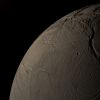
Enceladus-PIA10515.jpgEnceladus (natural colors; credits: Lunexit)57 visiteCaption NASA:"The Cassini Spacecraft acquired this view of Enceladus just after the Spacecraft passed within 25 Km (approx. 15 miles) of the surface on Oct. 9, 2008. Remarkably, only a handful of craters are visible in this view, indicating the relatively young age of this surface.
The image was taken in Visible Light with the Cassini Spacecraft narrow-angle camera on Oct. 9, 2008 at a distance of approx. 38.000 Km (about 24.000 miles) from Enceladus and at a Sun-Enceladus-Spacecraft, or Phase, Angle of 73°.
Image scale is 228 meters (746 feet) per pixel".MareKromium
(3 voti)
|
|
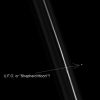
The_Rings-N00124203.jpgAnother UFO in the Space of Saturn?88 visiteCaption NASA:"N00124204.jpg was taken on November 16, 2008 and received on Earth November 17, 2008. The camera was pointing toward SATURN-RINGS that, at the time, were approx. 384.329 Km away, and the image was taken using the CL1 and CL2 filters. This image has not been validated or calibrated". MareKromium
(3 voti)
|
|
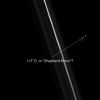
The_Rings-N00124204.jpgAnother UFO in the Space of Saturn?69 visiteCaption NASA:"N00124204.jpg was taken on November 16, 2008 and received on Earth November 17, 2008. The camera was pointing toward SATURN-RINGS that, at the time, were approx. 383.855 Km away, and the image was taken using the CL1 and CL2 filters. This image has not been validated or calibrated". MareKromium
(3 voti)
|
|

The_Rings-ERing-W00051101.jpgThe tenuous E-Ring of Saturn (RAW frame)59 visiteCaption NASA:"W00051101.jpg was taken on November 12, 2008 and received on Earth November 13, 2008. The camera was pointing toward SATURN's E-RING that, at the time, was approx. 1.234.847 Km away.
The image was taken using the CL1 and BL1 filters".
Nota Lunexit: in questo frame potete osservare una serie impressionante di image-artifacts (noise, per lo più, come spesso si vede nei frames CASSINI).MareKromium
(3 voti)
|
|

Mimas-N00121934-3D-MF.jpgMimas and the Rings (Hi-Def-3D; credits and Copyright: Dr M. Faccin and Lunar Explorer Italia)59 visitenessun commentoMareKromium
(3 voti)
|
|
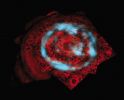
Saturn-PIA11396.jpgSouth Polar Aurora on Saturn59 visiteCaption NASA:"This image of the North Polar Regions of Saturn shows both the Aurora and underlying Atmosphere, seen at 2 different wavelengths of IR light as captured by NASA's Cassini spacecraft.
Energetic particles, crashing into the Upper Atmosphere cause the Aurora, shown in blue, to glow brightly at 4 microns (six times the wavelength visible to the human eye). The image shows both a bright ring, as seen from Earth, as well as an example of bright Auroral Emission within the Polar Cap that had been undetected until the advent of Cassini.
This Aurora, which defies past predictions of what was expected, has been observed to grow even brighter than is shown here. Silhouetted by the glow (cast here to the color red) of the hot interior of Saturn (clearly seen at a wavelength of 5 microns, or seven times the wavelength visible to the human eye) are the clouds and haze that underlie this Auroral Region. For a similar view of the Region beneath the Aurora see PIA09185.
This image is a composite captured with Cassini's Visual and Infrared Mapping Spectrometer. The aurora image was taken in the near-infrared on Nov. 10, 2006, from a distance of about 1 MKM (such as about 659.000 miles), with a phase angle of 157° and a sub-Spacecraft Planetocentric Latitude of 52° North.
The image of the clouds was obtained by Cassini on June 15, 2008, from a distance of approx. 602.000 Km (such as about 374.000 miles) and a sub-Spacecraft Planetocentric Latitude of 73° North".MareKromium
(3 voti)
|
|

StreamerChannel-PIA10509.jpgStreamer Channel59 visiteOk: quando Lunexit "chiama", la NASA...risponde! Pubblicata oggi (11 Novembre 2008) sul Planetary Photojournal, ecco la risposta NASA alla nostra illazione: la "vibrazione" dell'Anello "F" di Saturno è, effettivamente, uno Streamer Channel, provocato dalla Luna Pastore Prometheus.
L'effetto vibrazionale appare, nel filmato GIF del Dr Barca, più eclatante (e quindi fisicamente impossibile) solo perchè la ripresa - in quel primo contesto - era stata effettuata da una distanza inferiore ai 970.000 Km di questo frame.
Dunque nessuna "Onda Gravitazionale", ma solo uno Streamer Channel (ossìa un "canale" che viene scavato - letteralmente - da Prometheus quando attraversa l'Anello "F" di Saturno, e cioè una volta per orbita) particolarmente grande e ripreso da (relativamente) vicino.
Questa parte del Mistero, quindi, è risolta. Peccato che la NASA non ci abbia detto nulla, invece, dell'Oggetto Anomalo, ma chissà, magari in futuro...
Caption NASA:"The Cassini spacecraft focuses on a streamer-channel feature in Saturn's F-Ring.
These features are created by the moon Prometheus as it closely approaches the Ring once per orbit (see also PIA08397).
This view looks toward the unilluminated side of the Rings from about 36° above the Ring-Plane.The image was taken in Visible Light with the Cassini Spacecraft narrow-angle camera on Sept. 30, 2008.
The view was acquired at a distance of approx. 970.000 Km (such as about 602.000 miles) from Saturn and at a Sun-Ring-Spacecraft, or Phase, Angle of 45°.
Image scale is roughly 5 Km (about 3 miles) per pixel".
MareKromium
(3 voti)
|
|

Janus-PIA10507.jpgJanus: the RingMaster (natural colors; credits: Lunexit)58 visiteCaption NASA:"Saturn's battered moon Janus wears the record of its long history of impacts.
Janus (approx. 179 Km, or about 111 miles across) orbits just beyond the outer reaches of Saturn's "A" and "F" Rings, which are seen here.
This view looks toward the unilluminated side of the rings from about 4° above the Ring-Plane. The image was taken in Visible Light with the Cassini Spacecraft narrow-angle camera on Sept. 28, 2008.
The view was obtained at a distance of approx. 1,1 MKM (such as about 703.000 miles) from Janus and at a Sun-Janus-Spacecraft, or Phase, Angle of 28°.
Image scale is roughly 7 Km (about 4,5 miles) per pixel".MareKromium
(3 voti)
|
|

Tethys-PIA10506.jpgIthaca Chasma (natural colors - MULTISPECTRUM; credits: Lunexit)58 visiteCaption NASA:"The prominent crater Telemachus sits within the northern reaches of Ithaca Chasma on Saturn's moon Tethys.
Ithaca Chasma is an enormous rift that stretches more than 1000 Km (approx. 620 miles) from North to South across Tethys.
This view looks toward the Saturn-facing Side of Tethys from a position 55° North of the moon's Equator. The image was taken in visible light with the Cassini Spacecraft narrow-angle camera on Sept. 24, 2008.
The view was acquired at a distance of approx. 151.000 Km (such as about 94.000 miles) from Tethys and at a Sun-Tethy-Spacecraft, or Phase, Angle of 61°.
Image scale is 903 meters (2962 feet) per pixel".MareKromium
(3 voti)
|
|
| 2244 immagini su 187 pagina(e) |
 |
|
|
|
|
127 | |
|
|
|
|





