| Piú votate - Saturn: the "Ringed Beauty" and His Moons |
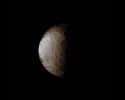
Japetus-V2-LXT.jpgJapetus (Natural Colors; credits: Lunar Explorer Italia)59 visitenessun commentoMareKromium
(3 voti)
|
|

Tethys.jpgTethys, from Voyager 1 (Natural Colors; credits: Ted Stryk)57 visitenessun commentoMareKromium
(3 voti)
|
|

Moonlet-PIA11148-1.jpgTiny Moonlet within a G-Ring Arc57 visiteCaption NASA:"This sequence of three images, obtained by NASA's Cassini Spacecraft over the course of about 10 minutes, shows the path of a newly found moonlet in a bright arc of Saturn's faint G-Ring.
In each image, a small streak of light within the Ring is visible. Unlike the streaks in the background, which are distant stars smeared by the camera's long exposure time of 46", this streak is aligned with the G-Ring and moves along the ring as expected for an object embedded in the Ring.
Cassini scientists interpret the moving streak to be reflected light from a tiny moon half a kilometer (a third of mile) wide that is likely a major source of material in the arc and the rest of the G-Ring.
Debris knocked off this moon forms a relatively bright arc of material near the inner edge of the G-Ring, the most visible part of the Ring in these images. That arc, in turn, leaks material to form the entire Ring.
These images were captured by Cassini's narrow-angle camera on Oct. 27, 2008.
The first image (left) was taken in Visible Light, the second image (middle) was taken in Red Light, and the third image (right) in Near-InfraRed Light centered at a wavelength of 750 nanometers.
Image scale for the first image is roughly 7 Km (a little more than 4 miles) per pixel while the second and third were taken at reduced resolution.
These spatially compressed images were captured at 14 Km (about 9 miles) per pixel and then displayed at a size equal to the first image. This view looks toward the un-illuminated side of the Rings from about 5° above the Ring-Plane.
The view was acquired at a distance of approx. 1,2 MKM (such as about 751.000 miles) from Saturn and at a sun-Saturn-Spacecraft, or Phase, Angle of 23°".MareKromium
(3 voti)
|
|
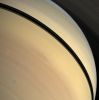
Saturn-PIA10588.jpgJust like an Iris... (Natural Colors; credits: NASA/JPL/Space Science Institute59 visiteCaption NASA:"Rendered in myriad hues, vivid details of Saturn's stormy Atmosphere play out below the shadow of the Rings. A well defined storm swirls through the atmosphere of the southern hemisphere in the lower left of the image, like the tight blue circle of an eye's iris.
This view looks toward the sunlit side of the Rings from about 36° below the Ring-Plane.
Images taken using red, green and blue spectral filters were combined to create this Natural Color view. The images were obtained with the Cassini Spacecraft wide-angle camera on Dec. 29, 2008 at a distance of approx. 1,1 MKM (such as about 680.000 miles) from Saturn and at a Sun-Saturn-Spacecraft, or Phase, Angle of 51°.
Image scale is roughly 60 Km (about 37 miles) per pixel".MareKromium
(3 voti)
|
|

Tethys-PIA10582.jpgGibbous Tethys58 visiteCaption NASA:"Like the lengthy story of its Greek king namesake, the humongous Odysseus Impact Basin stretches on and on across Tethys.
The approx. 450-Km (about 280-mile) wide Odysseus Crater is a well-preserved example of an ancient multi-ringed Impact Basin. The Outer Ring's steep, cliff-like walls descend to broad internal terraces. The Inner Ring consists of a circular band of icy mountains creating a crown shape with a diameter of about 140 Km (approx. 87-miles).
This view looks toward the leading hemisphere of Tethys (1062 kilometers, or 660 miles across). North on Tethys is up and rotated 2 degrees to the right.
The image was taken in visible light with the Cassini Spacecraft narrow-angle camera on Jan. 2, 2009. The view was obtained at a distance of approx. 816.000 Km (about 507.000 miles) from Tethys and at a Sun-Tethys-Spacecraft, or Phase, Angle of 58°.
Image scale is roughly 5 Km (about 3 miles) per pixel".MareKromium
(3 voti)
|
|
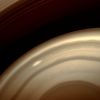
Saturn-PIA10580.jpgSouthern Atmosphere (Natural Colors; credits: Lunar Explorer Italia)59 visiteCaption NASA:"A Cassini Spacecraft image captures a bright, oblong storm swirling high through the Middle Latitudes of the Southern Hemisphere.
The image was taken through a spectral filter centered on wavelengths of light that are strongly absorbed by Methane gas. Hence, any light making it through this filter to the camera's detector has bounced off clouds that are high in the Atmosphere, making them visible, while light passing through the cloud-free surroundings gets absorbed by the Methane gas there before it reaches the lower clouds.
The image was taken with the Cassini Spacecraft wide-angle camera on Jan. 5, 2009 using a spectral filter sensitive to wavelengths of near-InfraRed Light centered at 890 nanometers. The view was acquired at a distance of approx. 711.000 Km (such as about 442.000 miles) from Saturn and at a Sun-Saturn-Spacecraft, or Phase, Angle of 106°.
Image scale is roughly 39 Km (about 24 miles) per pixel".MareKromium
(3 voti)
|
|

Dione-N00080526~0.jpgDione (Natural Colors; credits: Lunar Explorer Italia)59 visitenessun commentoMareKromium
(3 voti)
|
|

The_Rings-PIA10556.jpgFantastic View (possible True Colors; credits: Lunar Explorer Italia)57 visiteCaption NASA:"Three of Saturn's satellites are visible in this snapshot from the Cassini Spacecraft. Janus (approx. 179 Km, or about 111 miles across) is in the top left of the image. Pandora (approx. 81 Km, or about 50 miles across) is just outside the F-Ring and Pan (approx. 28 Km, or about 17 miles across) is the small moon that has cut a path inside the Rings below the center of the image.
This view looks toward the unilluminated side of the Rings from about 27° above the Ring-Plane. The image was taken in visible light with the Cassini Spacecraft wide-angle camera on Dec. 7, 2008 using clear filters: CL1 (635 nm) and CL2 (635 nm). It was obtained from a distance of approx. 1 MKM (such as about 641.000 miles) from Pan and at a Sun-Pan-Spacecraft, or Phase, Angle of 33°. Image scale is roughly 62 Km (about 38 miles) per pixel".MareKromium
(3 voti)
|
|

The_Rings-Shadow-N00127582.jpgEclipsing the Rings (3)58 visitenessun commentoMareKromium
(3 voti)
|
|

The_Rings-Shadow-N00127583.jpgEclipsing the Rings (4)60 visitenessun commentoMareKromium
(3 voti)
|
|
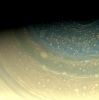
Saturn-PIA10553-1.jpgThe Blue Pole of Saturn (natural colors; credits: NASA/JPL/Space Science Institute and Lunar Explorer Italia)59 visiteCaption NASA:"Saturn's North Pole is littered with storms, as we see in this color view of it. A bit of the North Polar Hexagon is also visible at the upper-right. Cassini scientists are looking forward to sunrise on this Pole next year so that they can better study it in Visible Light.
Images taken using red, green and blue spectral filters were combined to create this full color view. The images were obtained with the Cassini Spacecraft wide-angle camera on Nov. 16, 2008 at a distance of approx. 673.000 Km (such as about 418.000 miles) from Saturn and at a Sun-Saturn-Spacecraft, or Phase, Angle of 71°.
Image scale is roughly 37 Km (about 23 miles) per pixel".MareKromium
(3 voti)
|
|

Rhea-PIA11143.jpgRhea (possible True Colors credits: Lunar Explorer Italia)59 visiteCaption NASA:"The Cassini Spacecraft's narrow-angle camera captured Saturn's moon Rhea as it gradually slipped into the Planet's (i.e.: Saturn) shadow — an event known as "ingress" — on Aug. 19, 2008.
This image was acquired by NASA's Cassini Spacecraft at a Solar Phase, or Sun-Rhea-Spacecraft, angle of about 28° and at a distance from Rhea of approx. 450.000 Km (about 280.000 miles). Image scale is roughly 2,7 Km (about 1,7 miles) per pixel".MareKromium
(3 voti)
|
|
| 2244 immagini su 187 pagina(e) |
 |
|
|
|
|
126 | |
|
|
|
|





