| Piú votate - Saturn: the "Ringed Beauty" and His Moons |

Prometheus-N00128992-b.gifPrometheus: the "Wave-Maker" (GIF-Movie; credits: Dr M. Faccin)72 visitenessun commentoMareKromium
(3 voti)
|
|

Rhea-PIA11458.jpgRhea (Natural Colors; credits: Lunar Explorer Italia)60 visiteCaption NASA:"The Terminator between light and dark throws Rhea's cratered surface into stark relief while the Southern Hemisphere is scored by bright icy cliffs.
North on Rhea is up and rotated 42° to the right in this 2-tile mosaic. This view looks toward the Leading Hemisphere of Rhea (approx. 1528 Km, or about 949 miles across).
The image was taken in visible light with the Cassini spacecraft narrow-angle camera on Feb. 2, 2009. The view was acquired at a distance of approx. 181.000 Km (such as about 112.000 miles) from Rhea and at a Sun-Rhea-Spacecraft, or Phase, Angle of 91°.
Image scale is roughly 1 Km (about 3300 feet) per pixel".MareKromium
(3 voti)
|
|
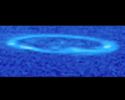
Saturn-PIA11832.jpgSaturnian Aurora61 visiteCaption NASA:"Glowing like a neon lasso, Saturn’s Aurora is seen spinning above Saturn’s North Pole over the course of most of a Saturn day in this image taken by the ultraviolet imaging spectrograph on NASA’s Cassini Spacecraft.
Saturn’s auroral lights are the result of a rain of electrically charged particles from the magnetic bubble, called the Magnetosphere, that surrounds the Planet.
When the particles strike gaseous Hydrogen in Saturn’s Atmosphere, the Hydrogen becomes excited and glows, creating Aurorae. Neon signs work in a similar way: electricity is used to excite a gas, usually Neon or Argon, in a tube.
Changes that occur in Saturn’s Magnetosphere can cause fluctuations in the Aurora. Undulations in the Aurora may be caused by waves moving along magnetic field lines.
A surge in auroral brightness is the result of a sudden injection of particles into the Magnetosphere. These charged particles come from a variety of sources, including the Sun, Saturn’s Rings, and the water ice plume of Saturn’s moon Enceladus.
This image was taken on May, 25th, 2007.
Saturn's Aurorae were discovered by NASA’s Pioneer 11 Spacecraft in 1979 and observed in the Saturn flybys by the NASA Voyager 1 and 2 Spacecrafts in the early '80s. NASA’s Hubble Space Telescope first obtained images of an Aurora in 1994. From Cassini’s always-changing orbit around Saturn, fresh observations in UltraViolet and InfraRed wavelengths are being combined with other data to help characterize similarities and differences among the Aurorae of Saturn, Jupiter and Earth". MareKromium
(3 voti)
|
|

PIA07966-112203-1.wavAudio Signals from the the Space of Saturn (by Dr M. Faccin)60 visitenessun commentoMareKromium
(3 voti)
|
|
PIA07967-072504.wavAudio Signals from the the Space of Saturn (by Dr M. Faccin)58 visitenessun commentoMareKromium
(3 voti)
|
|
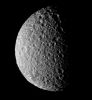
Mimas-V1.jpgMimas, from Voyager 156 visitenessun commentoMareKromium
(3 voti)
|
|
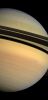
Saturn-PIA11453.jpgShadows (Natural Colors; credits: NASA/JPL/Space Science Institute)59 visiteCaption NASA:"Saturn's Rings cast a dramatic shadow separating the blues and greens of the Planet's Northern Hemisphere from the creamy pastels coloring the Southern Hemisphere.
This mosaic combines 6 images — 2 each of red, green and blue spectral filters — to create this Natural Color view. The images were obtained with the Cassini Spacecraft wide-angle camera on Dec. 30, 2008 at a distance of approx. 1,2 MKM (such as about 750.000 miles) from Saturn and at a Sun-Saturn-Spacecraft, or Phase, Angle of 30°.
Image scale is roughly 67 Km (about 42 miles) per pixel".MareKromium
(3 voti)
|
|

Saturn-W00051152.jpgSaturn: from b&w to Natural Colors (by Dr M. Faccin)58 visitenessun commentoMareKromium
(3 voti)
|
|
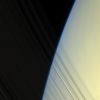
Saturn-PIA10598.jpgThe C-Ring (Natural Colors; credits: NASA/JPL/Space Science Institute)59 visiteCaption NASA:"The Cassini Spacecraft peers through Saturn's delicate, translucent inner C-Ring to see the diffuse blue limb of Saturn's Atmosphere.
This view looks toward the unilluminated side of the rings from about 20° above the Ring-Plane. Images taken using red, green and blue spectral filters were combined to create this Natural Color view. The images were obtained with the Cassini Spacecraft narrow-angle camera on April 25, 2008 at a distance of approx. 1,5 MKM (about 930.000 miles) from Saturn.
Image scale is roughly 8 Km (approx. 5 miles) per pixel".MareKromium
(3 voti)
|
|

Enceladus-N00048288.jpgEnceladus (RAW Natural Colors; credits: Dr M. Faccin)65 visitenessun commentoMareKromium
(3 voti)
|
|

Atlas-N00084627.jpgAtlas (by Dr M. Faccin)66 visitenessun commentoMareKromium
(3 voti)
|
|

Saturn-W00051968-70-71.jpgThe North Pole of Saturn (Natural Colors; credits: Dr M. Faccin)58 visiteCon calma, abbiamo "rivelato" quelli che, se non altro a nostro parere (ed in accordo alla nostra tecnica di colorizzazione delle immagini RAW), erano e sono i "True" e "Natural" colors di Marte.
Adesso è la volta di Saturno e delle sue mutevoli lune. In questa elaborazione, un esempio (il primo, di fatto) di processing RGB per i Colori Naturali realizzato dal nostro ECCEZIONALE Dr Faccin.
Guardate e valutate Voi.MareKromium
(3 voti)
|
|
| 2244 immagini su 187 pagina(e) |
 |
|
|
|
|
125 | |
|
|
|
|





