| Piú votate - Saturn: the "Ringed Beauty" and His Moons |

Startrail2-N00135049-N00135061.gifStartrail or UFO in-transit? (GIF-Movie; credits: Dr G. Barca)61 visitenessun commentoMareKromium
(3 voti)
|
|

Tethys-PIA11495.jpgOdysseus and Penelope58 visiteCaption NASA:"Two large craters named after characters in Homer's Odyssey take the stage in this scene on Saturn's moon Tethys.
The crater on the right is the Odysseus Crater (approx. 450 Km, or about 280 miles across). The one on the left is Penelope, named after the wife of Odysseus.
This view looks toward the anti-Saturn side of Tethys (approx. 1062 Km, or about 660 miles across). North on Tethys is up and rotated 44° to the right.
The image was taken in Visible Light with the Cassini Spacecraft narrow-angle camera on April 12, 2009. The view was acquired at a distance of approx. 931.000 Km (about 578.000 miles) from Tethys and at a Sun-Tethys-Spacecraft, or Phase, Angle of 33°.
Image scale is roughly 6 Km (a little less than 4 miles) per pixel".MareKromium
(3 voti)
|
|

Saturn-PIA11493.jpgBetween Day and Night... (Natural Colors; credits: NASA/JPL/Space Science Institute)70 visiteCaption NASA:"Rays of light from the Sun have taken many different paths to compose this glorious image of Saturn and its Rings.
This view looks toward the unilluminated (North) side of the Rings and, at the top of the image, the night side of Saturn. Sunlight has been reflected off the illuminated side of the Rings to light the Planet's Southern Hemisphere, seen here as a bright band of yellow-orange.
The Northern Hemisphere, in the top left corner of the image, is dimly lit by light diffusely scattered through the rings. The Planet's shadow cuts across the Rings, but light reflected off the Southern Hemisphere backlights parts of the C-Ring, making them visible in silhouette. Bright points of light in the image are stars occulted by the Rings.
This view looks toward the unilluminated side of the Rings from about 41° above the Ring-Plane. Images taken using red, green and blue spectral filters were combined to create this Natural Color view. The images were acquired with the Cassini Spacecraft wide-angle camera on March 20, 2009 at a distance of approx. 892.000 Km (such as about 554.000 miles) from Saturn.
Image scale is roughly 50 Km (about 31 miles) per pixel".MareKromium
(3 voti)
|
|

The_Rings-PIA11486.jpgShadow on the Rings (Natural Colors; credits: Lunar Explorer Italia)57 visiteCaption NASA:"Saturn's moon Tethys casts a wide shadow over the Planet's "F" and "A"-Rings.
Tethys itself is not visible in this image. As Saturn approaches its August 2009 Equinox, the planet's moons cast shadows onto the Rings. To learn more about this special time and to see a movie of a moon's shadow moving across the Rings, see also PIA11651.
This view looks toward the sunlit side of the rings from about 36° below the Ring-Plane.
The image was taken in Visible Light with the Cassini Spacecraft wide-angle camera on April 21, 2009. The view was obtained at a distance of approx. 1,1 MKM (such as about 684.000 miles) from Saturn and at a Sun-Saturn-Spacecraft, or Phase, Angle of 142°.
Image scale is roughly 63 Km (about 39 miles) per pixel".MareKromium
(3 voti)
|
|

The_Rings-PIA11489.jpgShadow on the Rings (Natural Colors; credits: Lunar Explorer Italia)57 visitenessun commentoMareKromium
(3 voti)
|
|

The_Rings-PIA11484.jpgShadow on the Rings60 visiteCaption NASA:"The shadow of the moon Mimas extends elegantly across Saturn's A and F-Rings. As Saturn approaches its August 2009 Equinox, the Planet's moons cast shadows onto the rings. To learn more about this special time and to see a movie of a moon's shadow moving across the Rings, see also PIA11651. Two background stars are visible in the image. Mimas is not shown.
This view looks toward the sunlit side of the rings from about 62° below the Ring-Plane. The image was taken in Visible Light with the Cassini Spacecraft narrow-angle camera on April 7, 2009. The view was acquired at a distance of approx. 1,1 MKM (such as about 684.000 miles) from Saturn and at a Sun-Saturn-Spacecraft, or Phase, Angle of 101°.
Image scale is roughly 6 Km (a little more than 4 miles) per pixel".MareKromium
(3 voti)
|
|

Tethys-PIA11476.jpgTethys (Natural Colors; credits: Lunar Explorer Italia)57 visiteCaption NASA:"The Terminator between shadow and light cuts across a large crater in the high Southern Latitudes of the moon Tethys.
Also visible near the Terminator on the left of the image is a portion of the Ithaca Chasma, a chasm that runs North-South for more than a 1000 Km (about 620 miles). This view looks toward the South Pole of Tethys, and the Pole lies on the Terminator between the crater and the chasm.
Lit Terrain seen here is mostly on the Trailing Hemisphere of Tethys.
The image was taken in Visible Light with the Cassini Spacecraft narrow-angle camera on Feb. 16, 2009. The view was acquired at a distance of approx. 873.000 Km (such as about 542.000 miles) from Tethys and at a Sun-Tethys-Spacecraft, or Phase, Angle of 96°.
Image scale is roughly 5 Km (a little more than 3 miles) per pixel".MareKromium
(3 voti)
|
|
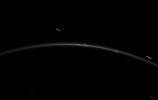
The_Rings-PIA11467.jpgMoonlet in the "G"-Ring58 visiteCaption NASA:"The faint "G"-Ring surrounding Saturn offers up a glimpse of its newfound tiny moonlet. The moonlet is near the center of this image.
A long exposure of 46" was required to capture the light from this tiny object and "G"-Ring, so the moonlet and a few stars have been smeared by motion, the stars showing up as short diagonal dashes.
The moonlet has also been smeared and appears to be a short vertical dash that is aligned with the Ring.
In August 2008 Cassini scientists spotted this moonlet, dubbed S/2008 S 1. It orbits in an arc, or partial ring, within the "G"-Ring. Imaging team scientists estimated the moonlet's diameter at about half a kilometer (one-third mile). For earlier images of this moonlet, see PIA11148.
This view looks toward the unilluminated side of the Rings from about 14° above the Ring-Plane. The image was taken in Visible Light with the Cassini Spacecraft narrow-angle camera on Feb. 20, 2009. The view was acquired at a distance of approx. 1,2 MKM (about 746.000 miles) from Saturn. Image scale is roughly 7 Km (a little more than 4 miles) per pixel".MareKromium
(3 voti)
|
|

The_Rings-PIA11462.jpgGhostly Spokes (Natural Colors; credits: Lunar Explorer Italia)112 visiteCaption NASA:"Faint, ghostly Spokes dapple the dark side of Saturn's A-Ring as the Planet's shadow makes a sharp diagonal cut across this image from Cassini.
The image was taken in Visible Light with the Cassini Spacecraft wide-angle camera on April 30, 2008.
This view looks toward the unilluminated side of the rings from about 26° above the Ring-Plane. The view was obtained at a distance of approx. 316.000 Km (such as about 196.000 miles) from Saturn and at a Sun-Saturn-Spacecraft, or Phase, Angle of 147°. Image scale is roughly 15 Km (about 9 miles) per pixel".MareKromium
(3 voti)
|
|

Saturn-PIA11461.jpgBlack Shadow from the "White Moon" (Natural Colors; credits: Lunar Explorer Italia)59 visiteCaption NASA:"The shadow of Saturn's moon Enceladus cast onto the Planet's Atmosphere appears like a drop of black ink on a canvas of Saturnian storms.
The image was taken with the Cassini spacecraft narrow-angle camera on June 20, 2008 using a spectral filter sensitive to wavelengths of Near-InfraRed Light centered at 750 nanometers. The view was obtained at a distance of approx. 1,3 MKM (such as about 810.000 miles) from Saturn and at a Sun-Saturn-Spacecraft, or Phase, Angle of 24°.
Image scale is roughly 7 Km (about 4 miles) per pixel".MareKromium
(3 voti)
|
|

Sky.gifThe Sky of Saturn...Through the Eyes of Cassini! (GIF-Movie; credits: Dr M. Faccin)71 visiteUno spettacolare GIF-Movie dedicato a tutti quelli che parlano dello Spazio ma, nel farlo, tendono a dimenticarsi della sua incredibile bellezza, profondità e dimensione.
Nel filmato, mentre le stelle lontane (inclusi almeno tre interessanti asterismi) scorrono lentamente attraverso il campo visivo di Cassini, sono visibili anche dei Raggi Cosmici che "incrociano" nei pressi della Sonda e, tanto per gradire, risultano pure facilmente individuabli alcuni classici vizi dell'immagine, sia "fissi" (ivi: microlesioni dell'obbiettivo), sia "mobili" o "fluttuanti" (ivi riconducibili, a nostro parere, a vizi di trasmissione dei dati a Terra e tra i quali riscontriamo "noise" e "dead pixels").
Buona visione!MareKromium
(3 voti)
|
|

Prometheus-N00128992-a.gifPrometheus: the "Wave-Maker" (GIF-Movie; credits: Dr M. Faccin)73 visitenessun commentoMareKromium
(3 voti)
|
|
| 2244 immagini su 187 pagina(e) |
 |
|
|
|
|
124 | |
|
|
|
|





