| |

| Piú votate - Saturn: the "Ringed Beauty" and His Moons |
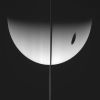
Saturn-W00061084.jpgWhat a Shadow!59 visiteUn'ombra davvero imponente (che evidenzia - molto bene! - anche le "penumbral areas") è disegnata sul disco illuminato di Saturno.
Le Original Captions NASA non ci sono di aiuto, anzi: confondono le idee (come leggerete)!
Dunque rivolgiamo il quesito a Voi: di quale Luna Saturniana è l'ombra che vediamo in questo frame?
Buon Lavoro!
W00061084.jpg was taken on November 07, 2009 and received on Earth November 08, 2009. The camera was pointing toward SATURN that, at the time, was approx. 2.059.699 Km away; the image was taken using the CB2 and CL2 filters. This image has not been validated or calibrated. A validated/calibrated image will be archived with the NASA Planetary Data System in 2010.MareKromium
(3 voti)
|
|
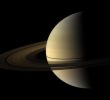
Saturn-PIA11613.jpgPost-Equinox Colors (Natural Colors; credits: NASA/JPL/Space Science Institute)70 visiteCaption NASA:"The Cassini Spacecraft captured this Natural Color View of Saturn almost a month after the Planet's August 2009 Equinox. The shadow cast on the Planet by the Rings remains narrow.
Spokes are visible on the B-Ring. To learn more about these ghostly radial structures, see PIA11144.
Mimas (approx. 396 Km, or about 246 miles across) can be seen in the lower left. Mimas and the Rings have been brightened relative to the Planet to increase visibility.
The novel illumination geometry that accompanies Equinox lowers the Sun's angle to the Ring-Plane, significantly darkens the Rings, and causes out-of-plane structures to look anomalously bright and cast shadows across the Rings. These scenes are possible only during the few months before and after Saturn's Equinox, which occurs only once in about 15 Earth years.
Before and after Equinox, Cassini's cameras have spotted not only the predictable shadows of some of Saturn's moons (see PIA11657), but also the shadows of newly revealed vertical structures in the Rings themselves (see PIA11665).
This view looks toward the Northern, sunlit side of the Rings from about 10° above the Ring-Plane.
The red, green and blue images that were mosaicked together to create this view were obtained with the Cassini Spacecraft wide-angle camera on Sept. 4, 2009. The view was obtained at a distance of approx. 2,7 MKM (such as about 1,7 MMs) from Saturn and at a Sun-Saturn-Spacecraft, or Phase, Angle of 92°.
Image scale is roughly 156 Km (about 97 miles) per pixel".MareKromium
(3 voti)
|
|
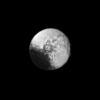
Japetus-PIA11608.jpgJapetus, from far away...64 visiteCaption NASA:"The Cassini spacecraft captures a far-off view of the two-toned surface of Saturn's moon Japetus. Scientists continue to investigate the nature of this moon's Surface. See also PIA08384 to learn more.
This view looks toward the Saturn-facing side of Japetus. North on Japetus is up and rotated 45° to the left. Scale in the original image was about 22 Km (approx. 14 miles) per pixel. The image has been magnified by a factor of three and contrast-enhanced to aid visibility.
The image was taken in visible light with the Cassini Spacecraft narrow-angle camera on Sept. 24, 2009. The view was obtained at a distance of approx. 3,7 MKM (such as about 2,3 MMs) from Japetus and at a Sun-Japetus-Spacecraft, or Phase, Angle of 12°".MareKromium
(3 voti)
|
|

The_Rings-PIA11674.jpgRocky-Rain on the Rings58 visiteCaption NASA:"The bright Streaks visible in these Cassini images taken during Saturn’s August 2009 Equinox are exciting evidence of a constant rain of interplanetary projectiles onto the Planet’s Rings.
Objects, each estimated to be one meter (3 feet) in size and traveling tens of kilometers per second (tens of thousands of miles per hour), likely smashed into the Rings and created elevated clouds of tiny particles that have been sheared out, or elongated and tilted, by orbital motion into bright streaks.
The image on the left shows an impact in the A-Ring. The Streak stretches from the right of the image to the middle, and it does not quite follow the arc of the Rings. The brightest part of that Streak is about 5000 Km (approx. 3100 miles) long (its azimuthal dimension) and about 200 Km (approx. 120 miles) wide (its radial extent, tip to tip) in this image.
The image on the right shows an impact into the C-Ring. This Streak is much smaller than the A-Ring Streak, and it appears on the right of the image. The brightest part of this Streak is approx. 200 Km (about 120 miles) long (its azimuthal dimension) and approx. 10 Km (about 6 miles) wide (its radial dimension, tip to tip) in this image.
By the brightness and dimensions of the Streaks, scientists estimate the impactor sizes at roughly one meter (3 feet), and the elapsed time since impact at one to two days. These Equinox data lend more confidence to a Cassini imaging observation made in 2005 of similar Streaks seen in the C-Ring (see PIA11675).
All together, these observations constitute the visual confirmation of a long-held belief that bits of interplanetary debris continually rain down on Saturn’s Rings and contribute to the Rings’ erosion and evolution.
Although the phase angle of these images is not the best for seeing clouds of small particles, these ejecta clouds are easily seen because very little sunlight is falling on the Rings during the exceedingly low Sun-angle condition prevalent during the four days surrounding exact Saturn Equinox.
Exact Equinox is when the sun is directly overhead at the Equator. A cloud of dust rising above the dark Ring-Plane is more directly catching the Sun’s rays, and is hence well lit and easily visible by contrast.
When the Ring background is at its usual brightness, impacts such as these are very difficult to detect.
The view of the A-Ring Streak on the left looks toward the northern side of the Rings from about 20° above the Ring-Plane. The image was taken in Visible Light with the Cassini Spacecraft narrow-angle camera on Aug. 13, 2009. The view was obtained at a distance of approx. 1,2 MKM (about 746.000 miles) from Saturn and at a Phase Angle of 87°.
Image scale is 7 kilometers (4 miles) per pixel.
The view of the C-Ring Streak on the right looks toward the southern side of the Rings from about 22° below the RingPlane. The image was taken in Visible Light with the Cassini Spacecraft narrow-angle camera on Aug. 11, 2009. The view was obtained at a distance of approx. 263.000 Km (about 164.000 miles) from Saturn and at a Phase Angle of 135°.
Image scale is roughly 1 Km (4007 feet) per pixel".MareKromium
(3 voti)
|
|
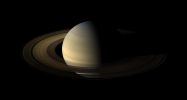
Saturn-PIA11667.jpgThe Lord of the Rings (Natural Colors; credits: NASA/JPL/Space Science Institute)60 visiteCaption NASA:"Of the countless Equinoxes Saturn has seen since the birth of the Solar System, this one, captured here in a mosaic of light and dark, is the first witnessed up close by an emissary from Earth … none other than our faithful robotic explorer, Cassini.
Seen from our planet, the view of Saturn’s Rings during Equinox is extremely foreshortened and limited. But in orbit around Saturn, Cassini had no such problems. From 20° above the Ring-Plane, Cassini’s wide angle camera shot 75 exposures in succession for this mosaic showing Saturn, its Rings, and a few of its moons a day and a half after exact Saturn Equinox, when the Sun’s disk was exactly overhead at the Planet’s Equator.
The novel illumination geometry that accompanies equinox lowers the Sun’s angle to the Ring-Plane, significantly darkens the Rings and causes out-of-plane structures to look anomalously bright and to cast shadows across the Rings themselves.
These scenes are possible only during the few months before and after Saturn’s Equinox which occurs only once in about 15 Earth years.
Before and after Equinox, Cassini’s cameras have spotted not only the predictable shadows of some of Saturn’s moons (see also PIA11657), but also the shadows of newly revealed vertical structures in the Rings (see, for example, PIA11665).
Also at Equinox, the shadows of the Planet’s expansive Rings are compressed into a single, narrow band cast onto the Planet as seen in this mosaic. (For an earlier view of the Rings’ wide shadows draped high on the Northern Hemisphere, see PIA09793)
The images comprising the mosaic, taken over about eight hours, were extensively processed before being joined together. First, each was re-projected into the same viewing geometry and then digitally processed to make the image “joints” seamless and to remove lens flares, radially extended bright artifacts resulting from light being scattered within the camera optics.
At this time so close to Equinox, illumination of the Rings by sunlight reflected off the planet vastly dominates any meager sunlight falling on the Rings. Hence, the half of the Rings on the left illuminated by planetshine is, before processing, much brighter than the half of the Rings on the right. On the right, it is only the vertically extended parts of the Rings that catch any substantial sunlight.
With no enhancement, the Rings would be essentially invisible in this mosaic. To improve their visibility, the dark (right) half of the Rings has been brightened relative to the brighter (left) half by a factor of three, and then the whole Ring System has been brightened by a factor of 20 relative to the Planet. So the dark half of the rings is 60 times brighter, and the bright half 20 times brighter, than they would have appeared if the entire System, Planet included, could have been captured in a single image.
The moon Janus (about 179 Km, or approx. 111 miles across) is on the lower left of this image. Epimetheus about (113 Km, or approx. 70 miles across) appears near the middle bottom. Pandora (about 81 Km, or approx. 50 miles across) orbits outside the Rings on the right of the image. The small moon Atlas (about 30 Km, or approx. 19 miles across) orbits inside the thin F-Ring on the right of the image.
The brightnesses of all the moons, relative to the Planet, have been enhanced between 30 and 60 times to make them more easily visible. Other bright specks are background stars. Spokes -- ghostly radial markings on the B ring -- are visible on the right of the image.
This view looks toward the northern side of the Rings from about 20° above the Ring-Plane.
The images were taken on Aug. 12, 2009, beginning about 1,25 days after exact equinox, using the red, green and blue spectral filters of the wide angle camera and were combined to create this Natural Colors view.
The images were obtained at a distance of approx. 847.000 Km (about 526.000 miles) from Saturn and at a Sun-Saturn-Spacecraft, or Phase, Angle of 74°.
Image scale is roughly 50 Km (about 31 miles) per pixel".
Nota Lunexit: una interpretazione in Colori Naturali davvero stupenda, per qualità, definizione e realismo. Una prova evidente che i lavori "brutti" (e cioè il 99% dei prodotti fotografici a colori riguardanti Marte) la NASA non li fa perchè "non è capace" (ovviamente), ma solo perchè "non vuole farli com sa fare".
Il motivo? Beh, certo non è "pigrizia" (anche se non si può mai dire)...MareKromium
(3 voti)
|
|

TheRings-GIF-W00059891.gifSaturn's "Moons-Carousel" (GIF-Movie; credits: Dr G. Barca)56 visitenessun commentoMareKromium
(3 voti)
|
|
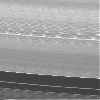
The_Rings-N00139376_to_97.gifSurfing through the Rings... (GIF-Movie; credits: Dr M. Faccin)58 visitenessun commentoMareKromium
(3 voti)
|
|

Janus-N00141745to56.gifIn the shadow of Saturn... (GIF-Movie; credits: Dr M. Faccin)58 visitenessun commentoMareKromium
(3 voti)
|
|
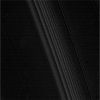
The_Rings-N00140419.jpgRings and "noise"60 visitenessun commentoMareKromium
(3 voti)
|
|

Daphnis_and_Rings-PIA11656-1.jpgWavy Shadows (ctx frame)59 visiteCaption NASA:"This image of shadows on the Rings and others like it (see also PIA11653 and PIA11655) are only possible around the time of Saturn's equinox which occurs every half-Saturn-year, equivalent to about 15 Earth years. The illumination geometry that accompanies equinox lowers the Sun's angle to the Ring-Plane and causes out-of-plane structures to cast long shadows across the Rings.
This view looks toward the unilluminated side of the Rings from about 49° above the Ring-Plane. The image was taken in visible light with the Cassini Spacecraft narrow-angle camera on April 13, 2009.
The view was obtained at a distance of approx. 1,2 MKM (about 746.000 miles) from Daphnis and at a Sun-Daphnis-Spacecraft, or phase, angle of 56°.
Image scale is roughly 7 Km (about 5 miles) per pixel".MareKromium
(3 voti)
|
|

ZO-Saturn_New_Moon-S2008-S1-PIA11503.jpgSaturn's New Moon S/2008 S162 visiteCaption NASA:"A bright arc within Saturn's faint G-Ring holds a tiny gift: a small moonlet is just visible as a short streak near the ansa of the G-Ring Arc in the top of two versions of the same image.
The second (bottom) version of the image has been brightened to enhance the visibility of the G-Ring. The other streaks in this version of the image are stars smeared by the camera's long exposure time of 26". This version of the image shows a gap in the G-Ring which was faintly visible in an earlier Cassini movie (see PIA08327).
This view looks toward the sunlit side of the Rings from about 1° below the Ring-Plane. The image was taken in Visible Light with the Cassini Spacecraft narrow-angle camera on Jan. 28, 2009. The view was acquired at a distance of approx. 1,2 MKM (such as about 746.000 miles) from Saturn and at a Sun-Saturn-Spacecraft, or Phase, Angle of 27°.
Image scale is roughly 7 Km (a little more than 4 miles) per pixel".MareKromium
(3 voti)
|
|

Pandora-PIA11499.jpgPandora56 visiteCaption NASA:"The thin shadow of the moon Pandora cuts across Saturn's narrow F-Ring.
As Saturn approaches its August 2009 Equinox, the planet's moons cast shadows onto the Rings. Pandora (about 81 Km, or approx. 50 miles across) is on the left of the image. Other bright points of light in the image are background stars.
This view looks toward the unilluminated side of the Rings from about 55° above the Ring-Plane. The image was taken in Visible Light with the Cassini Spacecraft narrow-angle camera on April 16, 2009. The view was obtained at a distance of approx. 1,3 MKM (such as about 808.000 miles) from Saturn and at a Sun-Saturn-Spacecraft, or Phase, Angle of 98°.
Image scale is roughly 8 Km (about 5 miles) per pixel".MareKromium
(3 voti)
|
|
| 2244 immagini su 187 pagina(e) |
|
|
|
|
|
123 | |
|
|
|
|
|
|





