| |

| Piú votate - Saturn: the "Ringed Beauty" and His Moons |
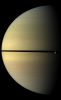
Saturn-PIA12513.jpgCrescent Saturn (Natural Colors; credits: NASA/JPL/Space Science Institute)57 visiteCaption NASA:"Saturn, stately and resplendent in this Natural Color view, dwarfs the icy moon Rhea.
Rhea orbits beyond the Rings on the right of the image. The moon Tethys is not shown here, but its shadow is visible on the Planet on the left of the image. This view looks toward the Northern, sunlit side of the Rings from just above the Ring-Plane.
Images taken using red, green and blue spectral filters were combined to create this Natural Color view. The images were obtained with the Cassini Spacecraft wide-angle camera on Nov. 4, 2009 at a distance of approx. 1,3 MKM (about 808.000 miles) from Saturn.
Image scale is roughly 72 Km (about 45 miles) per pixel".MareKromium
(3 voti)
|
|
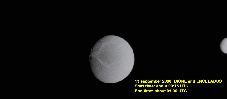
Dione_and_Enceladus-N00119781-N00119798.gifRush! (GIF-Movie; credits: Elisabetta Bonora)66 visitenessun commentoMareKromium
(3 voti)
|
|
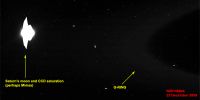
OverSaturation-N00148644.jpgOversaturation (by Elisabetta Bonora)60 visiteNon sempre la sovrasaturazione (o "sovraesposizione") - che è produttiva di una serie di image-artifacts tipici (su tutti, la cosiddetta "Light-Drop") - è il frutto di un errore: gli "oggetti a debole o debolissima luminosità", infatti, per essere evidenziati richiedono - come ben sapete - dei tempi di esposizione più lunghi del solito.
E quando poi, nel campo di ripresa, assieme all'"oggetto debole", vi è pure un "oggetto ad albedo elevata" - come in questo caso accade, rispettivamente, per l'Anello-G di Saturno e la sua luna Mimas -, ecco che l'immagine finale "sembra" venir fuori "sbagliata". Brutta e mossa, di regola (come vedete anche le stelle sono divenute, in questo frame, delle piccole "star-trails").
Ma la verità è che non si è trattato di un errore, ma di è una - oggettiva - necessità (come ben dimostra questa chiara elaborazione della nostra Elisabetta Bonora).MareKromium
(3 voti)
|
|
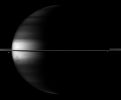
Saturn-PIA11649.jpgOut of the Darkness...61 visiteCaption NASA:"Dramatic differences between dark and light embellish this Cassini Spacecraft image of Saturn, its rings and its moons Dione and Enceladus.
Saturn's Northern and Southern Latitudes appear dark in this image because of the camera filter used. This view uses a spectral filter sensitive to absorption of certain wavelengths of light by Methane in Saturn's Atmosphere. The cloud tops in the Northern and Southern Latitudes are at a slightly greater depth than in the Equatorial Region, and are underneath a layer of Methane. This means that light travels along a longer path compared to the Equatorial Region as it enters the Atmosphere, reflects off the cloud tops, and returns through the Upper Atmosphere to enter the camera.
The light at Near-InfraRed wavelengths thus passes through more light-absorbing Methane at the Northern and Southern Latitudes than at the Equator, and so these Latitudes appear darker.
Dione (approx 1123 Km, or about 698 miles across) can be seen on the left of the image. Enceladus (approx. 504 Km, or about 313 miles across) is visible on the right.
This view looks toward the Northern, sunlit side of the Rings from just above the Ring-Plane.
The image was taken with the Cassini Spacecraft wide-angle camera on Oct. 21, 2009 using a spectral filter sensitive to wavelengths of Near-InfraRed Light centered at 890 nanometers. The view was obtained at a distance of approx. 2,5 MKM (such as about 1,6 MMs) from Saturn and at a Sun-Saturn-Spacecraft, or Phase, Angle of 104°.
Image scale is roughly 143 KM (such as about 89 miles) per pixel".MareKromium
(3 voti)
|
|

Rhea_and_Titan-MF.jpgRhea and Titan (NIR View; credits: Dr M. Faccin)60 visite...Una "Visione" davvero splendida, da lasciare con il fiato sospeso...MareKromium
(3 voti)
|
|

Rhea_and_Titan-EB.jpgJewels, in the Space of Saturn: Rhea and Titan (Natural Colors; credits: Elisabetta Bonora)60 visiteUn lavoro assolutamente PERFETTO e, detto sinceramente, di qualità mediamente superiore ai Lavori di colorizzazione "Made by NASA".
Complimenti vivissimi alla nostra Amica e Partner, Elisabetta Bonora!MareKromium
(3 voti)
|
|
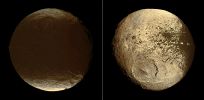
Japetus-PIA11690.jpgGlobal View of Japetus' "Brightness Dichotomy" (Approx. True Colors; credits: Lunexit)65 visiteCaption NASA:"These two global images of Japetus show the extreme brightness dichotomy on the Surface of this peculiar Saturnian moon. The left-hand panel shows Japetus' Leading Hemisphere and the right-hand panel shows its Trailing Side. While Low and Mid Latitudes of the Leading Side exhibit a Surface almost as dark as charcoal, broad tracts of the Trailing Side are almost as bright as snow.
The dark terrain covers about 40% of the Surface of Japetus and it has been named "Cassini Regio". The names of the bright terrain are Roncevaux Terra (North) and Saragossa Terra (South).
On both Hemispheres, the dominant landforms are impact craters. The largest known well-preserved basin on Japetus, called "Turgis", has a diameter of about 580 Km (approx. 360 miles). It lies at 17° North Latitude and 28° West Long., at the Eastern Edge of the Cassini Regio and is visible on the right side of the left-hand panel. The prominent basin on the Southern Trailing Side (at the lower left of the right-hand panel) is named Engelier.
Engelier is located at 41° South Latitude and 265° West Longitude, and it has a diameter of about 504 Km (such as approx. 313 miles).
Its formation destroyed about half of Gerin, another large basin on Japetus. Gerin is located at 46° South Latitude and 233° West Longitude; it has a diameter of about 445 Km (approx. 276 miles).
Tortelosa Montes, a part of the giant Equatorial Ridge that was discovered in Cassini images on December 25, 2004, is visible in the left panel as a thin line within Cassini Regio, and as a tall prominence at the Western Limb. It continues onto the Trailing Side (right side of right panel), where the bright Western Flanks of the Carcassone Montes appear as dominant bright spots within the Western Edge of Cassini Regio.
The cause of the extreme brightness dichotomy on Japetus is likely to be "thermal segregation of water ice" on a global scale.
Thermal effects are usually expected to act latitudinally.
That is, Polar Areas are colder than Equatorial Terrain in most cases due to the more oblique angle of the Solar Irradiation. Therefore, an additional process is required to explain the longitudinal difference as well.
In one model, dark, reddish dust coming in from space and preferentially deposited on the Leading Side forms a small, but crucial difference between the Leading and Trailing Hemispheres, which is sufficient to allow the thermal effect to evaporate the water ice on the Leading Side completely, but only marginally on the Trailing Side. (see PIA11689 to learn more)
Japetus' extremely slow Rotation Rate (about 1 hour and 54 minutes), its distance from the Sun, its relatively small size and Surface Gravity and its outer position within the regular satellite system of Saturn are also crucial contributing conditions for this mechanism to work as observed.
North on Japetus is approx. up in the images. Japetus has a diameter of about 1471 Km (approx. 914 miles).
The right-hand panel, released previously as PIA08384, shows a mosaic of 60 different images, obtained on September 10, 2007.
The left-hand panel is a color composite of three images obtained through InfraRed, Green and UltraViolet Spectral Filters (centered at 752, 568 and 338 nanometers, respectively) by Cassini's narrow-angle camera on Dec. 27, 2004.
The view was acquired at a distance of approx. 717.000 Km (about 446.000 miles) from Japetus and at a Sun-Japetus-Spacecraft, or Phase, Angle of 22°.
Scale in the original image on the left was about 4 Km (approx. 2,5 miles) per pixel. For ease of comparison, the scales in both the left and right images were set to 1400 meters (such as 4600 feet) per pixel".MareKromium
(3 voti)
|
|
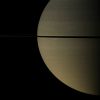
Saturn-PIA11640.jpgNarrow Shadow60 visiteCaption NASA:"From just above the Plane of Saturn's Rings, the Cassini Spacecraft snapped this shot of Saturn two months after Saturn's August 2009 Equinox, showing the shadow of its Rings as a narrow band on the Planet.
Cassini is looking toward the sunlit side of the rings from about 1° above the Ring-Plane.
The novel illumination geometry that accompanies Equinox lowers the Sun's angle to the Ring-Plane, significantly darkens the Rings, and causes out-of-plane structures to look anomalously bright and cast shadows across the Rings. These scenes are possible only during the few months before and after Saturn's Equinox, which occurs only once in about 15 Earth years.
Before and after Equinox, Cassini's cameras have spotted not only the predictable shadows of some of Saturn's moons (see, for instance, PIA11657), but also the shadows of newly revealed Vertical Structures in the Rings themselves (see PIA11665).
The image was taken with the Cassini Spacecraft wide-angle camera on Oct. 16, 2009 using a spectral filter sensitive to wavelengths of Near-InfraRed Light centered at 752 nanometers. The view was obtained at a distance of approx. 1,5 MKM (such as about 932.000 miles) from Saturn and at a Sun-Saturn-Spacecraft, or Phase, Angle of 83°.
Image scale is roughly 86 Km (approx. 53 miles) per pixel".MareKromium
(3 voti)
|
|

Daphnis-PIA11637.jpgHeavy Disturbances60 visiteCaption NASA:"This Cassini image, which at first appears to show a serene scene, in fact reveals dramatic disturbances created in Saturn's A-Ring by its moon Daphnis.
Near the center of the image, tiny Daphnis (about 8 Km across) appears as a bright dot in the Keeler Gap near the edge waves it has created in the A-Ring. The moon has an inclined orbit and its gravitational pull both perturbs the orbits of the particles of the A-Ring forming the Keeler Gap's edge and sculpts the edge into waves having both horizontal (radial) and out-of-plane components. Material on the inner edge of the gap orbits faster than the moon so that the waves there lead the moon in its orbit. Material on the outer edge moves slower than the moon, so waves there trail the moon.
Epimetheus (approx. 113 Km, or about 70 miles across) orbits beyond the F-Ring at the bottom of the image. Bright specks in the image are background stars.
This view looks toward the Northern, sunlit side of the Rings, from about 11° above the Ring-Plane.
The image was taken in Visible Light with the Cassini Spacecraft narrow-angle camera on Sept. 24, 2009. The view was obtained at a distance of approx. 1,8 MKM (about 1,1 MMs) from Daphnis.
Image scale is roughly 11 Km (a little less than 7 miles) per pixel".MareKromium
(3 voti)
|
|
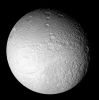
Tethys-CASSINI.jpgTethys59 visiteWhat processes formed the unusual Surface of Saturn's moon Tethys? To help find out, NASA sent the robotic Cassini Spacecraft right past the enigmatic ice moon in 2005. Pictured above is one of the HR images of an entire face of Tethys yet created. The pervasive white color of Tethys is thought to be created by fresh ice particles continually falling onto the moon from Saturn's diffuse E-Ring - particles expelled by Saturn's moon Enceladus. Some of the unusual cratering patterns on Tethys remain less well understood, however. Close inspection of the above image of Tethys' South Pole will reveal a great rift running diagonally down from the middle: Ithaca Chasma. A leading theory for the creation of this great canyon is anchored in the tremendous moon-wide surface cracking that likely occurred when Tethys' internal oceans froze.
If so, Tethys may once have harbored internal oceans, possibly similar to the underground oceans some hypothesize to exist under the surface of Enceladus today. Might ancient life be frozen down there?MareKromium
(3 voti)
|
|
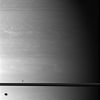
Saturn-PIA11633.jpgShadows...58 visiteCaption NASA:"The shadows of two moons appear on Saturn, above and below the plane of the Planet's Rings.
North on Saturn is up in this image, and the shadow of Dione can be seen south of the Planet's Equator. The smaller shadow of Mimas is north of the Equator.
Dione and Mimas both have orbits that are slightly inclined in relation to the Planet's Equatorial Plane, so, depending upon the orientation of their orbits, their shadows may appear North or South of Saturn's Equator. The moons themselves do not appear in this image.
This view looks toward the Northern, sunlit side of the Rings from about 1° above the Ring-Plane. Scale in the original image was about 100 Km (approx. 62 miles) per pixel. The image has been magnified by a factor of 1.5 and contrast-enhanced to aid visibility.
The image was taken with the Cassini Spacecraft wide-angle camera on Oct. 15, 2009 using a spectral filter sensitive to wavelengths of Near-InfraRed Light centered at 752 nanometers. The view was acquired at a distance of approx. 899.000 Km (about 558.000 miles) from Saturn and at a Sun-Saturn-Spacecraft, or Phase, angle of 65°".MareKromium
(3 voti)
|
|
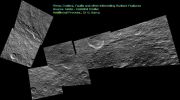
RHEA-ImageMosaic-GB1.jpgRhea (Image-Mosaic; credits: Dr G. Barca)59 visiteDedicato ai Ragazzi di Pasadena ed allo Space Science Institute (che ci offre, quest'ultimo, dei prodotti fotografici - spesso - inguardabili).MareKromium
(3 voti)
|
|
| 2244 immagini su 187 pagina(e) |
|
|
|
|
|
122 | |
|
|
|
|
|
|





