| Piú votate - Saturn: the "Ringed Beauty" and His Moons |

Mimas-PIA12867.jpgUneven Warmth on Mimas58 visiteThe image shows NASA's Cassini Spacecraft imaging science subsystem Visible-Light mosaic of Mimas from previous flybys on the left. The right-hand image shows the new CIRS temperature data mapped on top of the Visible-Light image.
It has to be underlined the unexpected and bizarre pattern of daytime temperatures found on Saturn's small inner moon Mimas (about 396 Km, or approx. 246 miles, in diameter). The data were obtained by the composite infrared spectrometer (CIRS) on the Cassini Spacecraft during the Spacecraft's closest-ever look at Mimas on Feb. 13, 2010.
The warm part has typical temperatures near 92 Kelvin (minus 294 Fahrenheit), while typical temperatures on the cold part are about 77 Kelvin (minus 320 Fahrenheit). The cold part is probably colder because surface materials there have a greater thermal conductivity, so the Sun's energy soaks into the Sub-surface instead of warming the Surface itself. But why conductivity should vary so dramatically across the Surface of Mimas is a mystery.
The map used to create this image is a mosaic of images taken by Cassini's imaging science subsystem cameras on previous flybys of Mimas. The cold side includes the giant Herschel Crater, which is a few degrees warmer than its surroundings. It's not yet known whether Herschel is responsible in some way for the larger region of cold temperatures that surrounds it.
Cassini took 85 minutes to make the temperature map, as the Spacecraft receded from Mimas. During that time, the distance to Mimas increased from 38.000 to 67.000 Km (such as about 24.000 to 42.000 miles) and the longitude of the center of Mimas' disk increased from 128° West to 161° West, due to the moon's rotation.
Because of this changing geometry, the alignment of the temperatures relative to specific features or coordinates on Mimas is shown only approximately. The temperatures were calculated from the brightness of the moon's infrared heat radiation, measured by CIRS at a wavelength of 12 to 16 microns".MareKromium
(3 voti)
|
|
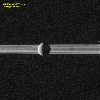
Rhea-Janus-Prometheus-_EB-LXTT.gifThe Endless "Cosmic Race" (a GIF-Movie by Elisabetta Bonora - Lunexit Team)62 visitenessun commentoMareKromium
(3 voti)
|
|
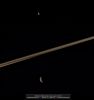
Tethys_and_Mimas-EB-LXTT.jpgSo close, and yet so Far: Tethys and Mimas (Natural Colors; credits: Elisabetta Bonora - Lunexit Team)58 visitenessun commentoMareKromium
(3 voti)
|
|
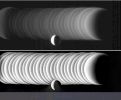
Polydeuces-EB.jpgPolydeuces? (an Image-Mosaic by Elisabetta Bonora and Marco Faccin - Lunexit Team)61 visitenessun commentoMareKromium
(3 voti)
|
|

Rhea_and_Telesto-N00152419-22-EB.jpgRhea and Telesto (an Image-Mosaic by Elisabetta Bonora - Lunexit Team)61 visitenessun commentoMareKromium
(3 voti)
|
|

Japetus-EB2.gifJapetus, like a "True Star"! (GIF-Movie; credits: Elisabetta Bonora - Lunexit Team)61 visitenessun commentoMareKromium
(3 voti)
|
|
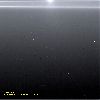
Enceladus-EB.gifFountains of Light, Star-trails and the G-Ring (GIF-Movie; credits: Elisabetta Bonora)69 visitenessun commentoMareKromium
(3 voti)
|
|

Japetus-EB-LXTT.jpgCrescent Japetus (Special Processing by Elisabetta Bonora - Lunexit Team)59 visitenessun commentoMareKromium
(3 voti)
|
|

Saturn-EB.jpgMethane in the Clouds of Saturn (Special Image Processing - credits: Elisabetta Bonora - Lunexit Team)60 visitenessun commentoMareKromium
(3 voti)
|
|
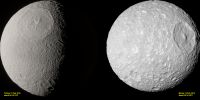
Tethys-Mimas-EB.jpgSaturnian Twins: Tethys and Mimas (Natural Colors - Image-Mosaic; credits: Elisabetta Bonora - Lunexit Team)60 visitenessun commentoMareKromium
(3 voti)
|
|

Skoll-EB1.gifSköll? (GIF-Movie; credits: Elisabetta Bonora)59 visiteSköll or Saturn XLVII (provisional designation S/2006 S 8) is a retrograde irregular satellite of Saturn. Its discovery was announced by Scott S. Sheppard, David C. Jewitt and Jan Kleyna on June 26, 2006, from observations taken between January 5 and April 30, 2006.
Sköll is about 6 Km in diameter (assuming an albedo of 0,04), and orbits Saturn at an average distance of 17,6 Gm in 869 days, following a highly eccentric and moderately inclined orbit.
It was named in April 2007 after Sköll, a giant wolf from Norse mythology, son of Fenrisulfr and twin brother of Hati.MareKromium
(3 voti)
|
|

SaturnianSpace-EB2.gifViews and Features of the Space of Saturn (GIF-Movie; credits: Elisabetta Bonora - Lunexit Team)59 visitenessun commentoMareKromium
(3 voti)
|
|
| 2244 immagini su 187 pagina(e) |
 |
|
|
|
|
120 | |
|
|
|
|





