| Piú votate - Saturn: the "Ringed Beauty" and His Moons |

Hyperion-PIA07741-2.jpgHyperion's unusual craters (2) - HR60 visiteOriginal caption:"Scientists will also be examining Cassini's sharp views to try to determine whether there have been multiple episodes of landslides on Hyperion. Such "downslope" movement is evident in the filling of craters with debris and the near elimination of many craters along the steeper slopes. Answers to these questions may help solve the mystery of why this object has evolved different surface forms from other moons of Saturn.
The images comprising this mosaic were taken with the Cassini spacecraft narrow-angle camera at distances ranging from approximately 8.500 Km (about 5.300 miles) to 4.600 Km (about 2.900 miles) from Hyperion. Image scale is 26 mt (about 85 feet) per pixel".
(8 voti)
|
|

Hyperion-N00040385.jpgHyperion (24)56 visiteSiamo al punto di massima vicinanza: poco più di 2200 Km dal Black Lake (questo cratere lo abbiamo battezzato noi...) che copre il versante Sud del frame. Purtroppo non si possono fare troppe speculazioni su simili immagini ma, a quanto ci dicono i nostri esperti di fotografia, il Black Lake che si vede in questa immagine è un grande cratere sul cui fondo potrebbero essere presenti abbondanti depositi di polveri e/o di ghiaccio nero.
Non "sembra" che, almeno all'interno di questo cratere, vi sìano e/o vi possano essere stati degli idrocarburi ghiacciati.
Purtroppo, con i pochissimi dati a disposizione, non possiamo spingerci oltre.
(8 voti)
|
|
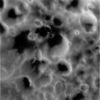
Hyperion-N00040366.jpgHyperion (21)54 visiteHyperion è a 6900 Km: Cassini guarda "dentro" qualcuno di questi strani crateri che sembrano contenere qualcosa. Questa immagine, al pari delle altre, è splendida ma quasi completamente enigmatica. Si intravedono dei rilievi, infatti (sul versante interno di alcuni dei crateri inquadrati), che potrebbero essere dei "seeps" così come dei semplici crepacci. In un altro cratere (in alto a Dx - diremmo ad ore 02:00) si vedono - molto bene - dei rilievi simili a land-slides al suo interno e quello strano (e, per ora, indecifrabile) materiale nero (o comunque scuro) che, in alcuni momenti, ci riporta alle black-dunes delle aree Polari e presso-Polari di Marte.
(8 voti)
|
|

Hyperion-N00040351.jpgHyperion (18)55 visiteA poco più di 10.500 Km da Hyperion possiamo vedere qualcosa che, almeno in apparenza, ci fa venire in mente la superficie di Titano: un terreno contraddistinto da aree chiare ed aree scure ma, soprattutto, la presenza di qualcosa all'interno di innumerevoli crateri.
La nostra sensazione, in attesa di compiere analisi ed elaborazioni più approfondite su questi frames, è che questo "qualcosa" potrebbe anche essere il "ghiaccio nero" (ossìa ghiaccio ricco di polveri di ferro e NON ghiaccio sul quale si sono depositati, nelle ere, dei grandi quantitativi di polveri - poichè, se così fosse, allora TUTTA la superficie di Hyperion dovrebbe essere scura e NON solo il fondo di una sua parte).
Certo è che ci sono anche altre ipotesi - forse un pò più esotiche... - che potremmo prendere in considerazione e la più "credibile" è quella che vede, sul fondo di questi crateri, dei grandi quantitativi di idrocarburi ghiacciati.
(8 voti)
|
|
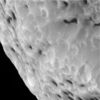
Hyperion-N00040349.jpgHyperion (17)54 visiteDa 11.600 Km di distanza da Hyperion e grazie a questo frame, possiamo definitivamente escludere che le zone "scure" sul fondo di innumerevoli crateri (e non solo quelli della specie che abbiamo battezzato "conica") sìano ombre.
Ma proseguiamo: le immagini migliori devono ancora arrivare...
(8 voti)
|
|

Tethys-W00010668.jpgCrescent Tethys and the Rings54 visiteUn bellissimo frame: poco da dire al riguardo se non che l'immagine è stata ottenuta alla fine del Fly-By dell'ultimo week-end di Settembre 2005, quando Cassini si era allontanata da Tethys ormai di oltre 45.000 Km...
(8 voti)
|
|

Rhea~1.jpgRhea54 visiteThe icy, cratered surface of Saturn's moon Rhea is seen in this HR image taken by Voyager 1 on November 11, 1980, from a distance of about 85.000 Km (such as approx. 52.800 miles) as the spacecraft passed over the Satellite's North Pole. The heavily cratered surface attests to the Satellite's ancient age. The largest craters, 50 to 100 Km across and several Km deep, are freshly preserved in Rhea's icy crust. The craters and landscape resemble those on the Moon and Mercury and are unlike the flattened crater forms that have collapsed in the soft icy crusts of the Jovian moons Callisto, Ganymede and Europa.
Scientists believe that Rhea (which is just 1600 Km - about 995 miles - in diameter, compared to the 5.500 Km of diameter of Ganymede) froze and became rigid, behaving like a rocky surface, very early in its history.
(8 voti)
|
|

Pan-PIA07587.jpgPan running in his "lane"54 visiteSaturn's moon Pan occupies the Encke Gap at the center of this image, which also displays some of the A-Ring's intricate wave structure. Pan is 26 Km (about 16 miles) across.
The two most prominent bright banded features seen on the left side of the image are Spiral Density Waves, which propagate outward through Saturn's Rings. The bright crests represent areas with higher ring particle densities.
The image was taken in visible green light with the Cassini spacecraft narrow-angle camera on Aug. 1, 2005, at a distance of approx. 794.000 Km (about 493.000 miles) from Pan. The image scale is 5 Km (such as 3 miles) per pixel.
(8 voti)
|
|

Telesto-PIA07586.jpgTelesto65 visiteCaption originale:"The blob of light seen here is Saturn's moon Telesto, which shares its orbital path with much larger Tethys. Telesto is 24 Km across.
Although this view may hint at a flattened, potato-like shape for Telesto (a common shape for Saturn's smaller moons), no features on the moon's surface can be resolved here.
The image was taken in visible green light with the Cassini spacecraft narrow-angle camera on Aug. 1, 2005, at a distance of approximately 768.000 Km from Telesto and at a Sun-Telesto-spacecraft angle of 37°. Resolution in the original image was 5 Km per pixel. The image has been contrast-enhanced and magnified by a factor of 4 to aid visibility".
(8 voti)
|
|

Janus-PIA07580.jpgJanus56 visiteOriginal NASA caption:"The Roman god Janus is usually depicted with two faces (nota: "Giano Bifronte"), one looking forward and one behind. Janus is captured here by Cassini, showing two faces of its own.
This view shows a sliver of Janus's dayside, plus much of the dark side. Part of the darkened terrain to the left is lit dimly by reflected light from Saturn, revealing craters there.
North on Janus is up in this image. A brightly sunlit view of Janus (181 Km, or 113 miles across) can also be seen in PIA07529.
The image was taken in visible green light with the Cassini spacecraft narrow-angle camera on Aug. 2, 2005, at a distance of approx. 541.000 Km (about 336.000 miles) from Janus and at a Sun-Janus-spacecraft, or phase, angle of 147°. Resolution in the original image was 3 Km (about 2 miles) per pixel.
The image has been contrast-enhanced and magnified by a factor of two to aid visibility".
(8 voti)
|
|

Rings-PIA07716.jpgCan the "clumps" in the Rings be the TSP (Transient Saturnian Phoenomena)?55 visite"Scientists have long suspected that small moons hiding among Saturn's Rings strands might be producing some of the unusual structure observed in the F-Ring. While the shepherd moon Prometheus is the main culprit behind the strange behavior of Saturn's F-Ring, it cannot explain all observed features. The current dilemma facing scientists is that Cassini is detecting extended objects like those pictured here - that may be either solid moons or just loose clumps of particles within the Ring. This montage of 4 enhanced Cassini narrow-angle camera images shows bright clump-like features at different locations within the F-Ring.
Two objects in particular, provisionally named S/2004 S3 and S/2004 S6, have been repeatedly observed by Cassini over the past 13,5 months and 8,5 months, respectively. The orbits for these 2 objects have not yet been precisely determined, in part because perturbations from other nearby moons make the orbits of objects in this region complicated. Thus, scientists cannot be completely confident at the present time if they in fact have observed new sightings of S3 and S6, or additional transient clumps.
The upper two images show features that may be S6. From previous observations, S6 appears to have an orbit that crosses that of the main F ring. This unexpected behavior currently is a subject of great interest to ring scientists.
The upper left image was taken on June 21, 2005, and shows an object in the outer ringlets of the F ring. The radial (or lengthwise) extent of the feature is approximately 2,000 kilometers (1,200 miles). The radial resolution on the ring is about 13 kilometers (8 miles) per pixel.
The image at the upper right was taken on June 29, 2005, and shows a bright feature within the F ring's inner ringlets. The radial extent of the feature seen here is about 2,000 kilometers (1,200 miles); the radial resolution is 36 kilometers (22 miles).
The image at the lower left was taken on August 2, 2005, and shows a feature that may be S3. S3 has been found to have an orbital path that is tightly aligned with that of the main F ring. The radial resolution in the image is 3.5 kilometers (2.2 miles) per pixel.
The lower right image was taken on April 13, 2005, and has a radial resolution of 7 kilometers (4 miles) per pixel. This object does not appear to be either S3 or S6.
Structures like knots and clumps within the F ring often are transient, appearing and then disappearing within months. Repeated observation of the objects seen in this region hopefully will give scientists firm evidence about whether these features are actual moons that disturb the material around them or perhaps the short-lived products of interactions between the F ring and larger moons such as Prometheus.
(8 voti)
|
|

Rings-PIA07579.jpgPandora, Prometheus and the F-Ring55 visiteOriginal NASA caption:"From just outside the faint edge of Saturn's F-Ring, the moon Pandora keeps watch over her fine-grained flock.
The outer flanks of the F-Ring region are populated by ice particles approaching the size of the particles comprising smoke!
As a shepherd moon, Pandora helps her cohort Prometheus confine and shape the main F-Ring (Pandora is 84 Km (such as 52 miles) across while Prometheus is 102 Km (such as 63 miles) wide and orbits interior to the F-Ring.
The small knot seen attached to the core is one of several that Cassini scientists are eyeing as they attempt to distinguish "embedded moons" from "transient clumps of material".
The image was taken with the Cassini spacecraft narrow-angle camera on Aug. 2, 2005, using a filter sensitive to wavelengths of infrared light centered at 930 nnmts at a distance of approx. 610.000 Km (such as about 379.000 miles) from Pandora and at a Sun-Pandora-spacecraft, or phase, angle of 146°. Image scale is 4 Km per pixel".
(8 voti)
|
|
| 2244 immagini su 187 pagina(e) |
 |
|
|
|
|
12 | |
|
|
|
|





