| Piú votate - Saturn: the "Ringed Beauty" and His Moons |

Enceladus-PIA06210.jpgEnceladus' "crispy & fractured" surface (false colors)59 visiteTo human eyes, Enceladus appears almost completely white, but false color reveals intriguing details. This view is a composite of images taken using filters sensitive to ultraviolet (centered at 338 nnmts), green (centered at 568 nnmts), and near-infrared (centered at 930 nnmts) light and has been processed to accentuate subtle color differences. The uppermost surface of these terrains appears uniformly grey in this picture, suggesting that they are covered with materials of homogeneous composition and grain size. However, the walls of many of the fractures appear to be somewhat bluer than typical surface materials. It is possible that the difference in color identifies outcrops of solid ice on the walls of fractures, or ice with different grain-sizes, compared to powdery surface materials. It is also possible that the color identifies some compositional difference between buried ice and ice at the surface. The surface is peppered with craters of all sizes, from the 21-Km diameter crater at the top of the image, down to tiny craters near the limit of resolution. The prominent crater at the top contains a central, domelike structure more than 11 kilometers (7 miles) in diameter. The dome, the crater -- and indeed the entire scene -- is sliced by a complex network of fractures ranging in width from hundreds of meters in some places, to over three kilometers (2 miles) in others.
(4 voti)
|
|

Enceladus-PIA06209.jpgEnceladus' "crispy & fractured" surface (false colors)59 visiteExtending through the center of this image is a system of rifts 3 Km wide and lanes of grooved terrain 20 Km wide, which separate 2 distinct geological provinces. To the right of the boundary is older, cratered terrain - a region peppered with craters ranging from 10 Km in diameter, down to craters near the limit of resolution. The region is believed to be old because it has accumulated a relatively high density of impact craters over time and the topography is soft and muted, suggesting that it is covered by a layer of particulate materials. The cratered terrain is cut crosswise by numerous faults and fractures ranging in width from hundreds of meters to a few Km. On the left side of the scene are grooved, icy plains. This broad, relatively flat region is scored by an extensive band of parallel grooves that appear to subdivide the surface into narrow lanes approx. 1 Km wide. The low abundance of impact craters and crisp relief on topographic features here imply that this region is geologically much younger than the cratered terrain at the right.
(4 voti)
|
|

Enceladus-PIA06207.jpgEnceladus' "crispy & fractured" surface57 visite(...) The rims and interiors of many craters seem to be sliced by a pervasive system of narrow, parallel grooves into slabs or lanes that typically are about 1 Km in width. The widely varied appearances of fractures in this region attest to the fact that the surface of Enceladus has been shaped by a long history of intense tectonic activity. The oldest fractures are characterized by a soft, muted appearance and are overprinted by numerous, superimposed impact craters. More recent fractures exhibit topographic relief that is relatively "crisp" in appearance, and they appear to slice through pre-existing impact craters and older fractures. On the right side of the image is a conspicuous and twisted network of ridges and troughs forming a distinct tectonic region on Enceladus. The paucity of craters and the sharp appearance of the topography in this area indicate that this is a relatively young terrain on Enceladus. One possibility is that the walls of the fractures expose outcrops of solid ice, or ice with different grain-sizes compared to powdery surface materials that blanket flat-lying surfaces. It is also possible that the color identifies some compositional difference between buried ice and ice at the surface. The distinct coloration of "youthful" fracture walls are nearly absent in the oldest fractures. This is consistent with the possibility that the older fractures are covered with a drape of particulate material which mantles nearly all the oldest features on the satellite.
(4 voti)
|
|

Enceladus-N00030111.jpgEnceladus, from approx. 4.000 Km56 visiteTabella riassuntiva delle caratteristiche superficiali di Encelado:
1. esistenza di una diffusa e fittissima rete di canyons, crepacci e canali;
2. sostanziale scarsità di crateri da impatto (salvo alcune aree, di modeste dimensioni);
3. presenza, accanto alle "reti di canali e canyons", di alcuni crepacci molto grandi, profondi e, apparentemente, recenti (si potrebbe trattare, forse, di "fratture tettoniche");
4. mancanza di profili "aspri" (anche i bordi dei pochi crateri visibili sembrano essere 'smussati');
5. albedo altissima (molte immagini recano chiari segni di sovraesposizione);
6. possesso di una atmosfera.
(4 voti)
|
|

Enceladus-N00030103.jpgEnceladus, from approx. 6.000 Km59 visitenessun commento
(4 voti)
|
|

Enceladus-N00030097.jpgEnceladus, from approx. 12.000 Km59 visiteAncora un grande e tortuoso crack della superficie di questa luna che, non più nè meno di Giapeto o Mimas, ci mostra, a mano a mano che ci avviciniamo, un volto capace di suscitare dei grandi interessi e che fa nascere infinite curiosità.
Perchè Encelado è così luminosa?
Che cosa è successo alla superficie di Encelado, e quando?
Proveremo un landing anche su Encelado, in futuro?!?...
(4 voti)
|
|

Enceladus-N00030059.jpgEnceladus, from approx. 27.000 Km59 visitenessun commento
(4 voti)
|
|

The F-Ring-PIA06600.jpgAttraction-Repulsion: the strange relationship between Prometheus and the F-Ring59 visiteCaption NASA originale:"Intriguing features resembling drapes and kinks are visible in this Cassini view of Saturn's thin F-Ring. Several distinct ringlets are present, in addition to the bright, knotted core of the ring.
The obvious structure in the ring and its strands has been caused by Prometheus, the inner F-Ring shepherd moon that recently swept past this region. (Prometheus is about 10° ahead of the F-Ring material in this image). These types of features were first seen in images taken just after Cassini entered into orbit around Saturn. The gravitational interaction of Prometheus (102 Km or 63 miles across) on the ring pulls material out the ring once every orbit (every 14,7 hours) as the moon gets close to the ring and its strands".
(4 voti)
|
|

Enceladus-PIA06597.jpgEnceladus and Tethys60 visiteCaption NASA originale:"In this unusual view, Cassini captured two icy moons of Saturn, Tethys and Enceladus, in a single narrow-angle frame. Little detail is visible on the surface of bright Enceladus, but battered Tethys shows many craters and the huge canyon system, Ithaca Chasma. Tethys has a diameter of 1.071 Km (approx. 665 miles) across, while Enceladus is 505 Km (approx. 314 miles) across.
The image was taken in visible light with the Cassini spacecraft narrow-angle camera on Jan. 29, 2005, at a distance of approx. 3,7 MKM (approx. 2,3 MMs) from Tethys and 3,5 MKM (approx. 2,2 MMs) from Enceladus. Resolution in the original image was 22 Km (approx. 14 miles) per pixel on Tethys and 21 Km (approx. 13 miles) per pixel on Enceladus. The image has been contrast-enhanced and magnified by a factor of two to aid visibility".
(4 voti)
|
|

Saturn-PIA06194.jpgAre these "anomalies" the clock-tracks of a New Moon?61 visiteUna piccola premessa: le irregolarità fisiche del margine esterno dell'Anello A, situate in prossimità di quella zona conosciuta come Divisione Keeler (larga circa 42 Km), sono ritenute dalla NASA una evidenza indiretta (o prova circostanziale) dell'esistenza di una nuova 'luna nascosta'. In realtà, queste alterazioni fisiche - le quali altro non sono che il riflesso visibile delle interazioni gravitazionali esercitate da corpi sufficientemente vicini - allorchè i corpi interagenti sono, almeno relativamente, "stabili" (come dobbiamo ragionevolmente supporre che sia nel nostro caso), si caratterizzano per una sostanziale regolarità e ripetitività. Ora nell'immagine di riferimento, come potete vedere Voi stessi, questa 'anomalia gravitazionale' sembra tutt'altro che regolare e ripetitiva. Perchè non provare a pensare, dunque, ad una vera e propria 'interazione complessa' (possibile indice della presenza di più lune) o, magari, a qualcosa di diverso (per esempio ad un - raro - Fenomeno Transitorio)?
(4 voti)
|
|

Pandora-N00028964~0.jpgPandora: the "Prisoner" and yet the "Guardian" of the Rings58 visiteUn frame molto suggestivo per un'altra "luna pastore" - Pandora - che in questa immagine, a causa della particolare prospettiva, sembra essere stata "ingabbiata" dagli Anelli. In realtà - e da un punto di vista squisitamente fisico - semmai è vero il contrario: è Pandora che concorre nel "modellare" e "mantenere in equilibrio" e, dunque, nell'"imprigionare", in una serie coordinata di abbracci gravitazionali, i detriti che formano gli Anelli del Gigante!
(4 voti)
|
|
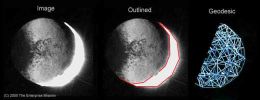
Japetus-A-W-Deathstar-23a.jpgWhat is the "real shape" of Japetus?67 visiteEcco il punto: tutte (o quasi tutte) le Singolarità che troviamo su Giapeto, sono "convenzionalmente spiegabili"! E' evidente che poi qualcuno crederà (istintivamente) alla loro spiegazione convenzionale e qualcun altro, invece, propenderà per la natura artificiale di queste strutture: fa parte del "gioco"... Ma ciò che noi pensiamo è che è proprio il QUANTITATIVO di Singolarità e NON la singola (e magari eclatante) Anomalia a fare la differenza! Noi non condividiamo l'approccio impiegato dal Prof. Hoagland perchè Lui ricollega immediatamente ogni Singolarità all'esistenza di una "struttura artificiale" la quale, a sua volta, si inserisce in un tessuto uniforme, coerente e stratificato di Anomalie di Superficie le quali, impiegando questa chiave di lettura, diventano le "erose vestigia" di una (per nulla) evidente Civiltà estinta.
Ebbene noi diciamo "NO": secondo noi questo modo di ragionare è errato in termini di principio! Giapeto è una luna "anomala", in tutto e per tutto, e ne prendiamo atto.
(4 voti)
|
|
| 2244 immagini su 187 pagina(e) |
 |
|
|
|
|
112 | |
|
|
|
|





