| Piú votate - Saturn: the "Ringed Beauty" and His Moons |

Hyperion-N00035353.jpgHyperion, from about 166.000 Km (1)66 visiteIperione, la luna 'rotolante' (--->tumbling moon) - così chiamata a causa del suo procedere caotico il quale la fa assomigliare di più ad un macigno scagliato nello Spazio piuttosto che ad un corpo celeste in orbita regolare attorno ad un Mondo Genitore.
Queste, come ovvio, sono le logiche e scientifiche conclusioni alle quali si arriva interpretando il movimento di alcuni corpi celesti in accordo al nostro 'Sapere Comune'. La congettura di base è che Iperione, come tante altre Lune Minori, non sia altro che una scheggia di roccia (un KBO, p.e.), proiettata verso l'interno del Sistema Solare a causa di un qualche ignoto cataclisma, o di un impatto o, magari, per effetto di impulsi o cicli mareali i quali, più o meno periodicamente, spingono dei corpi rocciosi di dimensioni medio-piccole verso il Sole. Il moto disordinato (ma che cosa è 'disordinato' e che cosa è 'lineare' nell'Universo?) di Iperione potrebbe quindi dipendere da fatto che, durante il suo viaggio, esso è passato accanto ad altri corpi...
(4 voti)
|
|

Epimetheus-PIA06226.jpgEpimetheus up close (from about 74.600 Km) but in false colors58 visiteCaption NASA originale:"The color of Epimetheus in this view appears to vary in a non-uniform way across the different facets of the moon's irregular surface. Usually, color differences among planetary terrains identify regional variations in the chemical composition of surface materials. However, surface color variations can also be caused by wavelength-dependent differences in the way a particular material reflects light at different lighting angles. The color variation in this false-color view suggests such "photometric effects" because the surface appears to have a more bluish cast in areas where sunlight strikes the surface at greater angles. The slightly reddish feature in the lower left is a crater named Pollux. The large crater just below center is Hilairea, which has a diameter of about 33 Km. At 116 Km across, Epimetheus is slightly smaller than its companion moon, Janus (181 Km across), which orbits at essentially the same distance from Saturn".
(4 voti)
|
|

Enceladus-PIA06628.jpgEnceladus from 1,1 MKM57 visiteCaption NASA originale:"Saturn's bright moon Enceladus hovers here, in front of the Rings darkened by Saturn's shadow.
This view is from less than 1° beneath the Ring plane. If seen from directly beneath the Rings, the planet's giant shadow would appear as an elongated half-ellipse; the acute viewing angle makes the shadow look more like a strip here. The dark shadow first takes a bite out of the rings at the right, where the distant, outermost ring material appears to taper and fade. Ring features visible in this image from the outer ring edge inward include: the A-Ring, the Cassini Division and the B-Ring. The C-Ring is the darker region that dominates the Rings here. The 2 gaps visible near the center and below the left of the center are the Titan Gap, about 77.800 Km from Saturn and an unnamed gap about 75.800 Km from the planet. The image was taken in visible light with the Cassini spacecraft narrow-angle camera on March 7, 2005, at a distance of approx. 1,1 MKM from Enceladus, at a phase angle of 30°".
(4 voti)
|
|
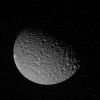
Mimas-N00032567.jpgMimas, from approx. 93.000 Km58 visiteUn'immagine che potrebbe essere bellissima, ma che invece è resa inguardabile - o quasi... - da un'infinità di artefatti fotografici. Resta comunque un frame importante - ed è per questo che lo proponiamo ugualmente - sia per ciò che riesce a mostrarci di Mimas, sia perchè ci permette di familiarizzare ancora di più con questi difetti delle immagini che in tantissimi frangenti possono essere e/o diventare causa di sviste e malintesi.
(4 voti)
|
|

Saturn-N00031212.jpgPan and Epimetheus (from approx. 1,5 MKM)64 visitenessun commento
(4 voti)
|
|
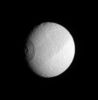
Tethys-PIA06625.jpgOdysseus: the "eye" of Tethys59 visiteCaption NASA originale:"Saturn's moon Tethys turns like a great eye as the enormous crater Odysseus (450 Km across) rotates into Cassini's view. The image was taken in visible light with the Cassini spacecraft narrow-angle camera on March 6, 2005, at a distance of approximately 1,7 MKM (approx. 1,1 MMs) from Tethys and from a Sun-Tethys-spacecraft, or phase, angle of 35°. The image scale is 10 Km (approx. 6 miles) per pixel. The image has been magnified by a factor of two and contrast- enhanced to aid visibility".
(4 voti)
|
|

Rings-PIA06616.jpgDistances...62 visiteCaption NASA originale:"This sweeping view from Cassini gives a sense of the awesome scale of the planet's disk-like ring system, which stretches many thousands of kilometers into the distance. The shepherd moon Prometheus maintains a lonely sojourn with the thin, outer F-Ring.
A notable brightening of the F-Ring material is visible ahead of Prometheus in its orbit, near the right side of this image.
The view was obtained in visible light with the Cassini spacecraft narrow-angle camera on Feb. 18, 2005, at a distance of approximately 1 MKM (approx. 621.000 miles) from Prometheus and at a phase angle of 105°. The image scale is 6 Km per pixel".
(4 voti)
|
|

Janus-PIA06613.jpgJanus (close-up)60 visiteCaption NASA originale:"This close-up view of Saturn's moon Janus shows what appear to be two large craters near the boundary between day and night. The left side of the moon is lit feebly by reflected light from Saturn. Janus is 181 Km across.
The image was taken in visible light with the Cassini spacecraft narrow-angle camera on Feb. 18, 2005, at a distance of approximately 1,1 MKM from Janus and at a phase angle of 108°. Resolution in the original image was 7 Km (approx. 4 miles) per pixel. The image has been contrast-enhanced and magnified by a factor of three to aid visibility".
(4 voti)
|
|
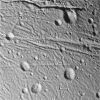
Enceladus-PIA06217.jpgCracks on Enceladus (and possible Anomaly)59 visiteCaption NASA originale:"During its very close flyby of Enceladus on March 9, 2005, Cassini took HR images of the icy moon that are helping scientists interpret the complex topography of this intriguing little world. This scene is an icy landscape that has been scored by tectonic forces. Many of the craters in this terrain have been heavily modified, such as the 10-Km-wide crater near the upper right that has prominent North-South fracturing along its northeastern slope".
Nota: è fortemente probabile che proprio al termine della frattura che taglia il frame nel suo margine superiore (Dx di chi guarda) vi sia una sorta di monolito (o comunque una struttura simile ad un pilastro) ad ore 1 del piccolo cratere che "chiude" il crepaccio (si nota, oltre all'ombra del bordo nord del cratere, anche l'ombra - MOLTO lunga! - di questo curioso rilievo).
Scherzo della prospettiva o un "nuovo monolito" (dopo le Lunar Spires - o Cuspidi di Blair - ed il Monolito di Phobos)?
(4 voti)
|
|

Janus-PIA06612.jpgJanus rides the Rings61 visiteCaption NASA originale:"Cassini was nearly in the plane of Saturn's Rings when it took this image of Janus. The nearly edge-on rings appear almost ribbon-like in this view and some surface detail is visible on the small moon. The image was taken in visible light with the Cassini spacecraft narrow-angle camera on Feb. 18, 2005, at a distance of approximately 911.000 Km from Janus and at a phase angle of 101°. The image scale is 5 Km per pixel".
(4 voti)
|
|

Telesto.jpgTelesto61 visiteCaption NASA originale:"Saturn's moon Telesto is visible below and to the left of center in this image from the Cassini spacecraft.
Telesto (only 24 Km across) shares the orbit of Saturn's moon Tethys (1.071 Km across), leading the larger moon in its path by 60°. Similarly sized Calypso (22 Km across) trails Tethys by the same amount. These positions, called Lagrange points, are dynamically stable. In being co-orbital moons of Tethys, Telesto and Calypso are like the Trojan moons of Jupiter, which occupy Lagrange points and orbit 60° ahead and behind of Jupiter. The Saturnian moon Dione also has companion moons: Helene, which leads Dione in its orbit and the Cassini-discovered trailing Lagrange moon, Polydeuces. This image was taken in visible light with the Cassini spacecraft narrow angle camera on Jan. 18, 2005, at a distance of approximately 3,7 MKM from Telesto. Resolution in the image is 7 Km per pixel. Telesto has been brightened by a factor of two to aid visibility".
(4 voti)
|
|

Enceladus-PIA07370.jpgThe atmosphere of Enceladus60 visiteCaption NASA originale:"The graphic shows the magnetic field observed by Cassini along its trajectory plotted in a vector form. Even though the spacecraft altitude was almost 500 Km (310 miles) at closest approach and the flyby was upstream of the moon (where the interaction is expected to be weaker) Cassini's magnetometer observed bending of the magnetic field consistent with its draping around a conducting object, which indicates that the Saturnian plasma is being diverted away from an extended atmosphere".
(4 voti)
|
|
| 2244 immagini su 187 pagina(e) |
 |
|
|
|
|
111 | |
|
|
|
|





