| Piú votate - Saturn: the "Ringed Beauty" and His Moons |

Hyperion-N00040363.jpgHyperion (20)105 visiteA soli 7500 Km di distanza da Hyperion (grazie ad immagini davvero molto belle - anche se non sappiamo sino a che punto davvero autentiche...) vediamo chiaramente che, all'interno di alcuni crateri, c'è qualcosa che ha uno spessore (o che sembra averlo).
Che cosa sono i rilievi contenuti nelle aree cerchiate in bianco? Secondo noi si tratta di "laghi" (ovviamente non pensiamo al concetto di laghi terrestri). Zone al cui interno si è "depositato" (o magari è "affiorato", dalle profondità di Hyperion?!?) qualcosa che, un tempo, poteva essere un fluido.
Queste sono le nostre speculazioni, basate sull'osservazione visuale e sulla nostra piccola esperienza. Ora dobbiamo aspettare che la NASA si pronunci sull'argomento...
(4 voti)
|
|
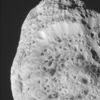
Hyperion-N00040276.jpgHyperion (7)58 visiteHyperion è a 32.000 Km e si avvicina rapidamente. Il filtro/colore usato per questa immagine non rende giustizia alle sfumature della superficie della "spongy-like Moon", come alla NASA chiamano Hyperion, ma avremo occasione di rifarci!
(4 voti)
|
|
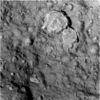
Tethys-N00040106.jpgTethys Fly-By (11)61 visiteSiamo a 18.700 Km da Tethys e questo frame, molto buono e di grande impatto, ci mostra un rilievo che a noi ricorda davvero moltissimo il Gula e/o anche il Maat Mons, su Venere.
Fantastichiamo? Verificate di persona: i due rilievi Venusiani sono stati inseriti nella Galleria dedicata a Venere.
Molto interessante, poi, in basso a Sx, il dettaglio di uno dei più grandi canyons che attraversano, un pò ovunque ed in tutte le direzioni, la superficie tormentatissima di Tethys.
(4 voti)
|
|
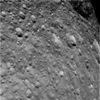
Tethys-N00040077.jpgTethys Fly-By (7)59 visitenessun commento
(4 voti)
|
|

Tethys-N00040067.jpgTethys Fly-By (5)58 visiteUn'immagine molto suggestiva del bordo di Tethys con la suggestione e la profondità conferite al paesaggio dall'incedere delle ombre le quali, come ben sapete, agiscono come "evidenziatori naturali" dei rilievi.
(4 voti)
|
|

Tethys-PIA07589.jpgOdysseus is "slicing" Tethis...55 visiteOriginal caption:"The profile of the 450-Km-wide (about 280 miles) Crater Odysseus makes this image look as if someone sliced off a chunk of Tethys. According to measurements made in Voyager images, the Crater rim rises to about 5 Km (approx. 3 miles) above the surrounding terrain.
This view shows territory eastward of a previously released Cassini view that looked more directly into the giant impact basin. Tethys' equatorial dark band can be seen here as well.
This view shows principally the Southern leading Hemisphere of Tethys. North is up and rotated 10° to the left.
The image was taken in visible light with the Cassini spacecraft narrow-angle camera on July 31, 2005, at a distance of approximately 1,3 MKM (approx. 800.000 miles) from Tethys and at a Sun-Tethys-spacecraft, or phase, angle of 18°. The image scale is 8 Km (about 5 miles) per pixel".
(4 voti)
|
|

Saturn-PIA07731-1.jpgSpokes (1)61 visiteAfter much anticipation, Cassini has finally spotted the elusive "spokes" in Saturn's Rings.
"Spokes" are the ghostly Radial Markings discovered in the Rings by NASA's Voyager spacecraft 25 years ago. Since that time, Spokes had been seen in images taken by NASA's Hubble Space Telescope but had not, until now, been seen by Cassini.
These three images, taken over a span of 27', show a few faint, narrow Spokes in the outer B-Ring. The Spokes are about 3500 Km (2200 miles) long and about 100 Km wide (60 miles). The motion of the Spokes here is from left to right.
They are seen just prior to disappearing into the Planet's shadow on the Rings.
(4 voti)
|
|

Mimas-N00037611.jpgMimas, from approx. 104.424Km61 visiteLa maggior parte di questi elementi - se non la totalità - in difetto di osservazioni dirette dell'impatto, dovrà essere dedotta da elementi circostanziali quali, ad esempio: 1) le dimensioni del cratere; 2) la forma del cratere; 3) la composizione della superficie impattata all'interno del cratere e nei suoi dintorni, sia quelli immediati, sia quelli più lontani (a tal riguardo è corretta l'analisi chimico-fisica degli ejecta; 4) la composizione del bolide (sempre ammesso che sia possibile trovarne qualche "pezzo" - non è da escludere, infatti, l'ipotesi di una totale annichilazione del corpo impattante al momento dell'impatto) e così via.
Ora, semplificando questa modesta trattazione il più possibile, ciò che possiamo dedurre - guardando un cratere come lo "Stickney Crater" di Phobos, oppure il "Copernicus Crater" della Luna e poi, naturalmente, il cratere che stiamo osservando ora e che chiamiamo "Occhio di Mimas" (ma il cui vero nome è "Herschel") - è che, in epoche remote, alcuni corpi celesti...
(4 voti)
|
|

Enceladus-PIA06433.jpgThe heat inside Enceladus...60 visiteThis image shows the warmest places in the South Polar Region of Enceladus. The unexpected temperatures were discovered by Cassini's Composite Infrared Spectrometer during a close flyby on July 14, 2005. The image shows how these temperatures correspond to the prominent, bluish fractures dubbed "Tiger Stripes". Such "warm" temperatures (91 and 89° Kelvin - about minus 296 and minus 299° Fahrenheit - are unlikely to be due to heating of the surface by the feeble sunlight striking Enceladus' South Pole. They are a strong indication that internal heat is leaking out of Enceladus and warming the surface along these fractures. Evaporation of this relatively warm ice probably generates the cloud of water vapor detected above Enceladus' South Pole by several other Cassini instruments. Scientists are unsure how the internal heat reaches the surface. The process might involve liquid water, slushy brine, or soft but solid ice.
(4 voti)
|
|

Enceladus-PIA06252.jpgEnceladus from about 208 Km58 visiteThe tortured southern polar terrain of Enceladus appears strewn with great boulders of ice in this fantastic view, one of the best HR images obtained so far by Cassini of any world.
Some smearing of the image due to spacecraft motion is apparent in this scene, which was acquired as Enceladus raced past Cassini's field of view near the time of closest approach. At the time, the imaging cameras were pointed close to the moon's limb, rather than directly below the spacecraft. This allowed for less motion blur than would have been apparent had the cameras pointed straight down. Thus, the terrain imaged here was actually at a distance of 208 Km from Cassini.
At this fine scale, the surface is dominated by ice blocks between 10 and 100 mt across. The origin of these icy boulders is enigmatic: scientists are interested in studying the sizes and numbers of the blocks in this bizarre scene and in understanding whether terrain covered with boulders is common on Enceladus.
(4 voti)
|
|

Saturn-PIA07545.jpgSaturn and Tethys59 visiteCaption NASA originale:"The majesty of Saturn overwhelms in this image from Cassini. Saturn's moon Tethys glides past in its orbit and the icy rings mask the frigid northern latitudes with their shadows. The image was taken in visible green light with the Cassini spacecraft wide-angle camera on June 10, 2005, at a distance of approx. 1,4 MKM (about 900.000 miles) from Saturn. The image scale is 80 Km (about 50 miles) per pixel".
(4 voti)
|
|
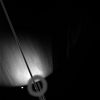
Saturn-W00009485.jpgHow many moons around Saturn? (3) - frame W0000948557 visiteQuesto è il frame che ci lascia più perplessi: la possibile Anomalia è nella coppia di punti luminosi che abbiamo evidenziato con una cerchiatura grigia. Siamo consapevoli del fatto che si possa trattare di photo-artifact, ma l'impressione/sensazione (purtroppo non spiegabile in termini tecnici e scientifici) è che, in realtà, stiamo guardando degli oggetti luminosi puntiformi in rapido movimento davanti alla fotocamera di Cassini.
Per la nostra esperienza in campo di fotografia spaziale, infatti, la coppia di luci che si vede - per ragioni prospettiche - proprio "sopra" gli anelli di Saturno (al pari degli altri due punti luminosi che vediamo sulla parte a Dx dell'immagine in alto) non pare proprio costituire il classico artefatto fotografico che abbiamo/avete già incontrato in altre migliaia di immagini similari (verificate Voi stessi).
Voi che ne dite?
(4 voti)
|
|
| 2244 immagini su 187 pagina(e) |
 |
|
|
|
|
109 | |
|
|
|
|





