| Piú votate - Saturn: the "Ringed Beauty" and His Moons |

Dione-N00041243.jpgDione's Fly-By (16): from about 1.835 Km56 visitenessun commento
(4 voti)
|
|

Dione-N00041240.jpgDione's Fly-By (15): from about 2.800 Km55 visitenessun commento
(4 voti)
|
|

Dione-N00041235.jpgDione's Fly-By (13): from about 4.000 Km55 visitenessun commento
(4 voti)
|
|
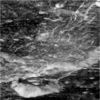
Dione-N00041227.jpgDione's Fly-By (12): from about 6.000 Km54 visitenessun commento
(4 voti)
|
|
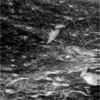
Dione-N00041225.jpgDione's Fly-By (11): from about 8.000 Km59 visitenessun commento
(4 voti)
|
|

Dione-N00041221.jpgDione's Fly-By (10): from about 10.000 Km58 visitenessun commento
(4 voti)
|
|

Dione-N00041210.jpgDione's Fly-By (9): from about 14.000 Km58 visitenessun commento
(4 voti)
|
|

Dione-N00041190.jpgDione's Fly-By (8): from about 26.000 Km60 visitenessun commento
(4 voti)
|
|

Dione-N00041054.jpgDione's Fly-By (1): from about 115.000 Km58 visitenessun commento
(4 voti)
|
|
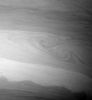
Saturn-PIA07600.jpgSaturnian Atmosphere: the "Cat's Eye"60 visiteOriginal caption:"During its time in orbit Cassini has already spotted many beautiful "Cat's Eye-shaped" patterns like the ones visible here. These patterns occur in places where the winds and the atmospheric density at one latitude are different from those at another latitude.
The opposing East-West flowing cloud bands are the dominant patterns seen here and elsewhere in Saturn's atmosphere. Contrast in the image was enhanced to aid the visibility of atmospheric features.
The image was taken with the Cassini spacecraft wide-angle camera on Aug. 20, 2005, at a distance of approx. 420.000 Km (about 261.000 miles) from Saturn using a filter sensitive to wavelengths of infrared light centered at 728 nnmts. The image scale is 22 Km (about 13 miles) per pixel".
(4 voti)
|
|
Saturn-PIA07599.jpgSaturnian Meteorology59 visitePrima del commento NASA ufficiale, un nostro commento: sappiamo che le immagini di Saturno (come quelle di Giove e degli altri Giganti Gassosi) non "incontrano" molto i gusti dei nostri Lettori. Peccato.
Peccato perchè questi Mondi non solo sono davvero affascinanti, ma anche perchè essi sono così grandi che basta solo riflettere per qualche istante sulle immagini che proponiamo per capire che cosa renda il nostro lavoro di Divulgatori così splendidamente "bello".
Pensate: state guardando delle formazioni nuvolose che caratterizzano gli strati superficiali dell'atmosfera di Saturno da quasi 500mila Km. Le osservate da quasi 500mila Km e le VEDETE! Capite che cosa vuol dire questo, in termini anche solo meramente "dimensionali"?!? Vuol dire che la Terra è davvero piccola. E che dire allora dell'Uomo il quale, rispetto alla Terra, è insignificante?!?...
Pensateci, prima di andare a guardare qualche altra immagine...
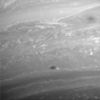
There is much to examine in detailed close-ups like this one of Saturn's atmosphere. Scientists are particularly interested in the bright, and in some places turbulent-looking, thin boundary between the large-scale features in the upper half of the image. The characteristic features of this thin boundary might be suggestive of a place where convection is occurring. Convection in Saturn's atmosphere occurs when sufficiently warm air at deeper levels rises to levels where it becomes less dense than the surrounding air.
Coverage on Saturn extends here from 18 degrees south to 50 degrees south latitude. Contrast in the image was enhanced to aid the visibility of atmospheric features.
The image was taken with the Cassini spacecraft wide-angle camera on Aug. 19, 2005, at a distance of approximately 487,000 kilometers (302,000 miles) from Saturn using a filter sensitive to wavelengths of infrared light centered at 752 nanometers. The image scale is 25 kilometers (16 miles) per pixel
(4 voti)
|
|

Tethys-PIA07736.jpgLandslides on Tethys (HR)57 visiteOriginal caption:"This view is among the closest Cassini images of Tethys' icy surface taken during the Sept. 24, 2005 flyby. This image is a clear-filter view and is the highest resolution image acquired by Cassini during the encounter. The two large craters at the right show evidence that landslides have modified their outlines and covered their floors with large quantities of debris. Linear depressions cutting across the terrain probably mark the surface expressions of faults or fractures.
This view is centered on terrain at approx. 4,2° South Latitude and 357° West Longitude on Tethys. The image has been rotated so that North on Tethys is up.
The view was obtained using the Cassini spacecraft narrow-angle camera at a distance of approx. 19.000 Km (about 11.800 miles) from Tethys and at a Sun-Tethys-spacecraft, or phase, angle of 17°.
Image scale is 110 mt (360 feet) per pixel".
(4 voti)
|
|
| 2244 immagini su 187 pagina(e) |
 |
|
|
|
|
108 | |
|
|
|
|





