| Piú votate - Saturn: the "Ringed Beauty" and His Moons |

Dione-N00048466.jpgSaturnshine over Dione58 visitenessun commento
(4 voti)
|
|

Dione&Co.-PIA07679.jpgProportions, dimensions, perspectives and distances...57 visiteOriginal caption:" Two of Saturn's battered, icy companions hover here, above the Ring-Plane.
To get a sense of the three-dimensional nature of the scene, note that the wide band of visible Rings is in between the two moons in this view from the Cassini spacecraft.
Mimas (397 Km, or 247 miles across, at left) is outside the far side of the Rings while Dione (1.126 Km, or 700 miles across) is outside the Rings and closer to Cassini.
The view is from just beneath the Ring-Plane and the image was taken in visible light, with the Cassini spacecraft narrow-angle camera on Dec. 18, 2005, at a distance of approx. 2,2 MKM (roughly 1,4 MMs) from Dione and 2,7 MKM (about 1,7 MMs) from Mimas. The image scale is 13 Km (about 8 miles) per pixel on Dione and 16 Km (about 10 miles) per pixel on Mimas".
(4 voti)
|
|

Rhea-N00048319.jpgFull Rhea83 visiteCaption originale:"N00048319.jpg was taken on January 17, 2006 and received on Earth January 18, 2006. The camera was pointing toward Rhea that, at the time, was approximately 245.031 Km away, and the image was taken using the CL1 and UV3 filters.
This image has not been validated or calibrated".
(4 voti)
|
|
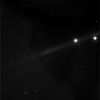
Saturn-E-Ring-W00012982.jpgOver-exposed Moons and the E-Ring58 visiteEscludendo che i due globi luminosi che vediamo in questo frame (in una posizione di quasi allineamento rispetto all'Anello E di Saturno) sìano dei photi-artifacts o degli UFO, la nostra sensibilità nell'analisi dei frames in arrivo dalla Sonda Cassini ci suggerisce l'idea che si tratti di due Lune di Saturno ampiamente sovraesposte.
Ma se ci chiedeste di quali Lune si tratta...Beh, non ci vergognamo di dire che questo proprio non lo sappiamo.
Caption originale:"W00012982.jpg was taken on January 11, 2006 and received on Earth January 12, 2006. The camera was pointing toward Saturn's E-Ring that, at the time, was approximately 2.048.891 Km away.
The image was taken using the CL1 and IRP90 filters and has not been validated or calibrated".
(4 voti)
|
|
Enygma-W00012854.jpgEnygma (2)59 visiteOriginal caption:"W00012854.jpg was taken on January 05, 2006 and received on Earth January 06, 2006. The camera was pointing toward SKY, and the image was taken using the CL1 and RED filters. This image has not been validated or calibrated".
(4 voti)
|
|

Dione-PIA07668.jpgIcy cliffs in the Sun...59 visiteAfter journeying a bit more than an hour across the Solar System, bright Sunlight reflects off the gleaming icy cliffs in the wispy terrain of Dione and is captured by the Cassini spacecraft's cameras several light seconds later.
Saturn's Ring-Plane is here tilted slightly toward the Cassini spacecraft and is bisected by the Planet's dark shadow stretching across the Rings.
This view looks toward the Saturn-facing Hemisphere on Dione.
The image was taken in visible light with the Cassini spacecraft narrow-angle camera on Dec. 3, 2005, at a distance of approx. 2,8 MKM (about 1,7 MMs) from Dione and at a Sun-Dione-spacecraft, or phase, angle of 104°. Resolution in the original image was roughly 17 Km (such as about 11 miles) per pixel on Dione. The image has been magnified by a factor of two and contrast-enhanced to aid visibility".
(4 voti)
|
|

Tethys-PIA07662.jpgGrand Canyon on Tethys69 visiteA crescent Tethys shows off its Grand Canyon, Ithaca Chasma, for which the moon is renowned. The chasm is about 100 Km (app.x 60 miles) across on average, and its up to 4 Km (about 2 miles) deep in places.
Ithaca Chasma is the most prominent sign of ancient geologic activity on Tethys, whose surface is characterized principally by heavy cratering.
The lit surface visible here is on the moon's Saturn-facing Hemisphere. North on Tethys is straight up.
The image was taken with the Cassini spacecraft narrow-angle camera on Nov. 28, 2005 using a filter sensitive to wavelengths of infrared light centered at 930 nnmts. The view was acquired from a distance of app.x 1,1 MKM (equivalento to about 700.000 miles) from Tethys and at a phase angle of 123°. Resolution in the original image was 6 Km (about 4 miles) per pixel. The image has been magnified by a factor of two and contrast-enhanced to aid visibility.
(4 voti)
|
|

Rhea-N00047136.jpgRhea60 visiteOriginal caption:"N00047136.jpg was taken on December 23, 2005 and received on Earth December 24, 2005. The camera was pointing toward RHEA that, at the time, was approximately 283.082 Km away.
The image was taken using the CL1 and IR3 filters".
(4 voti)
|
|

Dione-PIA07771.jpgBlack&White&Colors: Dione and Saturn62 visiteCool and icy Dione floats in front of giant Saturn bedecked in a dazzling array of colors.
The surface of Dione, which exhibits contrasting bright and dark areas when viewed up close, appears pale in this image. It is Saturn's multi-hued cloud bands that boldly steal the show. Discrete clouds and eddies in Saturn's Northern Hemisphere can be seen within the faint shadows of the Rings on the Planet. Cassini is in a phase of its mission in which its orbit will be nearly equatorial for some time. This view was obtained from about 1/3ed of 1° out of the Ring-Plane.
Images taken with red, green and blue filters were used to create this natural-color view.
The images were obtained with the wide-angle camera on Sept. 22, 2005, from a distance of approx. 803.000 Km (roughly 499.000 miles) from Dione and at a phase angle of about 43°.
The image scale is about 48 Km (30 miles) per pixel.
(4 voti)
|
|

Saturn-PIA07656.jpgA "Dry Hurricane" on Saturn!57 visiteAn oval-shaped feature, wider than Earth and with streamers extending out to the East and West, swirls in Saturn's Southern Hemisphere.
Like the rainbands of a Southern Hemisphere hurricane on Earth, the streamers spiral into the feature in a clockwise direction.
Unlike Earth's hurricanes, this storm probably contains no liquid water.
The Planet's equatorial Rings cut across the top of the image.
The image was taken in wavelengths of polarized infrared light with the Cassini spacecraft wide-angle camera on Oct. 30, 2005, at a distance of approximately 324.000 Km (appx. 202.000 miles) from Saturn. The image scale is about 32 Km (appx. 20 miles) per pixel.
(4 voti)
|
|

Saturn-W00012439.jpgSaturn and some of His Moons59 visiteHow thin are the Rings of Saturn? Brightness measurements from different angles have shown Saturn's rings to be about 1 Km thick, making them many times thinner, in relative proportion, than a razor blade. This thinness sometimes appears in dramatic fashion during an image taken nearly along the Ring-Plane. The Cassini spacecraft now orbiting Saturn has captured another shot that dramatically highlights the Ring's thinness. The above artistic looking image was taken early last month in infrared polarized light. If alone in space, the unlit part of Saturn would be much darker. Reflection of light off of moons (...) and the billions of small particles in Saturn's Rings, however, gives the giant space orb an unusual glow, an effect highlighted in polarized light.
W00012439.jpg was taken on December 17, 2005 and received on Earth December 18, 2005. The camera was pointing toward PROMETHEUS from a distance of approximately 2.830.065 Km.
The image was taken using the CL1 and CL2 filters.
(4 voti)
|
|

Enceladus-PIA06443.jpgThe biggest "Geyser" in the Solar System: the Enceladus' Fountain61 visiteDuring a non-targeted flyby by the Cassini spacecraft of Enceladus on Nov. 26, 2005, the Cassini's Visual and Infrared Mapping Spectrometer (VIMS) measured the spectrum of the plumes originating from the South Pole of the icy moon. The instrument captured a very clear signature of small ice particles in the plume data, at the 2,9 micron wavelength. This image of Enceladus, taken with the VIMS, shows not only the plume over the South Pole, but also the dark side of the moon, silhouetted against a foggy background of light from the E-Ring.
The bottom graph shows the measurements of the spectrum, of this background light. It shows a very similar signature of small ice particles to that in the plumes, confirming earlier expectations that Enceladus is indeed the source of the E-Ring.
Preliminary analyses suggest that the average size of the particles in the plume is about 10 microns (or 1/100.000 of a meter). The particles in the E-Ring are about 3 times smaller.
The sunlit surface of Enceladus itself, visible as a thin crescent at the bottom of the image, is also composed of water ice, but with a much larger grain size than the plume.
(4 voti)
|
|
| 2244 immagini su 187 pagina(e) |
 |
|
|
|
|
105 | |
|
|
|
|





