| Piú votate - Saturn: the "Ringed Beauty" and His Moons |
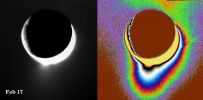
Enceladus-PIA07798.jpgEnceladus' active South Pole (1)61 visitePlumes of icy material extend above the Southern Polar Region of Enceladus, as imaged by the Cassini spacecraft in February 2005. The monochrome view is presented along with a color-coded version on the right. The latter reveals a fainter and much more extended plume component.
Images like these are being analyzed by scientists as they seek to explain the processes that could be producing such incredible features. As reported in the journal Science on March 10, 2006, imaging scientists believe that the plumes are geysers erupting from pressurized subsurface reservoirs of liquid water above 273 degrees Kelvin (0° C.).
Another plume view was taken 1 month earlier and looks broadside at the moon's prominent "Tiger Stripe" fractures. In the January view, the plume appears to have a single component. The February view looks along the Tiger Stripe fractures and reveals both a large and a small component to the plume; the smaller, fainter component is separated from the main plume by about 100 Km.
(4 voti)
|
|
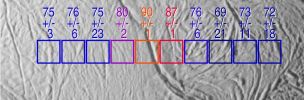
Enceladus-PIA07794.jpgEnceladus' surface temperatures (2)60 visiteEnhanced thermal emission is seen in the vicinity of the prominent "Tiger Stripe" fissures discovered by the imaging cameras.
In these images, the excess emission is most strongly seen in the left-most composite Infrared Spectrometer field of view, which includes a fissure near the end of one of the Tiger Stripes. The peak temperatures, 86 and 90 Kelvin (such as about -305 and -298 Fahrenheit) respectively, are averages over the Composite Infrared Spectrometer field of view, and other composite Infrared Spectrometer data suggest that much higher temperatures, up to at least 145 Kelvin (such as -199 Fahrenheit), occur in narrow zones a few hundred meters wide along the Tiger Stripe fissures.
The 1st image is centered near long. 135° W. and lat. 65° S. and each square from the composite infrared spectrometer field of view is about 17,5 Km (approx. 10,9 miles) across.
The 2nd image was taken nearly 3 times closer to Enceladus and is centered near long. 120° W, lat. 82° S.
(4 voti)
|
|
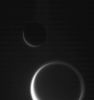
Tethys&Titan-PIA08124.jpgDancing in the dark59 visiteGhostly details make this dark scene more than just a beautiful grouping of two Saturn moons: Tethys and Titan.
In Titan's thick and inflated atmosphere, the detached high haze layer can be seen, as well as the complex Northern Polar "hood". Images like this one can help scientists make definitive estimates of the altitudes to which the high haze extends.
The faint vertical banded pattern is a type of noise that usually is removed during image processing.
Since this image was processed to enhance the visibility of details in Titan's atmosphere as well as in the faint G-Ring, the vertical noise was also enhanced.
This view was obtained in visible light with the Cassini spacecraft narrow-angle camera on Jan. 19, 2006, at a distance of approx. 2,4 MKM (such as about 1,5 MMs) from Titan and 1 MKM (about 600.000 miles) from Tethys. The image scale is 14 Km (about 9 miles) per pixel on Titan and 6 Km (about 4 miles) per pixel on Tethys.
(4 voti)
|
|

Mimas&Saturn-PIA08122.jpgThe King and I...59 visiteA small and battered reminder of the Solar System's violent youth, the ice moon Mimas hurtles around its gas giant parent, Saturn.
With its "poor dimensions" (Mimas is only about 397 Km across), this little moon is dwarfed by the immensity of Saturn (the Ringed Gas Planet is more than 150 times as wide as Mimas).
Mimas is seen here against the night side of Saturn and Saturn itself is faintly lit by sunlight reflecting off its Rings.
The image was taken in visible light with the Cassini spacecraft narrow-angle camera on Jan. 20, 2006, at a distance of approx. 1,4 MKM (such as about 900,000 miles) from Mimas and at a Sun-Mimas-spacecraft, or phase, angle of 145°. Image scale is about 9 Km (approx. 5 miles) per pixel.
(4 voti)
|
|

Tethys-N00051464.jpgTethys56 visitecaption originale:"N00051464.jpg was taken on February 25, 2006 and received on Earth February 26, 2006. The camera was pointing toward Tethys that, at the time, was approximately 152.812 Km away.
The image was taken using the UV1 and CL2 filters.
This image has not been validated or calibrated".
Nota: un frame davvero splendido, che ci mostra non solo la "tessitura" della superficie di Tethys (curiosamente lineare, almeno in apparenza), ma anche i dettagli di alcuni rilievi le cui immagini chiare e ravvicinate (ma davvero "chiare"!) farebbero sicuramente la felicità di tanti Studiosi di Scienze Planetarie. Ed ora guardate bene: siete certi che l'origine dei crateri che vediamo sia proprio - senza alcun dubbio - "da impatto"?...
(4 voti)
|
|
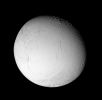
Enceladus-PIA07709.jpgEnceladus: a VERY active moon... (2)56 visiteWrinkles and cracks have reworked the surface of Enceladus, perhaps due to the influence of tidal stresses. The monochrome view also makes it clear that certain geological provinces on the moon have been altered by the activity, erasing ancient craters, while other places have retained much of the cratering record.
The terrain seen here is on the Trailing Hemisphere of Enceladus; North is up.
This image was taken using a near infrared spectral filter sensitive to wavelengths of light centered at 752 nnmts. The view was obtained using the Cassini spacecraft narrow-angle camera on Jan. 17, 2006 at a distance of approx. 153.000 Km (about 95.000 miles) from Enceladus and at a phase angle of 29°. Image scale is about 912 mt (such as approx. 2.994 feet) per pixel.
Nota: i 4 Giganti Gassosi (Giove, Saturno, Urano e Nettuno) sono mondi circondati da tante lune, alcune delle quali ancora geologicamente attive, a dispetto delle loro dimensioni e della enorme - e via-via crescente - distanza di questi Sistemi dal Sole. Pensate, p.e., ad Io ed Europa (per Giove); a Titano ed Encelado (per Saturno) ed infine ad Ariel (per Urano) e Tritone (per Nettuno). I piccoli mondi rocciosi, invece, hanno poche lune (o nessuna, come Venere e Mercurio) e queste lune NON sembrano - il dubitativo è d'obbligo - essere geologicamente attive. Il caso del Sistema Multiplo di Plutone va trattato a parte. Tutto ciò premesso, che cosa si può dedurre? Forse che la "Gioventù Geologica" di una piccolo pianeta roccioso (una "luna") dipende anche dalle caratteristiche del suo "Mondo Madre"? I 4 Giganti Gassosi emettono enormi quantitativi di radiazioni e posseggono caratteristiche tali da farli rassomigliare, ora più ed ora meno, a piccole "stelle mancate": questa circostanza potrebbe avere un peso?
(4 voti)
|
|
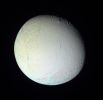
Enceladus-PIA07708.jpgEnceladus: a VERY active moon... (1)55 visiteA false color look reveals subtle details on Enceladus that are not visible in natural color views. The now-familiar bluish appearance (in false color views) of the Southern "Tiger Stripes" features and other relatively youthful fractures is almost certainly attributable to larger grain sizes of relatively pure ice, compared to most surface materials.
On the Tiger Stripes, this coarse-grained ice is seen in the colored deposits flanking the fractures as well as inside the fractures. On older fractures in other areas of Enceladus, the blue ice mostly occurs on the exposed wall scarps.
The color difference across the moon's surface (a subtle gradation from upper left to lower right) could indicate broad-scale compositional differences across the moon's surface. It is also possible that the gradation in color is due to differences in the way the brightness of Enceladus changes toward the limb, a characteristic which is highly dependent on wavelength and viewing geometry.
(4 voti)
|
|

Tethys-PIA07698.jpgSmiling Tethys...58 visiteCaption originale:"The profile of Ithaca Chasma forms a great scar in the icy crescent of Tethys. The chasm stretches more than a 1.000 Km (about 620 miles) over Tethys' surface, from North to South.
The image was taken in visible light with the Cassini spacecraft narrow-angle camera on Dec. 25, 2005 at a distance of approximately 313.000 Km (about 195.000 miles) from Tethys and at a Sun-Tethys-spacecraft, or phase, angle of 151°. Image scale is about 2 Km (approx. 1 mile) per pixel".
(4 voti)
|
|

Rhea-N00049536.jpgRhea and Companions (1)59 visiteCaption originale:"N00049536.jpg was taken on January 27, 2006 and received on Earth January 29, 2006. The camera was pointing toward Rhea that, at the time, was approximately 3.011.853 Km away, and the image was taken using the CL1 and CL2 filters".
(4 voti)
|
|

Dione-PIA07691.jpgDione's faulted surface (HR - enhanced colors)58 visiteCaption originale:"(...) To create this enhanced-color view, ultraviolet, green and infrared images were combined into a single black and white picture that isolates and maps regional color differences. This "color map" was then superposed over a clear-filter image.
The origin of the color differences is not yet understood, but may be caused by subtle differences in the surface composition or the sizes of grains making up the icy soil.
Even this view looks toward the Leading Hemisphere on Dione. North is up and rotated 20° to the right.
All the images were acquired with the Cassini spacecraft narrow-angle camera on Dec. 24, 2005 at a distance of approximately 151.000 Km(about 94.000 miles) from Dione and at a phase angle of 99°.
Image scale is approx. 896 mt (about 2.940 feet) per pixel".
(4 voti)
|
|

Rhea-PIA07686.jpgRhea (enhanced but real colors) from about 341.000 Km59 visiteOriginal caption:"This close view of Rhea prominently shows two large impact basins on the ancient and battered moon. The great age of these basins is suggested by the large number of smaller craters that are overprinted within them.
Terrain visible in this view is on the side of Rhea that faces away from Saturn. North on Rhea is up and tilted 30° to the left. This enhanced color view was created by combining images taken using filters sensitive to ultraviolet, visible green and infrared light.
The images were taken with the Cassini spacecraft narrow-angle camera on Dec. 23, 2005, at a distance of approximately 341.000 Km (approx. 212.000 miles) from Saturn and at a Sun-Saturn-spacecraft, or phase, angle of 42°. The image scale is approx. 2 Km (a little more than 1 mile) per pixel".
(4 voti)
|
|

Japetus-N00049173.jpgTwo-faced Japetus57 visiteOriginal caption:"N00049173.jpg was taken on January 24, 2006 and received on Earth January 25, 2006. The camera was pointing toward Japetus that, at the time, was approximately 954.836 Km away.
The image was taken using the CL1 and CL2 filters".
(4 voti)
|
|
| 2244 immagini su 187 pagina(e) |
 |
|
|
|
|
104 | |
|
|
|
|





