| Piú votate - Saturn: the "Ringed Beauty" and His Moons |

Rhea-N00055743.jpgMoments of Rhea (5)58 visitenessun commento
(4 voti)
|
|

Rhea-N00055739.jpgMoments of Rhea (4)58 visitenessun commento
(4 voti)
|
|

Rhea-N00055720.jpgMoments of Rhea (1)66 visitenessun commento
(4 voti)
|
|

Mimas-N00055634.jpgMimas (3)65 visiteCaption originale:"N00055634.jpg was taken on March 21, 2006 and received on Earth March 22, 2006. The camera was pointing toward Mimas that, at the time, was approximately 191.303 Km away.
The image was taken using the P0 and MT2 filters".
(4 voti)
|
|

Mimas-N00055602.jpgMimas (1)56 visitenessun commento
(4 voti)
|
|

Epimetheus-N00055513.jpgThe Runners...Again!57 visiteCaption NASA originale:"N00055513.jpg was taken on March 20, 2006 and received on Earth March 20, 2006. The camera was pointing toward Epimetheus that, at the time, was approximately 452.867 Km away.
This image was taken using the CL1 and CL2 filters and it has not been validated or calibrated".
(4 voti)
|
|
Saturn-N00055391.jpgWhat is rising? (2)56 visiteCaption NASA originale:"N00055391.jpg was taken on March 20, 2006 and received on Earth March 20, 2006. The camera was pointing toward Saturn that, at the time, was approximately 601.921 Km away.
This image was taken using the UV2 and CL2 filters and it has not been validated or calibrated".
(4 voti)
|
|

Rhea&Pandora-PIA08136.jpgRhea and Pandora57 visiteCaption NASA originale:"Distant Rhea poses here for the Cassini, as Pandora hovers against Saturn's dark shadow on the Rings.
This image was taken in visible light with the Cassini spacecraft narrow-angle camera on Feb. 12, 2006, at a distance of approx. 3,6 MKM (2,3 MMs) from Pandora and 4,3 MKM (2,7 MMs) from Rhea. The image scale is 26 Km (about 16 miles) per pixel on Rhea".
(4 voti)
|
|

Tethys&Dione-PIA08134.jpgCrossing Spheres59 visiteCaption originale:"Dione steps in front of Tethys for a few minutes in an occultation - or "mutual event". These events occur frequently for the Cassini spacecraft when it is orbiting close to the Ring-Plane.
The image was taken in visible red light with the Cassini spacecraft narrow-angle camera on Feb. 10, 2006, at a distance of approx. 3,7 MKM(such as about 2,3 MMs) from Dione and approx. 4 MKM (about 2,5 MMs) from Tethys. Resolution in the original image was about 22 Km (approx. 14 miles) per pixel on Dione and about 24 Km (approx. 15 miles) per pixel on Tethys.
The image has been magnified by a factor of two.
(4 voti)
|
|

Enceladus-PIA07800f-1~0.jpgEnceladus (2) - detail mgnf and HR58 visiteThe global mosaic of Enceladus was created from 21 false-color frames taken during the Cassini spacecraft's close approaches to Enceladus on March 9 and July 14, 2005. Images taken using filters sensitive to ultraviolet, visible and infrared light (spanning wavelengths from 338 to 930 nnmts) were combined to create the individual frames.
The mosaic is an orthographic projection centered at 46,8° South Lat. and 188° West Long. and has an image scale of 67 mt (about 220 feet) per pixel. The original images ranged in resolution from 67 mt per pixel to 350 mt were taken at distances ranging from 11.100 to 6.300 Km from Enceladus.
(4 voti)
|
|
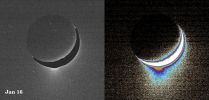
Enceladus-PIA07801.jpgEnceladus' active South Pole (2)58 visiteThese images were taken with the Cassini spacecraft narrow-angle camera at a distance of approximately 209.400 Km (about 130.100 miles) from Enceladus at a phase angle of 148°. The image scale is about 1,3 Km (0,8 mi) per pixel.
The mosaic is an orthographic projection centered at 46,8° South Lat. and 188° West Long. and has an image scale of 67 mt (about 220 feet) per pixel. The original images ranged in resolution from 67 mt per pixel to 350 mt (about 1.150 feet) per pixel and were taken at distances ranging from 11.100 to 61.300 Km from Enceladus.
(4 voti)
|
|
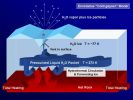
Enceladus-PIA07799.jpgEnceladus' Geysers Model60 visiteAs Saturn's active moon Enceladus continues to spew icy particles into space, scientists struggle to understand the mechanics of what is going on beneath the fractured south polar terrain. This graphic illustrates key aspects of the model proposed by the Cassini imaging science team in a paper published in the journal Science on March 10, 2006.
The model shows how proposed underground reservoirs of pressurized liquid water above 273 degrees Kelvin (0° Celsius) could fuel geysers that send jets of icy material into the skies above the moon's south pole. In the graphic, the vent to the surface pierces one of the "tiger stripe" fractures seen in Cassini views of the Southern Polar Terrain. Temperatures increase with depth.
Some combination of internal radioactive decay and flexing--perhaps concentrated within the tiger stripe fractures and brought about by the particular characteristics of Enceladus' orbit--is implicated as the source of the heat creating the liquid reservoirs. However, it is not yet clear how the deep interior of Enceladus functions, nor whether the moon is fully differentiated (separated into layers, with rock at the center and ice outside).
(4 voti)
|
|
| 2244 immagini su 187 pagina(e) |
 |
|
|
|
|
103 | |
|
|
|
|





