| Piú votate - Saturn: the "Ringed Beauty" and His Moons |

Janus-N00060322.jpgLonely Janus...73 visiteCaption NASA:"N00060322.jpg was taken on April 29, 2006 and received on Earth April 29, 2006. The camera was pointing toward Janus that, at the time, was approximately 225.386 Km away.
The image was taken using the P120 and GRN filters. This image has not been validated or calibrated".
(4 voti)
|
|

The Rings-PIA08163-2.jpgThe "E-Ring" of Saturn: the "Enceladus Ring" (2)58 visiteThis appearance implies that the particles in this part of the Ring have nonzero inclinations (a similar affect is seen in Jupiter's Gossamer Ring). An object with a nonzero inclination does not orbit exactly at Saturn¿s Ring-Plane: its orbit takes it above and below it. Scientists are not entirely sure why the particles should have such inclinations, but they are fairly certain that the reason involves Enceladus. One possible explanation is that all the E-Ring particles come from the plume of icy material that is shooting due South out of the moon's Pole.
This means all of the particles are created with a certain velocity out of the Ring-Plane, and then they orbit above and below that plane.
Another possible explanation is that Enceladus produces particles with a range of speeds, but the moon gravitationally scatters any particles that lie very close to the Ring-Plane, giving them nonzero inclinations. Stray light within the camera system is responsible for the broad, faint "Y" shape across the image.
The image was taken in visible light with the Cassini spacecraft wide-angle camera on March 15, 2006, at a distance of approximately 2.4 million kilometers (1.5 million miles) from Saturn. The image scale on the sky at the distance of Saturn is 142 kilometers (88 miles) per pixel.
(4 voti)
|
|

Saturn-PIA08159.jpgCrescent Moons (1)62 visiteCaption NASA originale:"The tilted crescent of Saturn displays lacy cloud bands here along with a bright Equatorial Region and threadlike ring shadows on the Northern Hemisphere. Three moons are visible here: Mimas (397 Km, or about 247 miles across) at left and faint, is aligned with the Ring-Plane. At right are Rhea (1.528 Km, or about 949 miles across, at top) and Tethys (1.071 Km, or 665 miles across, below Rhea).
The image was taken in polarized infrared light with the Cassini spacecraft wide-angle camera on March 11, 2006, at a distance of approximately 2,8 MKM (approx. 1,8 MMs) from Saturn.
The image scale is roughly 166 Km (about 103 miles) per pixel".
(4 voti)
|
|

Japetus-N00056325.jpgDarker than the Night!58 visiteCaption originale:"N00056325.jpg was taken on April 07, 2006 and received on Earth April 08, 2006. The camera was pointing toward Japetus that, at the time, was approximately 923.304 Km away.
The image was taken using the CL1 and CL2 filters. This image has not been validated or calibrated".
(4 voti)
|
|

Tethys-PIA08149.jpgPenelope is always waiting...61 visiteCaption NASA originale:"This dramatic close-up of Tethys shows the large crater Penelope lying near center, overprinted by many smaller, younger impact sites. Three smaller impact features of roughly similar size make a line left of Penelope that runs North-South: (from bottom) Ajax, Polyphemus and Phemius.
Features on Tethys are named for characters and places from "The Iliad" and "The Odyssey". The largest impact structure on Tethys is named Odysseus.
This view is toward the Saturn-facing Hemisphere on Tethys and North is up.
This image was taken in polarized ultraviolet light with the Cassini spacecraft narrow-angle camera on Feb. 25, 2006 at a distance of approximately 165.000 Km (about 103.000 miles) from Tethys and at a Sun-Tethys-spacecraft, or phase, angle of 23°.
Image scale is about 984 meters (approx. 3.227 feet) per pixel".
(4 voti)
|
|

Japetus-N00056228.jpgA little slice of light...56 visiteCaption originale:"N00056228.jpg was taken on April 01, 2006 and received on Earth April 02, 2006. The camera was pointing toward Iapetus that, at the time, was approximately 1.867.469 Km away, and the image was taken using the CL1 and IR1 filters".
(4 voti)
|
|
Rhea&Dione-N00056096.jpgIn-transit: Dione and Rhea (10)56 visitenessun commento
(4 voti)
|
|

Rhea&Dione-N00056095.jpgIn-transit: Dione and Rhea (9)59 visitenessun commento
(4 voti)
|
|

Rhea&Dione-N00056090.jpgIn-transit: Dione and Rhea (4)59 visitenessun commento
(4 voti)
|
|
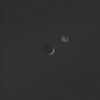
Rhea&Dione-N00056087.jpgIn-transit: Dione and Rhea (1)59 visiteUna delle centinaia (anzi: migliaia) di eclissi interplanetarie alle quali la Sonda Cassini può assistere durante il suo viaggio.
Questa volta le due lune che si incrociano sono Rhea e Dione, entrambe illuminate (ad eccezione di un leggerissimo spicchio) solo dal Saturnshine, o "chiaro di Saturno".
Splendido.
(4 voti)
|
|

Rhea-N00055844.jpgCrescent Rhea (2)58 visitenessun commento
(4 voti)
|
|

Rhea-N00055757.jpgMoments of Rhea (6)71 visiteCerchiature Bianche: due bizzarri crateri esagonali (quello di Sx sembra un esagono quasi regolare...).
Il Prof. Hoagland, parlando di Giapeto, per un rilievo simile si sbilanciò parlando di "...simmetrie evidenti... - ergo di - ...chiare origini artificiali...".
Tuttavia, sui pentagoni e gli esagoni di Rhea (addirittura - come questi - più regolari e definiti del rilievo Giapetiano) nonchè su alcune (curiose) linee che la attraversano per Km e Km (linee - apparentemente - lisce e dritte come autostrade), Hoagland non ha detto nulla.
Sarà perchè, forse, non se n'è accorto...
(4 voti)
|
|
| 2244 immagini su 187 pagina(e) |
 |
|
|
|
|
102 | |
|
|
|
|





