| Piú votate - Deep Sky Objects |

Fomalhaut-HST.jpgA ring of debris around Fomalhaut - HST136 visite"...Fra i diversi Strumenti per il Controllo di Massa di cui abbiamo parlato ce n'è uno che merita particolare attenzione e che si chiama "Deviatore".
Il suo funzionamento è semplicissimo; il rendimento, enorme.
L'uso del Deviatore viene precognizzato dal Trattato di T.W. Veerwaandt sul "Controllo degli Organismi Senzienti e degli Elementi Devianti" e già in quella fonte si prevede l'impiego, come Meccanismi Diffusori, della Televisione (primariamente) e della Letteratura Secondaria o Terziaria - detta anche "Letteratura Vile" - in misura minore.
Si tratta, detto in maniera davvero semplicissima, di far parlare e di far interagire con le Masse degli individui (che chiameremo "Testimonial") i quali non hanno, rispettivamente, nulla da dire né da trasmettere.
Il Deviatore ha il compito primario di distogliere l'attenzione delle Masse dalla focalizzazione dei loro interessi su talune problematiche di primario interesse Sociale, Culturale e Scientifico..."
P.C. Floegers - "Mind Numbing Methods"
(15 voti)
|
|

UFO-1-PIA07250.jpgFar distant galaxies and a UFO in front of the GALEX telescope! (1)98 visiteCaption NASA originale:"Galaxies aren't the only objects filling up the view of NASA's Galaxy Evolution Explorer. Since its launch in 2003, the space telescope (originally designed to observe galaxies across the universe in ultraviolet light) has discovered a festive sky blinking with flaring and erupting stars, as well as streaking asteroids, satellites and space debris. One such streaking object - possibly an Earth-orbiting satellite - can be seen here flying across the telescope's sight.
This probable satellite appears during the last 5' of a 13,5' observation. It looks elongated because each picture frame containing the moving object is 19" long. Faint ghost images on either side of the source are detector artifacts caused by the object's extreme brightness. These 'Bonus Objects' are being collected in to Public Catalogues for other Astronomers to study".
Bonus Objects. Un nuovo modo di classificare gli UFO? Un frame intrigante ed un commento ufficiale asciutto, ma possibilista: qualcosa si muove?!?
(15 voti)
|
|

HD 209458b.jpgPlanet HD 209458b144 visiteDa "NASA - Picture of the Day" del 5 Aprile 2005:"Light emitted by a planet far beyond our Solar System has been identified for the first time. The planet, illustrated in the above drawing, had its light detected by comparing the brightness of only the parent star, when the planet was behind the star, to the light emitted when both the planet and its parent star were visible. The Earth-orbiting Spitzer Space Telescope made the observation in infrared light, where the intrinsic glow of the planet outshines the light it reflects from its central star. The direct observation of light allowed a measurement of both the temperature and size of the planet: HD 209458b. Planet HD 209458b was confirmed to be larger than expected for its mass and on an orbit around its parent star that was unexpectedly close to a circle".
(15 voti)
|
|

Puppis A.jpgPuppis A - supernova remnant95 visite"...Qui nescit tacere nescit et loqui..."
(Seneca)
"...Chi non è capace di tacere, non sa neppure parlare..."
(15 voti)
|
|

Fomalhaut-PIA04942.jpgFomalhaut and its "Dust Disk"125 visiteCaption NASA originale:"The NASA SST has obtained the first infrared images of the dust disc surrounding Fomalhaut, the 17th brightest star in the sky. Planets are believed to form from such a flattened disc-like cloud of gas and dust orbiting a star very early in its life. The Spitzer telescope was designed in part to study these circumstellar discs, where the dust particles are so cold that they radiate primarily at infrared wavelengths. Located in the constellation Piscis Austrinus, the parent star and its putative planetary system is found at a distance of 25 light-years. The 70-micron image (lower left) clearly shows an asymmetry in the dust distribution, with the southern lobe one-third brighter than the northern. Such an unbalanced structure could be produced by a collision between moderate-sized asteroids in the recent past (releasing a localized cloud of dust) or by the steering effects of ring particles by the gravitational influence of an unseen planet".
(15 voti)
|
|
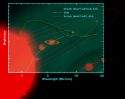
Graph-PIA07336.jpgA Brown-Dwarf's planetary system and the Solar System146 visiteThis artist's conception shows the relative size of a hypothetical brown dwarf-planetary system (below) compared to our own solar system. A brown dwarf is a cool or "failed" star, which lacks the mass to ignite and shine like our Sun. NASA's SST set its infrared eyes on an extraordinarily low-mass brown dwarf called OTS 44 and found a swirling disc of planet-building dust. At only 15 times the mass of Jupiter, OTS 44 is the smallest known brown dwarf to host a planet-forming, or protoplanetary, disc.
Astronomers believe that this unusual system will eventually spawn planets. If so, they speculate that OTS 44's disc has enough mass to make one small gas giant and a few Earth-sized rocky planets. Examples of these possible planets are depicted at the bottom of this picture, circling a low-mass brown dwarf. Above, the bodies of our own Solar System have been drawn to the same scale. In each system, the terrestrial planets have been enlarged and the distances between them and their parent bodies scaled down.
(15 voti)
|
|

V-838_Mon-03.jpgV-838 Monocerotis: a young "Binary System"81 visite"...Animo cupienti nihil satis festinatur..."
(Sallustio)
"…Nulla viene conseguito abbastanza in fretta per colui che desidera con tutto sé stesso…"
(15 voti)
|
|

RCW 38.jpgRCW 38 Star Cluster in Vela95 visite"...Brevis a Natura nobis Vita data est; at memoria bene redditae Vitae sempiternae..."
(Cicerone)
"...Breve è il Tempo (Vita) concessoci dalla Natura; ma eterna è la memoria di una Vita spesa bene..."
(15 voti)
|
|

Doradus Nebula - HST.jpgDoradus Nebula - HST91 visite"...Bonis nocet quisquis pepercit malis..."
(Binder)
"...Non punire i malfattori è deleterio per gli onesti..."
(15 voti)
|
|
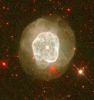
NGC-6578-02.jpgNGC 657880 visite"...There are many bridges between our World and Worlds beyond the one we know..."
(anonimo)
(15 voti)
|
|

N 11.jpgN 11 - A "Ring of Nebulae" inside the Large Magellanic Cloud114 visiteUna delle più grandi nebulose sino ad ora scoperte si è rivelata, in realtà, come un complesso anello di nebulose ad emissione minori, fra loro connesse da filamenti di gas luminoscenti. Questa curiosa struttura, conosciuta come N 11, si estende per oltre 1000 A.L. e si trova all'interno della Grande Nube di Magellano, la maggiore Galassia-Satellite della nostra Via Lattea. Al centro dell'immagine è ben visibile un ammasso stellare aperto (conosciuto come LH 9 - o anche NGC 1760), composto da circa 50 giovani stelle azzurre le quali sono responsabili dell'emissione della radiazione che ha letteralmente "eroso" l'area ad esse circostante, liberandola dai gas interstellari.
L'ipotesi più accreditata circa la formazione di N11 è che le diverse nebulose siano i residui di un gruppo di stelle aventi origini comuni, ma età differenti.
La regione più brillante, infine, visibile appena sopra il centro dell'immagine, è conosciuta come N 11-B, una "fucina di stelle", forse oggi ancora attiva.
(15 voti)
|
|

NGC-6369.jpgNGC 6369 - HST (?)126 visite"...Ex parvis, saepe, magnarum momenta rerum pendent..."
(Livio)
"...Da piccole cose, sovente, possono nascere grandi eventi..."
(15 voti)
|
|
| 1039 immagini su 87 pagina(e) |
 |
|
|
|
|
20 | |
|
|
|
|








