| Piú votate - Deep Sky Objects |

RY-Tau_gemini_f.jpgRY Tauri71 visite"...Lear si ribellava senza risparmiarsi contro l'arbitrio fatto Legge di coloro che esercitavano il diritto del più forte, per ritirarsi, deluso e sconcertato, quando gli stessi uomini al cui fianco si era posto per cercarne il riscatto, diventavano i nuovi tiranni contro cui combattere...
E così, la voglia di Verità e di Onestà un po' alla volta lo allontanarono da quegli uomini stupidi e violenti, avvicinandolo sempre più a quel piccolo punto luminoso il cui fascino, in fondo, stava nell'enorme distanza che lo separava da quel mondo falso e violento al quale lui non voleva più appartenere.
Una Stella lontana, a cui chiedere asilo per non assistere allo scempio che l'uomo stava compiendo di se stesso.
Un luogo dove poter vivere in armonia con il Creato e con Dio.
Viaggiò tra i Sistemi Solari con questa speranza, ma comprese troppo tardi che l'isola che cercava era già dentro di lui..."
G. Spina - "Una Sera attorno al Fuoco"
(16 voti)
|
|

NGC-0104.jpgNGC 104 alias 47 Tucanae - Globular Star Cluster108 visite"...I tell you, whatever you ask for in prayer, believe that you have received it, and it will be yours..."
Mark, 11:24
(16 voti)
|
|
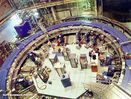
G - 2.jpgAnother Universe behind our Universe?154 visiteHow fast do fundamental particles wobble? A surprising answer to this seemingly inconsequential question has come out of Brookhaven National Laboratory in New York, USA and may not only indicate that the Standard Model of Particle Physics is incomplete but also that our universe is filled with a previously undetected type of fundamental particle. Specifically, the muon, a particle with similarities to a heavy electron, has had its relatively large wobble under scrutiny since 1999 in an experiment known as g-2 (gee-minus-two), pictured above. The result has galvanized other experimental groups around the world to confirm it, and pressures theorists to better understand it. The rate of wobble is sensitive to a strange sea of virtual particles that pop into and out of existence everywhere. The unexpected wobble rate may indicate that this sea houses virtual particles that include nearly invisible supersymmetric counterparts to known particles. If so, a nearly invisible universe of real supersymmetric particles might exist all around us.
(16 voti)
|
|

M 1-67.jpgNebula M 1-67 around Star WR 124107 visite"...Science Fiction writers foresee the inevitable, and although problems and catastrophes may be inevitable, solutions are not..."
Isaac Asimov (1920-1992) - "How Easy to See the Future"
(16 voti)
|
|

N30-B.jpgN30-B "Double Bubble"89 visite"...Mi stenderò sulla nuda terra
ed aspettando che una mano amica
stringa la mia,
lascerò che l'aria indaghi il mio corpo
ed il canto di terre e di acque lontane
plachi i miei pensieri.
E intanto aspetterò
e veglierò per un tempo infinito
finché non sarò cielo e terra
vento e pioggia.
Poi, mi alzerò,
e se non sarai ancora con me
ti chiamerò e ti cercherò
perché allora
il Dio che sarà con me
vorrà conoscerti,
ed io amarti..."
Giuseppe Spina - "Il Bosco"
(16 voti)
|
|

HCG-87.jpgHickson Compact Group (HCG) 87109 visite"...Stultum est timere quod vitare non potes..."
(P. Siro)
"...E' da sciocchi aver paura dell'inevitabile..."
(16 voti)
|
|

Sagittarius~0.jpgThe "Sagittarius' Dwarf Tidal Stream"117 visiteDa "NASA - Picture of the Day" del 29 Maggio 2005:"Recent 'Wide Field Images' and analyses indicate that our home galaxy is actually still in the process of devouring one of its closer satellite neighbors.
This unfortunate neighbor, the Sagittarius Dwarf Galaxy, is now seen to be part of a larger Sagittarius Tidal Stream, a loose filament of stars, gas, and possibly dark matter that entangles the Milky Way. Speculation also holds that the Sagittarius Dwarf was once pulled through the Milky Way disk very close to our Sun's current location. An important resulting realization is that galaxies contain a jumble of clumps and filaments of both dim and dark matter".
Che sia questo residuo di onda mareale - o forse si tratta di un corpo oscuro 'dimenticato'? - la causa delle strane ed apparentemente inspiegabili accelerazioni e decelerazioni del Voyager, ormai giunto agli estremi confini dell'area di influenza mareale del Sole?
O forse non è poi così facile riuscire a "mollare gli ormeggi solari"?...
(16 voti)
|
|

Barnard-072-SNAKE-NEBULA.jpgBarnard 72 - The "Black Snake Nebula"159 visiteCaption NASA originale:"Dark nebulae snake across a gorgeous expanse of stars in this wide-field view toward the constellation Ophiucus and the center of our Milky Way Galaxy. In fact, the central S-shape seen here is well known as the "Snake Nebula". It is also listed as Barnard 72 (B72), one of 182 dark markings of the sky cataloged in the early 20th century by astronomer E. E. Barnard. Unlike bright emission nebulae and star clusters, Barnard's nebulae are interstellar dark clouds of obscuring gas and dust. Their shapes are visible in cosmic silhouette only because they lie in the foreground along the line of sight to rich star fields and glowing stellar nurseries near the plane of our Galaxy. Many of Barnard's dark nebulae are themselves likely sites of future star formation. Barnard 72 is a few light years across and about 650 light years away".
(16 voti)
|
|

Supernova G21_xray_full.jpgG21.5-0.9 - Supernova99 visite"...All books are either Dreams or Swords,
You can cut, or you can drug, with Words..."
Amy Lowell (1874 - 1925)
(16 voti)
|
|

N-44-C-PIA04225_modest.jpgN44C Nebula - HST88 visite"...Aspettami ogni sera,
Davanti a quel portone,
E se verrai, stasera,
Mi chiamerai, per nome...
Chissà che occhi avremo,
Chissà che occhi avrò...
Ma se mi chiami, "Amore",
Ti riconoscerò..."
Francesco De Gregori - "Pane e Castagne"
(16 voti)
|
|

Vega-PIA07218_fig1.jpgVega100 visiteCaption NASA originale:"NASA's Spitzer Space Telescope recently captured these images of the star Vega, located 25 LY away in the constellation Lyra. SST was able to detect the heat radiation from the cloud of dust around the star and found that the debris disc is much larger than previously thought.
This side by side comparison, taken by Spitzer's multiband imaging photometer, shows the warm infrared glows from dust particles orbiting the star at wavelengths of 24 microns (in blue) and 70 microns (in red).
Both images show a very large, circular and smooth debris disc. The disc radius extends to at least 815 Astronomical Units. (One astronomical unit is the distance from Earth to the Sun, which is 150 MKMs or 93 MMs).
Scientists compared the surface brightness of the disc in the infrared wavelengths to determine the temperature distribution of the disc and then infer the corresponding particle size in the disc. Most of the particles in the disc are only a few microns in size. These fine dust particles originate from collisions of embryonic planets near the star at a radius of approximately 90 astronomical units, and are then blown away by Vega's intense radiation. The mass and short lifetime of these small particles indicate that the disc detected by Spitzer is the aftermath of a large and relatively recent collision, involving bodies perhaps as big as the planet Pluto".
(16 voti)
|
|

HD 107146 + AU Microscopii.jpgHD 107146 and AU Microscopii149 visite"...Nihil est tam difficile et arduum, quod non humana mens vincat et in familiaritatem perducat adsidua meditatio..."
(Seneca)
"...Non esiste mistero tanto complesso ed arduo che la Mente Umana non riesca, usando una costante riflessione, a sciogliere e comprendere..."
(16 voti)
|
|
| 1039 immagini su 87 pagina(e) |
 |
|
|
|
|
16 | |
|
|
|
|








