| Piú votate - Deep Sky Objects |

NGC-4039_-_HST.jpgNGC 4039 - The "Antennae" Colliding Galaxies95 visite"...A tragic situation exists when virtue does not triumph but when it is still felt that man is nobler than the forces that destroy him..."
George Orwell - "Lear, Tolstoy and the Fool"
(17 voti)
|
|

NGC-6293-6.jpgNGC 6293 - The Helix Nebula (HD)93 visite"The progress of true Science is achieved, as History amply demonstrates, through intuitive leaps... Truth, mind you, is not always demonstrable."
(Traduzione)
"...Il progresso della vera Scienza si realizza, come la Storia dimostra ampiamente, attraverso salti intuitivi...La Verità, si badi bene, non è sempre dimostrabile..."
Edgar Allan Poe - "Eureka"
(17 voti)
|
|
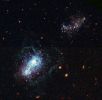
I Zwicky 18.jpgI Zwicky 1869 visite"...Bonae mentis soror est paupertas..."
(Petronio)
"...La miseria è (sempre) compagna (sorella) dell'intelligenza..."
(oggi diremmo "La Cultura non serve a comprare il pane")
(17 voti)
|
|

CW Leonis.jpgCW Leonis174 visite"Nemo doctus unquam mutationem consilii incostantiam dixit esse..."
(Cicerone)
"...Nessun uomo saggio ha mai detto che il cambiare idea è sinonimo di volubilità..."
(Voltaire riprese il medesimo concetto nel suo "Candide" con la frase - poi divenuta proverbiale - secondo cui "Soltanto le vacche non cambiano mai idea")
(17 voti)
|
|

Microquasars.jpgMicro-Quasar in Cassiopeia and IC 1805102 visiteMicroquasars (MQ), bizarre binary star systems, generating high-energy radiation and blasting out jets of particles at nearly the speed of light, live in our Milky Way galaxy. The energetic microquasar systems seem to consist of a very compact object, either a neutron star or a black hole, formed in a supernova explosion but still co-orbiting with an otherwise normal star. And now, using a very long array of radio telescopes, astronomers are reporting that at least 1 MQ (LSI+61 303) can be traced back to its probable birthplace, within a cluster of young stars in the constellation Cassiopeia. About 7.500 LY from Earth, the star cluster and surrounding nebulosity are shown in the deep sky image above. The cluster stars are identified by yellow boxes and circles.
A yellow arrow indicates the common apparent motion of the cluster stars; the green one shows the deduced motion of the microquasar system and the red arrow depicts the microquasar's motion relative to the star cluster itself.
(17 voti)
|
|

Supernova remnant and Neutron Star.jpgSupernova remnant and a Neutron Star94 visite"…L'Ateismo? Niente altro che una parola.
Possiamo anche dire che si tratta di una sorta di "Dichiarazione di Principio", ma nulla di più. Non ci può essere convinzione dietro questa posizione intellettuale, poiché ogni Uomo - per il fatto stesso di essere tale - comunque "crede" nell'esistenza di Qualcosa che va oltre se stesso ed oltre il suo impalpabile universo percettibile.
Non mi credete? Allora portatemi un vero "Ateo", qui, ed io vi porterò Dio…"
Paolo C. Fienga
(17 voti)
|
|

NGC-4038_and_NGC-4039.jpgNGC 4038 and NGC 4039 - Deep Inside the "Antennae" Colliding Galaxies163 visite"...Una volta chiesi al mio Professore di Astronomia che cosa pensasse della teoria relativa all'Universo inteso come uno spazio tendenzialmente infinito ma NON effettivamente infinito.
Mi aspettavo un'illuminazione, un raggio di sapienza, una risposta capace di infondermi coraggio, nuovi sogni ed entusiasmi.
E, in effetti, quella risposta arrivò".
"...E cioé? Che cosa disse?..."
"...Mi disse che non aveva idea di che cosa stessi parlando..."
Paolo Catello Fienga
(17 voti)
|
|

Syrius_.jpgSyrius139 visite"…Se ogni mille stelle ce ne fosse una con pianeti che ospitano una Civiltà avanzata, allora nel raggio di 50 anni luce dalla Terra (una distanza risibile, ragguagliata alle dimensioni dell'Universo) dovrebbe esistere almeno una di queste stelle…"
(una conseguenza dell'Equazione di Frank Drake - 1961)
(17 voti)
|
|

NGC-7635-00.jpgNGC 7635 - Bubble Nebula (mgnf) - HST105 visite"...C'è un tipo di individuo - nella nostra Società contemporanea - che, pur non essendo spinto né da una vera sensibilità, né da un'autentica "fame di sapere", ama razzolare fra i grandi eventi del Mondo. Costui li osserva - così come un avvoltoio contempla il suo prossimo pasto - e poi, quando qualcosa si compie, ne raccoglie l'eco e ne impiega il contenuto (o, più spesso, il solo riflesso) a proprio vantaggio.
Questo individuo si maschera, solitamente, dietro il proprio benessere che - lui dice - potrebbe diventare il benessere di tutti; egli si maschera dietro il sorriso che - lui asserisce - è la "porta dell'Anima"; costui, di regola, è persona molto devota nel praticare il culto di sé: l'unica Religione che egli conosce ed accetta.
Per cui io vi dico: guardatevi, Amici miei, da questo Messaggero: egli diffonde il suo verbo come un virus letale; promette prosperità, stagioni di abbondanza e grandi raccolti ma, in realtà, coltiva solo un campo.
Il suo...".
Paolo C. Fienga
(17 voti)
|
|

Southern_Sky.jpgSouthern Skies94 visite"...Good News: in the Future, new technology will allow police to solve 100% of all crimes committed.
The Bad News is that we'll realize that 100% of the population are criminals, including the police..."
Scott Adams - "The Dilbert Future" (prediction n. 49)MareKromium
(16 voti)
|
|

NGC-2170.jpgNGC 2170 - Bright Nebula in Monoceros84 visite"...La Libertà di parlare, al pari di tutte le Grandi Libertà, è assolutamente intoccabile.
Sono tuttavia convinto che molti individui, allorché usano questa Libertà, dovrebbero cercare comunque di limitarsi: sia per il loro bene, sia per il bene di coloro che li stanno ad ascoltare..."
Paolo Catello Fienga
(16 voti)
|
|

SouthernCross_Phenomenon_label.jpgThe Southern Cross81 visite"...There are, doubtless, many different kinds of sounds in the World, and nothing is without sound..."
- 1 Corinthians, 14:10
Caption NASA:"This stunning view of dark skies over Western Australia highlights wonders of the Southern Milky Way - including the famous Southern Cross, the dark Coal Sack Nebula and bright reddish emission regions surrounding massive star Eta Carinae. Recorded at about 2 am, the thirty minute long color film exposure also captured a bright but mysterious object that moved slowly across the sky for over an hour. Widely seen, the object began as a small point and expanded as it tracked toward the North (left), resulting in a comet-like appearance in this picture.
What was it? Reports are now identifying the mystery glow with a plume from the explosion of a malfunctioned Russian rocket stage partially filled with fuel. The rocket stage was marooned in Earth orbit after a failed communication satellite launch almost a year ago on February 28, 2006".
(16 voti)
|
|
| 1039 immagini su 87 pagina(e) |
 |
|
|
|
|
14 | |
|
|
|
|








