| Piú votate - Deep Sky Objects |
Sagittarius~1.jpgSagittarius Region81 visite"...Ragazzata: espressione indicante il risultato finale dell'incapacità della Famiglia in prima battuta, della Collettività in seconda, e dello Stato in terza, di prevenire e/o sanzionare in maniera adeguata i comportamenti antigiuridici posti in essere da minorenni dotati di cospicua arroganza ed ignoranza ma privi di intelligenza, educazione, e senso civico.
Paolo C. Fienga - "Dizionario del XXI Secolo"
(17 voti)
|
|

ABELL 2218-2.jpgDistant Galaxy "lensed" by Cluster Abell 2218109 visite"There is nothing more false and improbable in this world than hearing a lawyer profess humility and a philosopher speak in an understandable manner."
(Traduzione)
"...Non c'é nulla di più falso ed improbabile a questo mondo, del sentire un Avvocato fare professione di umiltà ed un filosofo parlare in maniera comprensibile..."
(frase attribuita a W. Churchill)
(17 voti)
|
|

V-838_Mon-02.jpgV838 Monocerotis, the Milky Way and Us...93 visite"...The Proletarian State must bring up thousands of excellent "mechanics of culture", "engineers of the soul"...
Maxim Gorky (1868-1936) - from his speech at the Writers' Congress (1934)
"...In free society, Art is not a weapon, and Artists are not "engineers of the soul"..."
J.F. Kennedy (1917-1963) - from his speech in Amherst College (1963)
(17 voti)
|
|

HH-0047.jpgHH 4776 visite"...Dès que la guerre sera déclarée, il sera impossible de retenir les poètes. La rime reste le tambour le plus efficace...."
Jean Giraudoux (1882-1944) - "La Guerre de Troie n'aura pas lieu"
(17 voti)
|
|
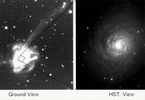
NGC-7252-1.jpgNGC 7252 - Spiral Galaxy70 visiteE forse è questo il mio Destino,
Pallida Luce di Stella, troppo lontana,
Mi confesso a te e tu, teneramente,
Scintilli e mi guardi senza parlare...
Pallida Luce di Stella, Amica mia,
Le scelte sono parte dell'Esistenza,
Come i dilemmi e le ansietà,
Ma nel Dolore, lo sai, noi siamo soli...
E se questo fosse il mio Destino
Pallida Luce di Stella, Amica mia,
Mi ritroverò a piangere, nella Notte,
E, per sempre solo, ascolterò il mio Niente...
Pallida Luce di Stella, ascoltami,
Che sarà di me e del mio cuore?
Che sarà di questo passaggio fugace?
Che sarà di noi e dei nostri sogni?
Non hai parole, lo so, ma io ti guardo
E guardandoti ti chiedo, Amica mia,
Pallida Luce di una Stella lontana,
Sorridi per un istante e amami,
Scintilla una volta ancora e guardami,
Sussurrami una preghiera e guidami....
Paolo C. Fienga - "Poesie"
(17 voti)
|
|

N-132-D~0.jpgSupernova Remnants N-132-D97 visite"...As long as the Earth endures, seedtime and harvest, cold and heat, Summer and Winter, day and night, shall not cease..."
Genesis 8:22
(17 voti)
|
|

Quasar PG1115+080-1.jpgQuasar PG 1115+080 in Leo69 visite"...Nequiquam sapit, qui sibi non sapit..."
(Cicerone)
"...Un uomo che sia saggio nel dare consigli (agli altri), ma avventato per sé (cioè nelle decisioni che lo riguardano), non è un uomo saggio..."
(17 voti)
|
|

Herbig-Haro 46-47-PIA04939.jpgHerbig-HARO 46-47 - SST113 visiteMi avevano detto che sarebbe stato un lungo viaggio,
ma mi dissero anche che il vero viaggio l’avrei cominciato
proprio quando sarei giunto.
Nella mia memoria, i loro volti hanno contorni sempre più incerti,
non così le loro parole.
Fatico a considerare ciò che vedo la cosa più bella
che la mia mente possa abbracciare ma,
nella sua immensa piattezza, l’universo mi mostra ormai da troppo tempo la sua scura faccia.
Mi avevano detto che ne avrei individuato la tana
guardando le sue vittime cadervi dentro,
ma che non sarei stato io,
a scovare lui
ma lui a catturare me quando sarei stato ancora
una piccola insignificante scintilla tra miliardi di fuochi.
Sarei diventato la sua preda più ambita
e avrebbe piegato lo spazio ancor più,
pur di farmi scivolare dentro la sua immensa bocca.
Il suo pasto era ben altra cosa, rispetto a me, ma
Io ero l’Intelligenza dell’Uomo.
Non pago della sua smisurata e brutale forza,
per esser certo d’avermi,
mi avrebbe lusingato e mostrato orizzonti
che mi avrebbero fatto perdere la ragione.
e su quell’orizzonte, avrei fatto il più lungo viaggio
che l’umanità intera avrebbe mai potuto compiere.
Adesso sono di fronte a lui.
Il suo aspetto muta di continuo,
e non c’è più traccia della spaventosa voragine
che aveva reso incerta la mia fede.
Mi avevano sussurrato che non sarei più tornato tra loro
ma mi avevano pregato di portarli, lo stesso,
tutti con me nel mio cuore,
perché forse, là, avrei potuto incontrare Dio.
L’universo si sta illuminando.
C’è luce da ogni parte.
I volti sbiaditi della mia memoria
sono diventati i sorrisi di coloro che sono qui ad aspettarmi.
Sembra un sogno.
Forse il mio viaggio è finito, ma avevano ragione loro,
sento che invece sta per cominciare!
Giuseppe Spina - "Black Hole"
(17 voti)
|
|

V-838_Mon-04.jpgV 838 Monocerotis: the Nebula is "growing up"!82 visite"…Gli uomini sono sospesi tra un prima ed un dopo che chiamano Vita, al di fuori della quale sentono che esiste qualcosa al di la di sé stessi, a cui neanche la loro straordinaria capacità di pensiero ha consentito di arrivare a sfiorarne la Natura. Ciò non di meno, di questo qualcosa - che per comodo chiameremo Dio - sappiamo quanto basta da non poterne ignorare la forza.
C'é chi Lo vede nell'Universo, chi nell'astrattezza del nostro pensiero e chi, ancora, nella coscienza di sé e del mondo che l'uomo possiede…"
Giuseppe Spina - "Dio"
(17 voti)
|
|
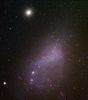
SmallMagellanCloud.jpgSmall Magellanic Cloud, NGC 362 and 47 Tucanae80 visiteDa "Astronomy Picture of the Day" del 17 Giugno 2005:"Portuguese navigator Ferdinand Magellan and his crew had plenty of time to study the southern sky during the first circumnavigation of planet Earth.
As a result, two celestial wonders easily visible for southern hemisphere skygazers are known as the Clouds of Magellan. These cosmic clouds are now understood to be dwarf irregular galaxies, satellites of our larger spiral Milky Way Galaxy. The Small Magellanic Cloud pictured above actually spans 15.000 LY or so and contains several hundred million stars. About 210.000 LY distant in the constellation Tucana, it is the forth closest of the Milky Way's known satellite galaxies, after the Canis Major and Sagittarius Dwarf galaxies and the Large Magellanic Cloud. This gorgeous view also includes two foreground globular, star clusters NGC 362 (top left) and 47 Tucanae. Spectacular 47 Tucanae is a mere 13.000 LY away and seen here to the right of the Small Magellanic Cloud".
(17 voti)
|
|
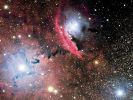
NGC-6559-0.jpgNGC 6559 - The "Story" of a Star Forming Region95 visiteIn questa immagine vediamo delle nebulose ad emissione - ossia che brillano di luce propria - di color rosso (Idrogeno); nebulose a riflessione - cioé che riflettono la luce delle stelle circostanti - di color blu (costituite da polveri) - e nebulose ad assorbimento - o 'nebulose oscure' - le quali, anch'esse formate da polveri interstellari, 'assorbono e, in un certo senso, soffocano' la luce degli oggetti circostanti.
Ed ecco la 'storia' che NGC 6559 ci racconta: le prime stelle ultra-massicce che si sono formate per addensamento dei gas presenti nella Regione emetteranno luce, onde mareali e possenti venti solari i quali eroderanno e ridefiniranno questa zona del Cosmo.
Tuttavia, queste ciclopiche stelle non avranno una lunga vita: esse, in tempi relativamente brevi, esploderanno.
Un 'caos cosmico' regnerà per qualche decina di milioni di anni, ma poi tutte le polveri verranno consumate, i gas residui saranno dispersi e ciò che vedremmo sarebbe solo uno splendido ammasso aperto di giovani stelle...
(17 voti)
|
|

VisibleandInvisible-PIA07490.jpgBlinded by the Light...126 visite"...Grande solacium est cum Universo rapi..."
(Seneca)
"…E' di grande conforto sapere che la nostra natura mortale è condivisa da tutto quanto esiste nell'Universo…"
(17 voti)
|
|
| 1039 immagini su 87 pagina(e) |
 |
|
|
|
|
13 | |
|
|
|
|








