| |

| Piú votate - Mars Spirit Anomalies and Maps |

SOL390-2N160994710EFFA300P1820L0M1-A.jpgAssimilation or Birth? - Sol 390 (ctx frame - credits: Ivana Tognoloni)154 visiteDall'occhio e dalla cura della nostra Amica e Partner, Ivana Tognoloni, un altro caso - affascinante ed un pò inquietante - di "Assimilazione o Nascita?".
Certo, la qualità intrinseca del frame è piuttosto scarsa (e l'edm, sempre realizzato da Ivana, lo prova ampiamente), ma che la Surface Feature che vediamo abbia delle (chiamiamole così...) NOTEVOLI peculiarità strutturali, è un fatto.
Inoltre, per i nostri Lettori più attenti e "datati", Vi facciamo notare che la porzione inferiore (e più chiara) della Pseudo-Roccia assomiglia davvero tantissimo ad un'altra roccia (o presunta tale), un pò più piccola ed individuata, quattro anni fa, dal nostro Caro Amico "Roby" e che venne catalogata in un frame dal titolo "One and the Same" (che potete trovare sia in questo stesso Album - ultima pagina -, sia nell'Album "Mars Opportunity Anomalies and Maps").
Morale? Se una singola "coincidenza" costituisce un'Anomalìa Scientifica, che cosa si può dedurre, sempre in chiave "Scientifica", quando le "coincidenze" diventano due, o tre, o quattro...etc.? Pensateci e poi, se volete, scriveteci!MareKromium
(4 voti)
|
|

SOL226-2P146429416EFF8522P2570L7M1-3.jpgThe "Metal Bar", on Mars... - Sol 226 (possible True Colors; credits: Dr G. Barca)140 visitenessun commentoMareKromium
(4 voti)
|
|
SOL424-2P164022235EFFA8B3P2666L2M1-2.jpgAlien Probe? - Sol 424 (extra-detail mgnf; credits: Dr G. Barca)145 visiteAlla "prova" dell'extra-detail mgnf, il particolare curioso individuato dal Dr Barca si rivela, a nostro avviso, per ciò che è davvero: uno S.L.O. (Star-Like Object), appunto, di Natura ignota.
Non si tratta, a nostro parere, di un image-artifact - la qualità del frame è, come già detto, eccellente - e quindi ora non si può fare altro che tornare ai "tempi" del Programma Apollo ed alle decine di frames lunari i quali ritraevano, nel buio cielo al di sopra degli Astronauti, questi stranissimi "oggetti simili ad una stella", che noi abbiamo poi battezzato Star-Like Objects.
Navi Spaziali Aliene? Space "Fireflies"? Chimere? Raggio Cosmico?
Cari Amici: ad oggi, sono solo degli "Star-Like Objects"...E Congratulazioni al Dr Barca!
Una nota finale: guardate bene l'area circostante lo Star-Like Object. Notate anche Voi una leggera, ma regolare, deformazione dello spazio ad esso circostante (come se l'oggetto pulsasse e, nel farlo, si circondasse di un campo energetico - o gravitazionale - di un qualche tipo)?!?
Chissà...MareKromium
(4 voti)
|
|
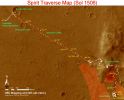
ZP-L-MERA_A1506_2.jpgSpirit's Traverse Map, from Sol 1 up to Sol 1506104 visitenessun commentoMareKromium
(4 voti)
|
|

SOL061-4-RATT_1.jpgThe "Martian Rat" strikes again! (1 - credits: Lorenzo Leone)162 visiteDal nostro Carissimo Amico, Socio e Collega, Lorenzo Leone, una nuova pagina di riflessioni sull'ormai "famoso" Topo Marziano il quale, volenti o nolenti, è ancora qui, dopo quattro anni di analisi e di riflessioni, a mostrarci il suo muso e le sue bizzarre fattezze.
Ma soprattutto, è ancora qui a mostrarci la sua "tana rocciosa": una "tana" che, piaccia o meno, è ancora uno dei più intriganti ed irrisolti enigmi superficiali individuati sul Pianeta Rosso.
Ma ora cediamo la parola a Lorenzo Leone, per le Sue riflessioni:"...Visti gli ultimi commenti riguardanti "The Rat", riprendo in cosiderazione le 2 immagini effettuate da Spirit durante i Sol che vanno da 56 a 60, ed estrapolando solo il particolare di quella roccia.
Analizzando e rielaborando i frame non è possibile, almeno per me, ottenere risultati migliori e più certi ("certi" si fa per dire perchè, finchè non saremo in loco...) riguardanti ciò che avviene su quella roccia, utilizzando filtri di vario genere.
Perchè in effetti "qualcosa", su quella roccia, accade. Ma cosa?
Allo stato attuale io escluderei effetti dovuti alla compressione dell'immagine.
Per qualche strano motivo quella roccia cambia le sue sembianze.
Cambia la sua fisionomia...".MareKromium
(4 voti)
|
|

SOL061-5-RATT_2_shift.jpgThe "Martian Rat" strikes again! (2 - credits: Lorenzo Leone)153 visite"...Non credo che ciò sia dovuto ad una compressione del file in quanto, osservando l'ambiente circostante, notiamo che esso rimane comunque sostanzialmente invariato (e cioè non si ravvisano gravi e pesanti distorsioni di alcun tipo) da quando si può intravedere una sagoma simile ad un ratto, a quando la sagoma sembra essere sparita.
Ora, io parto da un punto focale della questione che potrebbe far rivedere (forse ed in qualche modo) l'approccio allo studio dei frames.
E cioè: dal momento che Marte sembra avere 1/3 dell'illuminazione solare terrestre, presumo che l'ambiante marziano sia decisamente buio.
Come molti di noi sapranno, per effettuare delle riprese fotografiche valide avrò necessità di:
a) avere un flash, al fine di illuminare zone decisamente buie oppure
b) dare maggiore apertura al diaframma, con la risultante che tutto ciò che è in movimento risulterà - come ovvio - mosso (sbiadito/sfocato) nella foto.
Analizzando quindi le due immagini che ho rinominato Ratt 1 e Ratt 2 shift, quella che potrebbe essere una forma vita biologica di qualche tipo, effettua un movimento verso il basso (si veda questo quadro) lasciando sul frame l'impronta della precedente posizione a favore della nuova.
Si potrà notare, infatti, come in questo quadro (RATT 2 shift) si veda una sorta di "sfocatura" proprio nella posizione originale del cosiddetto Ratto.
In sintesi, a mio modesto avviso, su quella roccia qualcosa succede. Ratto o NON Ratto, forse siamo davanti ad una possibile prova che qualcosa (sempre FORSE), lassù, si muove.
Oppure decidendo per un pianeta decisamente disabitato da qualsiasi forma di vita, potrei dire che qualcuno alla NASA "tarocca" i frames a piacimento per destabilizzare e mettere nel ridicolo tutti i Gruppi di Ricerca Indipendenti, sìano essi seri o non seri...".
Che dire di più? Di "cibo per i pensieri", qui, in queste immagini ed in queste riflessioni, ne abbiamo in quantità. Oltre non si può andare.
Un GRANDE Complimento ed un Grazie di Cuore a Lorenzo Leone per il Suo OTTIMO Lavoro!MareKromium
(4 voti)
|
|
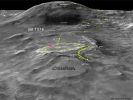
ZP-G-Trav_onHiRISE_N_1_5X.jpgSpirit's Race against Winter132 visiteCaption NASA:"While struggling to reach a Winter Outpost necessary for survival on Mars, Spirit has been slowed by sand in the bottom of a shallow, bowl-like depression. Spirit's goal is to reach a slope on the North Edge of Home Plate that will keep its Solar Panels trained on the Sun.
If the Rover can collect enough sunlight to survive, Spirit will continue to study terrain near Home Plate, which the rover reached after crossing the floor of Gusev Crater and scaling the Columbia Hills. This map shows the Rover's progress from July 2004 to November 2007".MareKromium
(4 voti)
|
|
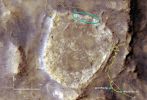
ZP-I-PIA10127.jpgHeading for the next Winter Haven...97 visiteCaption NASA:"Approaching its 47th month of a Mars Surface Mission originally planned to last 3 months, NASA's Spirit Rover was also approaching the Northern Edge of a low plateau called Home Plate. The Rover's Operators selected an area with North-Facing Slope there as a destination where Spirit would have its best chance of surviving low-solar-energy conditions of oncoming Martian Winter.
The yellow line on this map of the Home Plate area indicates Spirit's route from early February 2006, entering the mapped area from the North (top), to late November 2007, on the Western Edge of the bright-toned Home Plate plateau. The map covers an area about 160 mt (525 feet) across from West to East. Labels indicate the area intended for Spirit to spend many months spanning the Rover's 3rd Martian Winter, the site where it spent about 7 months (April to November 2006) spanning its 2nd Winter, and the site where it lost use of the drive motor for 1 of its 6 wheels.
A North-Facing Slope helps Spirit maximizes electric output from its Solar Panels during Winter months because Spirit is in the Southern Hemisphere of Mars, so the Sun appears only in the Northern Sky during Winter. For the 3rd winter, which will reach its minimum solar-energy days in early June 2008, Spirit faces the challenge of having more dust on its Solar Panels than it had during its 2nd one.
The base image for this map is a portion of a color image taken on Jan. 9, 2007, by the High Resolution Imaging Science Experiment camera on NASA's Mars Reconnaissance Orbiter".
MareKromium
(4 voti)
|
|
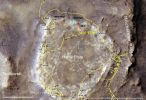
ZP-J-PIA10129.jpgSpirit nears North-Tilting Site for Winter Haven128 visiteCaption NASA:"NASA's MER Spirit made daily progress in early December 2007 toward the Northern Edge of a low plateau called Home Plate. The rover's operators selected an area with North-Facing Slope there (indicated by the blue-outlined rectangle) as a destination where Spirit would have its best chance of surviving low-solar-energy conditions of oncoming Martian Winter.
As indicated by the yellow line tracing the path Spirit has driven, the Rover was near the Western Edge of the plateau on Sol 1390 of the mission (Nov. 30, 2007), but nearing the Northern Edge by Sol 1397 (Dec. 8, 2007).
A north-facing slope helps Spirit maximizes electric output from its Solar Panels during Winter months because Spirit is in the Southern Hemisphere of Mars, so the Sun appears only in the Northern Sky during Winter. For the 3rd Winter, which will reach its minimum solar-energy days in early June 2008, Spirit faces the challenge of having more dust on its Solar Panels than it had during its 2nd Winter.
The base image for this map is a portion of a color image taken on Jan. 9, 2007, by the High Resolution Imaging Science Experiment camera on NASA's Mars Reconnaissance Orbiter".MareKromium
(4 voti)
|
|

SOL050-2N130812340EFF1000P1901R0M1-1.jpgAnother "Silver Anomaly" (3) - Sol 50 (context image)199 visitenessun commentoMareKromium
(4 voti)
|
|

SOL050-2N130812340EFF1000P1901L0M1-1.jpgAnother "Silver Anomaly" (1) - Sol 50 (context image)170 visiteAssieme alla sempre affascinante (ed ancora inspiegata ed inspiegabile) "Silver Sphere", un nuovo enigma argenteo che ci porta alla mente ipotesi esotiche e scenari Alieni per definizione.
Nel ringraziare il Dr Gianluigi Barca - Presidente di Lunar Explorer Italia, Sez. Liguria e Piemonte - il quale ha trovato questi frames interessantissimi e di tre Soles anteriori rispetto al frame-base che abbiamo utilizzato per le nostre ricerche (e relativo al Sol 53), noi non possiamo fare altro che rimettere alla Vostra prudenza la valutazione sul "che cosa" questo artefatto potrebbe o non potrebbe essere.
Manufatto Alieno? Frammento del "nest" in cui il MER Spirit era rinchiuso? Evidenza oggettiva che questa fotografia è falsa (e cioè NON è stata scattata realmente su Marte? Come sempre, quando si parla di Marte (o di Luna, o di Spazio in generale) ce n'è per tutti i gusti, le competenze e le idee ed ognuno di noi, a condizione che sia capace di sostanziare la propria idea - e senza deridere le opinioni altrui -, può legittimamente credere e sostenere quello che vuole...
MareKromium
(4 voti)
|
|
SOL052-2P130990683EFF1120P2427R1M1.jpgA piece of metal is shining in the Sun? (2) - Sol 52153 visitenessun commentoMareKromium
(4 voti)
|
|
| 274 immagini su 23 pagina(e) |
|
|
|
|
|
11 | |
|
|
|
|
|
|








