| Piú votate - Curiosity and the Exploration of Gale Crater |

SOL0059-NLA_402729734EDR_D0050000NCAM00501M_-PCF-LXTT-00.jpgHorizon and Sky at Gale - Sol 59 (Absolute Natural Colors; credits for the additional process. and color.: Dr Paolo C. Fienga/Lunar Explorer Italia/Italian Planetary Foundation) 96 visiteFrame taken at 12:15:15 Mars Local Solar TimeMareKromium
(6 voti)
|
|

SOL0054-PIA14762-NASA-JPL-Caltech-MSSS.jpg"Bathurst Inlet" Rock - Sol 54 (Natural Colors; credts: NASA/JPL-Caltech, Malin Space Science Systems)92 visiteNASA's Mars Rover Curiosity held its Mars Hand Lens Imager (MAHLI) camera about 10,5" (---> inches, such as about 27 centimeters) away from the top of a Rock called "Bathurst Inlet" for a set of 8 images combined into this merged-focus view of the Rock. This context image covers an area that is roughly 6,5 by 5" (such as 16 by 12 centimeters). Resolution is about 105 microns per pixel.
MAHLI took the component images for this merged-focus view, plus closer-up images of Bathurst Inlet, during Curiosity's 54th Martian Day, or Sol (such as September 30, 2012). The instrument's principal investigator had invited Curiosity's science team to "MAHLI it up!" in the selection of Sol 54 targets for inspection with MAHLI and with the other instrument at the end of Curiosity's Arm: the Alpha Particle X-Ray Spectrometer.
The "Bathurst Inlet" Rock is dark gray and appears to be so fine-grained that MAHLI cannot resolve Grains or Crystals in it. This means that the Grains or Crystals, if there are any at all, are smaller than about 80 microns in size. Some windblown sand-sized Grains or Dust Aggregates have accumulated on the Surface of the Rock, but this Surface is clean (if compared, for example, to the pebbly substrate below the rock - upper left and lower right in this context image).
MAHLI can do focus merging onboard the MER and, in fact, the full-frame versions of the 8 separate images that were combined into this view were not even returned to Earth -- just the thumbnail versions. In other words, merging the images onboard reduces the volume of data that is supposed to be downlinked to Earth.MareKromium
(6 voti)
|
|

SOL0003-MF-EB-LXTT-IPF.jpgSundial and Surface - Sol 3 (Natural Colors; credits for the additional process. and color.: Elisabetta Boniora and Marco Faccin/Lunar Explorer Italia/Italian Planetary Foundation)123 visitenessun commentoMareKromium
(6 voti)
|
|

SOL0016-NLA_398919509EDR_F0030078NCAM00300M_.jpgDisturbed Terrain and extremely "Foggy" Horizon - Sol 16 (Enhanced Absolute Natural Colors; credits for the additional process. and color.: Dr Paolo C. Fienga/Lunar Explorer Italia/Italian Planetary Foundation)67 visitenessun commentoMareKromium
(6 voti)
|
|
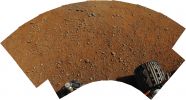
SOL0003-EB-MF-LXTT-IPF.jpgLooking Around... - Sol 3 (an Image-Mosaic in RAW Natural Colors; credits for the additional process. and color.: Elisabetta Bonora and Marco Faccin/Lunar Explorer Italia/Italian Planetary Foundation)76 visitenessun commentoMareKromium
(6 voti)
|
|

SOL3872-raw_images_1226582_site3Dmsl.jpgPanorama - Sol 3872192 visitenessun commentoMareKromium
(5 voti)
|
|

SOL3872-raw_images_1226579_site3Dmsl.jpgPanorama - Sol 3872231 visitenessun commentoMareKromium
(5 voti)
|
|

SOL0538-6012_PIA17944-FigA_Mcam-SOL538-raw-full2.jpgLooking Back - Sol 538 (Natural Colors - Credits: NASA)99 visiteThis look back at a dune that NASA's Curiosity Mars rover drove across was taken by the rover's Mast Camera (MastCam) during the 538th Martian Day, or Sol, of Curiosity's work on Mars (Feb. 9, 2014). The Rover had driven over the dune three days earlier. For scale, the distance between the parallel wheel tracks is about 9 feet (i.e.: approx.
2,7 meters). The dune is about 3 feet (a little more than 1 meter) tall in the middle of its span across an opening called "Dingo Gap". This view is looking Eastward. This raw color image was recorded by the camera under Martian lighting conditions. MareKromium
(5 voti)
|
|

SOL0369-RLB_430259923EDR_F0130000RHAZ00311M_.jpgWatch carefully! - Sol 369 104 visiteATTENZIONE ai "punti neri". Specialmente quello a Sx. NON si tratta di difetti delle lenti od image-artifacts.MareKromium
(5 voti)
|
|

SOL0174-PIA16804.jpgSutton Inlier - Sol 174 (Absolute Natural Colors; credits for the additional process. and color.: NASA/JPL)107 visiteThe Mast Camera (MastCam) on NASA's Mars Rover Curiosity showed researchers interesting internal color in this rock called "Sutton_Inlier," which was broken by the Rover driving over it. The Mastcam took this image during the 174th Martian day, or sol, of the rover's work on Mars (Jan. 31, 2013). The rock is about 5" (12 cm) wide at the end closest to the camera. This view is calibrated to estimated "Natural" Color, or approximately what the colors would look like if we were to view the scene ourselves on Mars. The inside of the rock, which is in the "Yellowknife Bay" area of Gale Crater, is much less red than typical Martian dust and rock surfaces, with a color verging on grayish to bluish.
NASA's Jet Propulsion Laboratory, Pasadena, Calif., manages the Mars Science Laboratory Project and the mission's Curiosity rover for NASA's Science Mission Directorate in Washington. The rover was designed and assembled at JPL, a division of the California Institute of Technology in Pasadena.MareKromium
(5 voti)
|
|

SOL0174-PIA16804-PCF-LXTT-IPF.jpgSutton Inlier - Sol 174 (Absolute Natural Colors; credits for the additional process. and color.: Dr Paolo C. Fienga/Lunar Explorer Italia/Italian Planetary Foundation)151 visiteThis frame, which was taken by the Mast Camera (MastCam) onboard the NASA - Mars Exploration Rover (MER) - Mars Laboratory "Curiosity", shows us some very interesting colors which were found inside a Rock called "Sutton Inlier": a relatively small Rock that was broken by the Rover itself, while driving over it.
The MastCam took this image during the 174th Martian Day, or Sol, of the Rover's work at Gale Crater - Mars (such as January 31, 2013 on Earth). The Rock is about 5" - inches - (such as 12,7 centimeters) wide at the end closest to the camera. The inside of the Rock, which is found in the "Yellowknife Bay" area of Gale Crater, shows us a color that lies in between from a light gray to a very pale blue, and without traces of orange or red (the colors that, as you know, are the typical ones that characterize almost all the exposed - to the Martian Open Environment - Dusty and/or Rocky Materials and Surfaces).
This picture (which is an Original NASA - Mars Exploration Rover - Mars Laboratory "Curiosity" natural"color frame published on the NASA - Planetary Photojournal with the ID n. PIA 16804) has been additionally processed and then re-colorized in Absolute Natural Colors (such as the colors that a human eye would actually perceive if someone were near the NASA - Mars Exploration Rover (MER) - Mars Laboratory "Curiosity" and then looked ahead, towards the Rock dubbed "Sutton Inlier", which is located in front of the Rover), by using an original technique created - and, in time, dramatically improved - by the Lunar Explorer Italia Team. Different colors, as well as different shades of the same color, mean, among other things, the existence of different Elements (Minerals) present on the Surface of Gale Crater, each having a different Albedo (---> Reflectivity) and Chemical Composition.MareKromium
(5 voti)
|
|

SOL0192-MF-LXTT-IPF-1.jpgExtremely unusually-looking Surface Feature on the Surface of Gale Crater: "The Transparent Ring" - Sol 192 (CTX Frame - Natural Colors; Credits: Research, additional process. and color.: Elisabetta Bonora and Marco Faccin/LXTT/IPF)74 visiteUn dettaglio praticamente impossibile da individuare se non si sa ESATTAMENTE che cosa si cerca. Come vedrete meglio nella versione in colori e contrasti esaltati ed amplificati, c'è "Qualcosa" dalla forma quasi-circolare, di textura (forse) liscia e trasparente sulla Superficie di Gale Crater. Qualcosa che ha tutta l'apparenza di essere Materiale Organico. Forse saremo noi a sbagliarci ed a "Vedere troppo" nei frames Curiosity. Forse.
O forse coloro che hanno i mezzi, le capacità e, tutto sommato, il "compito istituzionale" di "vedere bene", sono un pò distratti e condizionati dall'ormai "consolidata certezza" secondo cui, su Marte, non può esistere, al momento, Vita Animale. Noi, come Gruppo di Ricerca Lunar Explorer Italia/Italian Planetary Foundation, confermiamo per l'ennesima volta che questo modo di approcciare la Materia - e cioè quello adottato dalla NASA e dagli Scienziati e Ricercatori "convenzionali" - è strabico e fuorviante. E, sempre a nostro umile parere, anche piuttosto superato dai fatti.MareKromium
(5 voti)
|
|
| 261 immagini su 22 pagina(e) |
 |
|
|
|
|
10 | |
|
|
|
|








