| Piú votate - Curiosity and the Exploration of Gale Crater |

SOL3694-mars_nasa_gov_msl-raw-images_proj_msl_redops_ods_surface_sol_03694_opgs_edr_ncam_NRB_725407718EDR_F0990188NCAM00560M_.JPGSol 3694 - What a Top!107 visitenessun commentoMareKromium
(13 voti)
|
|

SOL3747-mars_nasa_gov_msl-raw-images_proj_msl_redops_ods_surface_sol_03747_opgs_edr_ncam_NRB_730154125EDR_S1000696NCAM00545M_.JPGDark Clouds over Gale - Sol 374791 visiteSuggestiva. Peccato non sia a colori.MareKromium
(12 voti)
|
|

SOL3423-PIA25176-8192x2276.jpg"(Alli)Gator Back" Rocks on "Greenheugh" - Sol 3423182 visiteNASA’s Curiosity Mars rover used its Mast Camera, or MastCam, to take this 360° panorama on March 23, 2022, the 3.423th Martian Day, or Sol, of the Mission. The team has informally described the wind-sharpened rocks seen here as “gator-back” rocks because of their scaly appearance.
Wind-sharpened rocks like these are called ventifacts, and are responsible for chewing up Curiosity’s wheels earlier in the mission. Since then, rover engineers have found ways to slow wheel wear, including a traction control algorithm. They also plan rover routes that avoid driving over such rocks, including these latest ventifacts, which are made of sandstone – the hardest type of rock Curiosity has encountered on Mars.
These rocks form the Surface of the “Greenheugh Pediment,” a broad, sloping plain in the foothills of Mount Sharp. The floor of Gale Crater is visible along the edges of the mosaic. When Curiosity’s team saw the gator-back rocks, they ultimately decided to turn the rover around and take an alternative path to continue climbing Mount Sharp, a 3,4-mile-tall (approx. 5,5-Km-tall) mountain that Curiosity has been ascending since 2014. As it climbs, Curiosity is able to study different sedimentary layers shaped by water billions of years ago. These layers help scientists understand whether microscopic life could have survived in the ancient Martian Environment.MareKromium
(12 voti)
|
|

SOL3563-1-PIA25413-DeepZoom.jpgPanorama - Sol 3563116 visitenessun commentoMareKromium
(12 voti)
|
|
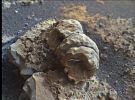
SOL2666-49495967062_00f7262938_h.jpgIs this a fragment of an Alien (i.e.: Martian "Mammal") "Backbone"? - Sol 2666406 visiteGuardate bene: io, da "appassionato" di Anatomia, ho visto svariati tipi di scheletri. Umani e non.
Quello che si vede in questa immagine, a mio umilissimo avviso, é una sezione (un frammento, se volete), costituita/o da tre vertebre, ancora perfettamente aggregate, di una qualche sorta di "creatura" equiparabile ad un mammifero terrestre.
Ora, ne sono certo, mi verrà detto che sono un incompetente ed un visionario (nel senso di scemo). Ma non credo sia così. Quelle, GUARDATELE BENE!, sono tra vertebre fossilizzate. Il frame é stato identificato e magnificato da Marco Faccin ed Elisabetta Bonora.
Forse nemmeno loro hanno realizzato cosa sono riusciti a beccare. Io Vi dico la mia: su Marte c'é stata Vita, anche evoluta - in Superficie - e poi si é estinta, per ragioni a me ignote. Nel sottosuolo (sub-superficie - e cioé a pochi metri dalla Superficie) c'é ancora qualcosa.
Ma in questo caso, ipotesi a parte, mi assumo tutte le responsabilità di quel che dico (scrivo): quelle sono tra vertebre fossilizzate. NON POSSONO ESSERE tre sassi allineati e combacianti, con foro centrale, "a caso". NON POSSONO ESSERLO!
Le probabilità che si formi una configurazione geologica superficiale di questo tipo sono una su milioni.
Ora guardate, valutate, fate paragoni e scrivete. Volete insultarmi? Fatelo pure: ma non blaterando su blog che valgono meno di zero e che non leggo più.
Scrivetemi DIRETTAMENTE, con Nome e Cognome (se avete il coraggio e gli attributi). Ed io Vi risponderò. Con Educazione.
Un riguardo che verso di me é stato assai raramente usato. E "saluti" a tutti gli sciocchi e le loro stupidaggini (condite da foto ridicole) che costellano il web. E, parafrasando quanto disse un Caro Associato, "pulitevi le mani prima di scrivere circa Lunexit".
Perché noi siamo quel che siamo (Umani, quindi sbagliamo - a volte), ma Voi, anonimi offensori, siete solo zero. Eufemismo.MareKromium
(12 voti)
|
|

SOL2410-MF-EB-LXTT-Curiosity_Navcam_R_sol_2410-clouds_on_Mars.jpgSkyline and Clouds.... - Sol 2410 (Credits: NASA/JPL; Credits for the Add. Process. and Color.: Marco Faccin & Elisabetta Bonora)141 visiteMeravigliosa Visione del Cielo di Marte, quieto, sopra Curiosity. In basso, l'Orizzonte Marziano, avvolto nell'oscurità.MareKromium
(12 voti)
|
|

SOL3690-mars_nasa_gov_msl-raw-images_proj_msl_redops_ods_surface_sol_03690_opgs_edr_ncam_NRB_725065045EDR_S0990000NCAM00594M_.JPGFunny-shaped "Mounds" - Sol 3690101 visiteHo un dubbio: si tratta di "Mounds" o (piccole) "Buttes"?MareKromium
(11 voti)
|
|

SOL3758-mars_nasa_gov_msl-raw-images_msss_03758_mcam_3758MR1036740021803144C00_DXXX.jpgPanorama (1) - Sol 375889 visitenessun commento (o magari "si", ma perché toglierVi il piacere di scoprire la "curiosità"?!?)MareKromium
(11 voti)
|
|

SOL3063-2-PIA24661-Curiosity_GIF_Shows_Drifting_Clouds_Over_Mount_Sharp.gifBlowin' in the Wind... - Sol 3063 (GIF-Movie)123 visitenessun commentoMareKromium
(11 voti)
|
|

SOL3048-1050_E-PIA24662-LXTT-IPF.jpgIridescent Clouds over Gale Crater - Sol 3048151 visiteCaption NASA Originale:"NASA’s Curiosity Mars Rover spotted these Iridescent, or “Mother of Pearl,” Clouds on March 5, 2021, the 3.048th Martian Day, or Sol, of the Mission. Seen here are five images stitched together from a much wider panorama taken by the rover’s Mast Camera, or Mastcam". MareKromium
(11 voti)
|
|

SOL3072-4-PIA24646-Curiosity_Navigation_Cameras_Spot_Twilight_Clouds_on_Sol_3072.gifNoctilucent Clouds over Gale Crater - Sol 3072 (GIF-Movie)113 visiteCaption NASA Originale:"Using the Navigation Cameras on its Mast, NASA’s Curiosity Mars Rover took these images of clouds just after sunset on March 28, 2021, the 3.072nd Sol, or Martian Day, of the Mission. These Noctilucent, or Twilight Clouds, are made of Water Ice, such as ice crystals that reflect the setting Sun, allowing the detail in each cloud to be seen more easily".MareKromium
(11 voti)
|
|

SOL3219-E3-PIA23139.jpgKnockfarril Hill - Sol 3219 (Natural Colors)122 visiteCaption NASA Originale:"The Mast Camera (MastCam) on NASA's Curiosity Mars Rover captured this mosaic as it explored the "clay-bearing unit" on Feb. 3, 2019 (Sol 2309). This landscape includes the rocky landmark nicknamed "Knockfarril Hill" (center right) and the edge of Vera Rubin Ridge, which runs along the top of the scene".MareKromium
(11 voti)
|
|
| 261 immagini su 22 pagina(e) |
1 |
 |
|
|
|
|
|
|
|
|
|








