| Piú votate - Mars from Orbit (from July 2009) |
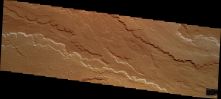
Volcanic_features-LavaFlows-Daedalia_Planum-PCF-LXTT.jpgLava Flows in Daedalia Planum (False Colors; credits: Lunar Explorer Italia)56 visiteCaption NASA:"This image shows a small portion of the extensive Lava Flows from Arsia Mons that make up Daedalia Planum".
Source: NASA/2001 Mars Odyssey Orbiter
Coord.: 21,1° South Lat. and 240,8° East Long.
MareKromium
(3 voti)
|
|

Landslides-Melas_Chasma-20080204a-PCF-LXTT.jpgHuge Landslide in Melas Chasma (Enhanced Absolute Natural Colors; credits for the additional process. and color.: Dr Paolo C. Fienga - Lunexit Team)59 visiteCaption NASA:"This landslide in Melas Chasma is so large that a single THEMIS VIS image can cover only a portion of the deposit.
This image clearly shows the sub-radial grooves typical of the surface of landslides on Mars".
MareKromium
(3 voti)
|
|
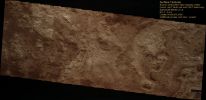
Vastitas_Borealis-20080624a-PCF-LXTT.jpgSurface Textures of the Northern Plains (Absolute Natural Colors; credits for the additional process. and color.: Dr Paolo C. Fienga - Lunexit Team)57 visiteCaption NASA:"Though the Northern Plains of Mars have little topographic variation, the surfaces textures very greatly from one Region to the next.
The cause of such variation is unknown".MareKromium
(3 voti)
|
|
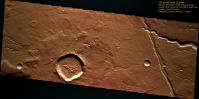
Channels-Unnamed_Channel_and_Graben-20080617a.jpgUnnamed Channel (Natural Colors/Tri-Chromatic Version; credits: Dr Paolo C. Fienga - Lunexit Team)59 visitenessun commentoMareKromium
(3 voti)
|
|
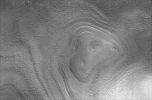
South_Polar_Regions-PIA08774-01.jpgThe "South Polar Margin" (1 - RAW and b/w NASA Original Frame)58 visiteCaption NASA:"Layers of ice are easily seen in this image of the margin of the South Polar Cap".
Image information: VIS instrument;
Latitude: - 78,5° North;
Longitude: 116,4° East;
Resolution: 17 meter/pixel.
(3 voti)
|
|

Aeolian_Features-Yardangs-Apollinaris_PateraPIA08729.jpgYardangs in Apollinaris Patera (Original NASA/MGS/MSSS b/w Frame)68 visiteCaption NASA originale:"Only a portion of the ejecta remains around this Unnamed Crater. Wind action is creating Yardangs and stripping off the Surface Materials in this Region".
Image information: VIS instrument;
Latitude: 7,0° South;
Longitude: 173,8° East;
Resolution: 18 meter/pixel.
(3 voti)
|
|
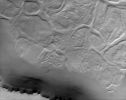
North_Polar_Features-North_Polar_Margin-PIA08705-2.jpgThe North Polar "Margin" (2 - Original NASA/JPL/ASU b/w Frame)60 visiteImage information: VIS instrument;
Latitude: 81,1° North;
Longitude: 299,2° East:
Resolution: 20 meter/pixel.
(3 voti)
|
|
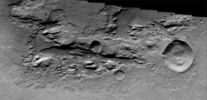
Craters-Millochau_Crater-PIA03292-1.jpgThe Floor of Millochau Crater (Original NASA/JPL/ASU b/w Frame)57 visiteOriginal caption:"The Floor of Millochau Crater has been filled by material that is now being eroded away".
Image information: VIS instrument;
Coord.: 21,1° South Lat. and 85,6° East Long.
Resolution: 17 meter/pixel.
(3 voti)
|
|
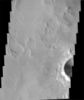
Craters-Holden_Crater-2-PIA03192.jpgHolden Crater's Dunes (2)57 visiteProsieguo del frame precedente; nessun commento.
(3 voti)
|
|
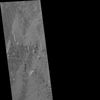
Craters-Holden_Crater-1-M0302733.jpgHolden Crater floor near intersection with Uzboi Vallis (1)61 visiteQuesta serie di 4 frames (ottenuti da un solo frame, troppo grande e troppo dispersivo per essere pubblicato unitariamente) non mostra quello che si potrebbe immaginare pensando al 'fondo' di un cratere.
In realtà, quello che vediamo da questa serie di immagini - ottenute da un'altezza di circa 374 Km - è un autentico "mondo in sè", fatto di rilievi assolutamente fantastici e suggestivi i quali, in alcuni punti, sembrano ricordare le "Bianche Scogliere di Dover" (the "White Cliffs of Dover"). Come questo paesaggio possa apparire ai nostri occhi dal Datum "0" (cioè dalla superficie) non possiamo saperlo, ma la nostra sensazione è che si tratterebbe di uno spettacolo indimenticabile...
(3 voti)
|
|
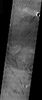
Aeolian_Features-Windstreaks-PIA03935-00.jpgWindstreaks (Natural Colors; credits for the additional process. and color.: Dr Paolo C. Fienga - Lunexit Team)58 visiteCaption NASA originale:"Windstreaks are features caused by the interaction of Wind and Topographic Landforms. The raised Rims and Bowls of Impact Craters cause a complex interaction such that the Wind Vortex in the Lee (--->sedimento) of the Crater can both scour away the Surface Dust and deposit it back in the center of the Lee. If you look closely, you will see evidence of this in a darker Rim enclosing a brighter interior. These Windstreaks are located in the region between Gordii Dorsum and Amazonis Mensa".
Image information: VIS instrument;
Latitude 23,2° North;
Longitude 237,1° East (such as 122,9 West);
Resolution: 36 meter/pixel.
(3 voti)
|
|

Craters-Holden_Crater-Black_Dunes-1-PIA07830.jpgBlack Dunes inside Holden Crater58 visiteCaption NASA originale:"A common location for dune fields on Mars is in the basin of large craters. This dune field is located in Holden Crater at 25° South Latitude".
Image information: VIS instrument;
Latitude 25,5° South;
Longitude 326,8° East (such as 33,2° West);
Resolution: 19 meter/pixel.
(3 voti)
|
|
| 1003 immagini su 84 pagina(e) |
 |
|
|
|
|
61 | |
|
|
|
|





