| |

| Piú votate - Mars from Orbit (from July 2009) |

Craters-Martz_Crater-PIA16273-PCF-LXTT-IPF.jpgFeatures of Martz Crater (Absolute Natural Colors; credits for the additional process. and color.: Dr Paolo C. Fienga/Lunar Explorer Italia/Italian Planetary Foundation)79 visiteThis picture, taken by the NASA - Mars Odyssey Orbiter during its 49.480th orbit around the Red Planet, shows us a small portion of the Inner Rim of the ancient Martz Crater, heavily dissected by a great number of small Channels.
Martz Crater is located in the Southern Hemisphere of Mars, in a Region known as Terra Cimmeria; it is almost 100 Km (such as a little more than 62 miles) wide and approximately 1,5 Km (such as about 0,9 miles) deep. Martz Crater is well known among Planetary Scientists because of its very prominent and steep Complex Central Peak (which is approx. 1500 meters - or 5000 feet - tall): a Central Peak that formed, like you know, at the same time of the Crater (and as a consequence of a phenomenon known as "Rebound Effect"), right after a medium-sized Celestial Object (probably something in between 0,5 to 1 Km - such as from 0,31 to 0,62 miles - across) impacted the Surface of Mars.
Latitude (centered): 34,614° South
Longitude (centered): 143,722° East
Instrument: VIS
Captured: February, 8th, 2013
This frame (which is an Original Mars Odyssey Orbiter b/w frame published on the NASA - Planetary Photojournal with the ID n. PIA 16273) has been additionally processed and then colorized in Absolute Natural Colors (such as the colors that a human eye would actually perceive if someone were onboard the NASA - Mars Odyssey Orbiter and then looked down, towards the Surface of Mars), by using an original technique created - and, in time, dramatically improved - by the Lunar Explorer Italia Team.MareKromium
(3 voti)
|
|
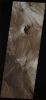
Volcanoes-Nili_Patera-PIA16653-PCF-LXTT-IPF.jpgFeatures of Nili Patera (Absolute Natural Colors; credits for the additional process. and color.: Dr Paolo C. Fienga/Lunar Explorer Italia/Italian Planetary Foundation)73 visiteThis frame, taken by the NASA - Mars Odyssey Orbiter during its 48021st orbit around the Red Planet shows us a portion of the very large Dunefield that covers most of the Floor of Nili Patera. This ancient Volcano, located in the Martian Region of Syrtis Major, spans about 50 Km (about. 31,5 miles) wide, 2 Km (such as a little more than 1 mile) deep, and forms part of a bigger Caldera Complex that stretches some 400 Km (a little less than 250 miles) along a North-to-South direction. What gives Nili Patera special interest for Planetary Geologists is that it contains two kinds of Lava: Basalt and Dacite. This is an unusual circumstance for Mars, where most Lavas are Basalt, and this discovery showed that the Red Planet is, even from a Volcainc point of view, an extremely complex world.
Furthermore, the execution of a series of Gravity Field Measurements which covered the whole Region, showed evidence of a Positive Gravity Anomaly, centered on the Caldera Complex, and suggesting the presence, deep under the Surface, of an approx. 600-by-300 Km (such as about 373-by-186 miles), North-to-South oriented and elongated (now extinct) Magma Chamber, probably containing some very dense Minerals (like, for instance and mainly, Pyroxene, with Olivine also possible).
Latitude: 8,95193° North
Longitude: 67,3367° East
Instrument: VIS
Captured: October, 11th, 2012
This frame (which is an Original Mars Odyssey Orbiter b/w frame published on the NASA - Planetary Photojournal with the ID n. PIA 16653) has been additionally processed and then colorized in Absolute Natural Colors (such as the colors that a human eye would actually perceive if someone were onboard the NASA - Mars Odyssey Orbiter and then looked down, towards the Surface of Mars), by using an original technique created - and, in time, dramatically improved - by the Lunar Explorer Italia Team.MareKromium
(3 voti)
|
|
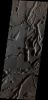
Volcanic_Features-Collapse_Pits_and_Chains-AM-PIA16647-PCF-LXTT-IPF.jpgCollapse Features on the Northern Flank of Ascraeus Mons (Absolute Natural Colors; credits for the additional process. and color.: Dr Paolo C. Fienga/Lunar Explorer Italia/Italian Planetary Foundation)65 visiteThis image was taken by the NASA - Mars Odyssey Orbiter, this time during its 47952nd Orbit, and it shows us a small fraction of the unbelievably compllicated Network of Collapse Features (Pits, Pit-Chains, Channels and Fissures) which are located on the Northern Flank of the Martian Volcano known as Ascreaus Mons (a large Shield Volcano located in the Tharsis Region of the Red Planet). Ascraeus Mons is the Northernmost and tallest of the 3 (three) Shield Volcanoes collectively known as the Tharsis Montes,being the other two huge Volcanoes known as Pavonis and Arsia Mons (if you wish to have an orbital vision of all these three fascinating Volcanoes, as well as a portion of the Noctis Labyrinthus Region of Mars, please go to Archive and refer to the APOD of February, 14th, 2012). Out of curiosity, Ascraeus Mons' location corresponds to the so-called "Classical Albedo Feature" which was known as Ascraeus Lacus.
Ascraeus Mons was actually discovered by the NASA - Mariner 9 Spacecraft in 1971. This enormous Volcano, however, was originally just called "North Spot", since it was the Northernmost of the only 4 (four) "Spots" (---> Reliefs) visible on the whole Surface of Mars which, at that time (and due to a Global Dust Storm), looked completely featureless from the orbit. As the Dust cleared, the abovementioned "Spots" were revealed to be extremely tall Shield Volcanoes whose Summits stood above the Dust-flooded, Lower Atmosphere. The Volcano's name officially became Ascraeus Mons in 1973.
Latitude: 13,6538° North
Longitude: 257,429° East
Instrument: VIS
Captured: October, 5th, 2012
This frame (which is an Original Mars Odyssey Orbiter b/w frame published on the NASA - Planetary Photojournal with the ID n. PIA 16647) has been additionally processed and then colorized in Absolute Natural Colors (such as the colors that a human eye would actually perceive if someone were onboard the NASA - Mars Odyssey Orbiter and then looked down, towards the Surface of Mars), by using an original technique created - and, in time, dramatically improved - by the Lunar Explorer Italia Team.MareKromium
(3 voti)
|
|
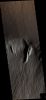
Volcanic_Features-Escarpment-OM-PIA16651-PCF-LXTT-IPF.jpgOlympus' Escarpment (Absolute Natural Colors; credits for the additional process. and color. Dr Paolo C. Fienga/Lunar Explorer Italia/Italian Planetary Foundation)64 visiteThis image, taken by the NASA - Mars Odyssey Orbiter during its 48003rd Orbit, shows us a VERY small (but still extremely interesting, as you can see by yourself) portion of the steep Escarpment existing between the Main Edifice of the Great Martian Volcano known as Olympus Mons and the surrounding Volcanic Plains (remember that an Escarpment is a - usually - steep Slope or a long Cliff that occurs from Erosion or Faulting and separates 2 (two) - relatively levelled/flat - areas/terrains which are situated at different elevations with regard to a certain, and given, Datum - such as that Point, Place or Region of a Celestial Body that is conventionally considered to be situated at Zero Altitude (the Sea Level, for instance, and as far as the Planet Earth is concerned).
Latitude: 13,9669° North
Longitude: 227,030° East
Instrument: VIS
Captured: October, 9th, 2012
The picture (which is an Original Mars Odyssey Orbiter b/w frame published on the NASA - Planetary Photojournal with the ID n. PIA 16651) has been additionally processed and then colorized in Absolute Natural Colors (such as the colors that a human eye would actually perceive if someone were onboard the NASA - Mars Odyssey Orbiter and then looked down, towards the Surface of Mars), by using an original technique created - and, in time, dramatically improved - by the Lunar Explorer Italia Team.MareKromium
(3 voti)
|
|
Craters-Lyot_Crater-PIA16512-PCF-LXTT-IPF.jpgThe Dunefield inside Lyot Crater (Absolute Natural Colors; credits for the additional process. and color.: Dr Paolo C. Fienga/Lunar Explorer Italia/Italian Planetary Foundation)72 visiteOrbit Number: 47648
Latitude (centered): 50,2217° North
Longitude (East): 28,7883°
Instrument: VIS
Captured: September, 10th, 2012MareKromium
(3 voti)
|
|
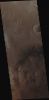
Craters-Trouvelot_Crater-PIA16641-PCF-LXTT-IPF.jpgThe Dunefield inside Trouvelot Crater (Absolute Natural Colors; credits for the additional process. and color.: Dr Paolo C. Fienga/Lunar Explorer Italia/Italian Planetary Foundation)69 visiteOrbit Number: 47874
Latitude (centered): 16,1118° North
Longitude (East): 346,733°
Instrument: VIS
Captured: September, 29th, 2012MareKromium
(3 voti)
|
|
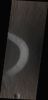
Volcanoes-Ceraunius_Tholus-Summit-PIA16595-PCF-LXTT-IPF.jpgThe Eastern Side of Ceraunius Tholus' Summit Caldera (Absolute Natural Colors; credits for the additional process. and color.: Dr Paolo C. Fienga/Lunar Explorer Italia/Italian Planetary Foundation)71 visiteThis image (taken by the NASA - Mars Odyssey Orbiter during its 47827th orbit around the Red Planet) shows us the Eastern Side of the Summit Caldera of a Volcano known as Ceraunius Tholus (which is part, jointly with Uranius Mons and Uranius Tholus, of the so-called "Uranius Group of Volcanoes"). Ceraunius Tholus is approx. 130 Km across and approx. 5,5 Km high; it was so named after a Classical Albedo Feature and it is located in the Tharsis Quadrangle of Mars. Ceraunius Tholus is generally believed to be a Basaltic Shield-Volcano with the lower part buried beneath the lava-formed Plains forming. Earlier interpretations suggested also that it may be a "Stratovolcano". The Slopes on Ceraunius Tholus are quite steep with an average slope of 8° and with many Radial Erosional Channels and Pitted Valleys extending from just below the Rim of the Caldera, toward the base of the Volcano. The current view, however, is that the Valleys were eroded by Water. Interesting features that characterize Ceraunius Tholus are 3 (three) large Canyons located on the North/Western Flank of the Volcano and which are up to approx. 2,5 km wide and 300 meters deep. The biggest of these 3 (three) Canyons also appears to be the youngest one; it protrudes from the lowest point of the Volcanic Summit Caldera and it ends at the interesting Rahe Crater (an oblique Impact Crater with measures of about 35 × 18 Km), just North from the Volcano, where it formed a Depositional Fan. Its origin is (let us say, "obviously") still debatable and there are at least 3 (three) Main Models proposed to explain it: Creation by way of Fluvial Action, Volcanic (---> Lava) Flows or a combination of both of them. The Caldera of Ceranius Tholus is also dotted with many Collapse Pits (NOT visible in this frame), which, as you should know, are distinct from Impact Craters since they have no Rim and vary in abundance all across the Caldera. Some scientists believe that Glaciers may have existed on many of the Volcanoes located in the District of Tharsis, including Olympus Mons, Ascraeus Mons, and Pavonis Mons. Ceraunius Tholus, on uts side, may also have had its Glaciers Melt to form some temporary Lakes in the past. In fact, the smoothness and flatness of the Ceraunius Tholus' Summit Caldera Floor strongly suggests that, in a far and distant past, some meltwater might actually have accumulated over there, thus forming a so-called (and just temporary, as we said before) "Caldera Lake".
Latitude (centered): 24,0691° North
Longitude: 263,105° East
Instrument: VIS
Captured: September, 25th, 2012
This frame (which is an Original Mars Odyssey Orbiter b/w frame published on the NASA - Planetary Photojournal with the ID n. PIA 16595) has been additionally processed and then colorized in Absolute Natural Colors (such as the colors that a human eye would actually perceive if someone were onboard the NASA - Mars Odyssey Orbiter and then looked down, towards the Surface of Mars), by using an original technique created - and, in time, dramatically improved - by the Lunar Explorer Italia Team.MareKromium
(3 voti)
|
|
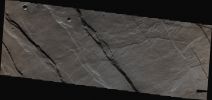
Volcanic_Features-Fractures-AM-PIA16499-PCF-LXTT-IPF.jpgFractures near and around Alba Mons (Absolute Natural Colors; credits for the additional process. and color.: Dr Paolo C. Fienga - Lunar Explorer Italia - Italian Planetary Foundation)80 visiteIn addition to its great size (consider that its Lava Flow Fields extend from over than 1400 Km from the Summit) and relatively low relief (the Summit of the Volcano reaches an elevation of "only" 6,8 Km as to the surrounding Lava Plains), Alba Mons possesses a number of other very distinguishing features. For instance, the central portion of the Volcano is surrounded by an incomplete Ring of Faults (---> Graben) and Fractures (like the ones that we see in today's APOD), called Alba Fossae (the ones located on the Volcano's Western Flank), and Tantalus Fossae (which are found on its Eastern Flank).
Alba Mons also has very long and well preserved Lava Flows that form a Radiating Pattern, starting from its Central Region. The enormous lengths of some individual Flow (something more than 300 Km - such as about 190 miles) implies that the Lavas which formed them were not only very fluid (---> meaning that they possessed very Low Viscosity) at the time of the eruption, but that they also must have been erupted in an extremely high volume (---> quantity). Many of the Flows have distinctive morphologies, consisting of long, sinuous Ridges with discontinuous Central Lava Channels. The low areas between the Ridges (and particularly along the Alba's Northern Flank) show a branching pattern of shallow Gullies and Channels (---> Valley Networks) that likely formed by water runoff. Last, but not least, Alba Mons shows, among other things, some of the oldest, and most extensively exposed Deposits that can be found in the whole Volcanic District of Tharsis.
Orbit Number: 47503
Latitude: 45,2558° North
Longitude: 248,587° East
Instrument: VIS
Captured: August, 29th, 2012
This frame (which is an Original Mars Odyssey Orbiter b/w frame published on the NASA - Planetary Photojournal with the ID n. PIA 16499) has been additionally processed and then colorized in Absolute Natural Colors (such as the colors that a human eye would actually perceive if someone were onboard the NASA - Mars Odyssey Orbiter and then looked down, towards the Surface of Mars), by using an original technique created - and, in time, dramatically improved - by the Lunar Explorer Italia Team.MareKromium
(3 voti)
|
|

Aeolian_Features-DD_Tracks-AP-PIA16473-PCF-LXTT-IPF.jpgDust Devils' Tracks in Arcadia Planitia (Absolute Natural Colors; credits for the additional process. and color.: Dr Paolo C. Fienga/Lunar Explorer Italia/Italian Planetary Foundation)82 visiteOrbit Number: 47093
Latitude: 62,264° North
Longitude: 194,781° East
Instrument: VIS
Captured: July, 26th, 2012MareKromium
(3 voti)
|
|

Volcanic_Features-Lava_Flows_in_Tharsis-PIA16335-PCF-LXTT-IPF.jpgLava Flows in Tharsis (Absolute Natural Colors; credits for the additional process. and color.: Dr Paolo C. Fienga/Lunar Explorer Italia/Italian Planetary Foundation)64 visiteOrbit Number: 48151
Latitude (centered): 11,2222° North
Longitude (East): 279,398°
Instrument: VIS
Captured: October, 21st, 2012MareKromium
(3 voti)
|
|

Craters-Brashear_Crater-Dunefield-PIA16337-PCF-LXTT-IPF.jpgThe Dunes of Brashear Crater (Absolute Natural Colors; credits for the additional process. and color.: Dr Paolo C. Fienga/Lunar Explorer Italia/Italian Planetary Foundation)68 visiteOrbit Number: 48153
Latitude (centered): 53,3619° South
Longitude (East): 240,455°
Instrument: VIS
Captured: October, 22nd, 2012MareKromium
(3 voti)
|
|
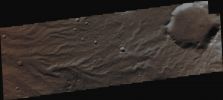
Channels-Unnamed_Channels_near_Huygens_Crater-PIA16322-PCF-LXTT-IPF.jpgUnnamed Channel near Huygens Crater (Absolute Natural Colors; credits for the additional process. and color.: Dr Paolo C. Fienga/Lunar Explorer Italia/Italian Planetary Foundation)78 visiteOrbit Number: 47248
Latitude: 16,8887° South
Longitude: 61,3382° East
Instrument: VIS
Captured: August, 8, 2012MareKromium
(3 voti)
|
|
| 1003 immagini su 84 pagina(e) |
|
|
|
|
|
43 | |
|
|
|
|
|
|





