| |

| Piú votate - Mars from Orbit (from July 2009) |

Craters-Holden_Crater-PIA03694-2.jpgDeposits inside Holden Crater (2)59 visitenessun commento
(4 voti)
|
|

Dunes-PIA03291-00.jpgDefrosted Dunes (Original NASA/JPL/ASU b/w Frame)60 visiteOriginal caption:"These Dark Dunes are Frost covered for most of the year but, as Southern Summer draws to a close, the Dunes have now been almost completely defrosted".
Image information: VIS instrument;
Latitude: 66,6° South;
Longitude: 37,0° East;
Resolution: 34 meter/pixel.
(4 voti)
|
|

Dunes-PaleoDunes-2.JPGPaleodunes (2 - Original NASA/MGS/MSSS b/w Frame)58 visiteCaption NASA:"A similar effect at a much smaller scale can be seen by examining some Sandstones and Siltstones on Earth (if conditions were right, ripples formed in either water or wind are preserved in such rocks). The first MOC view, labeled M03-00006, was taken on July 1, 1999. The second view, M07-05007, was acquired September 26, 1999. Both MOC images are illuminated from the left. The Dunefield is located East of the Apollinaris Patera volcano and North-East of Gusev Crater (at about 12,5° South Lat. and 181° West Long.)".
(4 voti)
|
|

Chaotic_Terrain-Jani_Chaos-PIA03200.jpgFeatures of Iani Chaos (Original NASA/2001 Mars Odyssey Orbiter b/w Frame)59 visitePiccolo promemoria: quando si parla di "chaos terrain", si tratta di un'area che è stata - letteralmente - privata di sostegno sotterraneo e che quindi è "crollata su se stessa" (---> "Chaos" is typically interpreted to be a collapse terrain; it is the blocky landscape after the transport and removal of subsurface support).
(4 voti)
|
|
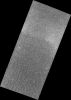
North_Polar_Regions-Olympia_Undae-PIA06848-00.jpgNorth Polar Erg: Olympia Undae (Original NASA/JPL/ASU b/w Frame)86 visiteImage information: VIS instrument;
Latitude: 81,4° North;
Longitude: 180,6° East (such as 179,4° West);
Resolution: 19 meter/pixel.
(4 voti)
|
|

North_Polar_Regions-Aspledon_Undae-PIA18237-PCF-LXTT-IPF.jpgAspledon Undae (Absolute Natural Colors; credits for the additional process. and color.: Dr Paolo C. Fienga/Lunar Explorer Italia/Italian Planetary Foundation)116 visiteIn this VIS image, taken by the NASA - Mars Odyssey Orbiter on February, 27th, 2014, and during its 54.150th orbit around the Red Planet, we can see a small portion of a Martian Region known as Aspledon Undae: one of the several large Dunefields located near the North Pole of Mars. The term Undae, as you can easily understand, comes from the Latin word "Unda" (---> Wave; plural Undae ---> Waves) and, in this specific case, as the image suggests quite clearly, means Dunes (better yet: Wave-shaped Dunes).
Latitude (centered): 72,4562° North
Longitude (centered): 307,9130° East
Instrument: VIS
This image (which is a crop taken from an Original Mars Odyssey Orbiter b/w and Map-Projected frame published on the NASA - Planetary Photojournal with the ID n. PIA 18237) has been additionally processed, magnified to aid the visibility of the details, contrast enhanced, Gamma corrected and then colorized in Absolute Natural Colors (such as the colors that a human eye would actually perceive if someone were onboard the NASA - Mars Odyssey Orbiter and then looked down, towards the Surface of Mars), by using an original technique created - and, in time, dramatically improved - by the Lunar Explorer Italia Team.MareKromium
(3 voti)
|
|

North_Polar_Regions-The_Erg-PIA18233-PCF-LXTT-IPF.jpgFeatures of the North Polar Erg (Absolute Natural Colors; credits for the additional process. and color.: Dr Paolo C. Fienga/Lunar Explorer Italia/Italian Planetary Foundation)65 visiteIn this VIS image, taken by the NASA - Mars Odyssey Orbiter on February, 26th, 2014, and during its 54.141st orbit around the Red Planet, we can see a small area of the North Polar Erg (---> Sea of Dunes). As the season changes from Spring to Summer, the Dunes surrounding the North Polar Cap, as you can see here, become darker and darker.
Only the round and bright Feature located on the left (Sx) margin of the frame (that we have already noticed in the past, when other pictures of this very same area were taken even by other Orbiters), seems to remain - basically - unchanged during the entire Martian Year. Unfortunately, we do not know what that Feature actually is, but our educated guess is that it could reasonably be a (relatively large) patch of Permanent Ice and Frost, thick and compacted enough to resist to the Winds' Action and then make it through the whole Martian Summer, when the temperature considerably raises, without sublimating or melting.
Latitude (centered): 79,7727° North
Longitude (centered): 198,7900° East
Instrument: VIS
This image (which is an Original Mars Odyssey Orbiter b/w and Map-Projected frame published on the NASA - Planetary Photojournal with the ID n. PIA 18233) has been additionally processed, magnified to aid the visibility of the details, contrast enhanced, Gamma corrected and then colorized in Absolute Natural Colors (such as the colors that a human eye would actually perceive if someone were onboard the NASA - Mars Odyssey Orbiter and then looked down, towards the Surface of Mars), by using an original technique created - and, in time, dramatically improved - by the Lunar Explorer Italia Team.
MareKromium
(3 voti)
|
|

North_Polar_Regions-North_Polar_Erg-PIA17866-PCF-LXTT-IPF-1.jpgSpring over the North Polar Erg (Absolute Natural Colors; credits for the additional process. and color.: Dr Paolo C. Fienga - Lunar Explorer Italia/Italian Planetary Foundation)79 visiteIn this VIS image, taken by the NASA - Mars Odyssey Orbiter on December, 1st, 2013, and during its 53.077th orbit around the Red Planet, we can see, once again, the Erg (---> Sea/Ocean of Dunes) that surrounds the North Polar Cap of Mars. It is Springtime, now, at the North Pole (---> in the Northern Hemisphere of Mars) and the Dunes are starting to lose their Frost cover. As the season continues towards Summer, the Dunes will appear darker and darker, as the Frost sublimates.
Specifically, throughout the accurate observation (and, even more, after the colorization) of the landscape that is shown here, we are able to easily notice that, in this portion of the North Polar Erg (a portion that is positioned a little more towards the South of the Northern Hemisphere - as compared to the Latitude of the Region observed during the 53.076th orbit of the NASA - Mars Odyssey Orbiter), there has been more Frost lost from the Dunes, and this circumstance caused them to appear darker than the Dunes that were shown in yesterday's APOD.
Latitude (centered): 79,990° North
Longitude (centered): 128,365° East
Instrument: VIS
This image (which is an Original Mars Odyssey Orbiter b/w and Map-Projected frame published on the NASA - Planetary Photojournal with the ID n. PIA 17866) has been additionally processed, magnified, contrast enhanced, Gamma corrected and then colorized in Absolute Natural Colors (such as the colors that a human eye would actually perceive if someone were onboard the NASA - Mars Odyssey Orbiter and then looked down, towards the Surface of Mars), by using an original technique created - and, in time, dramatically improved - by the Lunar Explorer Italia Team.MareKromium
(3 voti)
|
|

North_Polar_Regions-North_Polar_Erg-PIA17865-PCF-LXTT-IPF.jpgSpring over the North Polar Erg (Absolute Natural Colors; credits for the additional process. and color.: Dr Paolo C. Fienga - Lunar Explorer Italia/Italian Planetary Foundation)85 visiteIn this VIS image, taken by the NASA - Mars Odyssey Orbiter on December, 1st, 2013, and during its 53.076th orbit around the Red Planet, we can see the Erg (---> Sea/Ocean of Dunes) that surrounds the North Polar Cap of Mars. It is Springtime, now, at the North Pole (---> in the Northern Hemisphere of Mars) and the Dunes are starting to lose their Frost cover. As the season continues towards Summer, the Dunes will appear darker and darker, as the Frost sublimates.
The bright (and round, as we have found out using other frames) spot visible on the upper side of the picture should be just a patch of Permanent Ice which is located (and therefore, somehow, protected) inside a relatively shallow Depression of the Surface - possibly (but we have no way to be sure), an almost rimless and very old Impact Crater. You can take a look, if you wish to get a few more visual information about this area, at the APOD of April, 1st, 2013.
Latitude (centered): 80,267° North
Longitude (centered): 157,439° East
Instrument: VIS
This image (which is an Original Mars Odyssey Orbiter b/w and Map-Projected frame published on the NASA - Planetary Photojournal with the ID n. PIA 17865) has been additionally processed, magnified, contrast enhanced, Gamma corrected and then colorized in Absolute Natural Colors (such as the colors that a human eye would actually perceive if someone were onboard the NASA - Mars Odyssey Orbiter and then looked down, towards the Surface of Mars), by using an original technique created - and, in time, dramatically improved - by the Lunar Explorer Italia Team.MareKromium
(3 voti)
|
|

Craters-Unnamed_Craters-AP-PIA17856-PCF-LXTT-IPF.jpgCraters in Southern Amazonis Planitia (Absolute Natural Colors - Credits for the additional process. and color.: Dr Paolo C. Fienga/Lunar Explorer Italia/Italian Planetary Foundation)78 visiteIn this VIS image, taken by the NASA - Mars Odyssey Orbiter on November, 20th, 2013, and during its 52.949th orbit around the Red Planet, we can see two Impact Craters - with a compact Ejecta Blanket - that stand out above the surrounding Surface (these Craters are technically defined as "Pedestal Craters") and one - slightly bigger than the first two - Impact Crater that has been almost completely buried, most likely, by a Flow of Volcanic Material (you can see that only the small upper portion of the Outer Rim of this Crater can still be seen, with two small Buttes located to the North/East).
The Ejecta Blanket of the two Pedestal Craters has remained in place, while the surrounding Material was, in time, removed by the action of powerful Winds and, as a matter of fact, here, in this (Southern Side) of the Martian Region known as "Amazonis Planitia", an extensive phenomenon of Wind-related Erosion is quite common. Amazonis Planitia is one of the smoothest Volcanic Plains that can be found on Mars and it is located between the Tharsis and Elysium Volcanic Provinces, to the West of Olympus Mons, in the Amazonis and Memnonia Quadrangles.
This Martian Region is centered at 24,8° North Latitude and 196° East Longitude and, just out of curiosity, the Plain's Topography exhibits extremely smooth Surface Features at several different lengths of scale.
Latitude (centered): 6,131° North
Longitude (centered): 194,416° East
Instrument: VIS
This image (which is an Original Mars Odyssey Orbiter b/w and Map-Projected frame published on the NASA - Planetary Photojournal with the ID n. PIA 17856) has been additionally processed, magnified, contrast enhanced, Gamma corrected and then colorized in Absolute Natural Colors (such as the colors that a human eye would actually perceive if someone were onboard the NASA - Mars Odyssey Orbiter and then looked down, towards the Surface of Mars), by using an original technique created - and, in time, dramatically improved - by the Lunar Explorer Italia Team.MareKromium
(3 voti)
|
|

Aeolian_Features-Windstreaks-SMP-PIA17683-PCF-LXTT-IPF.jpgWindstreaks in Syrtis Major Planum (EDM - Absolute Natural Colors; credits for the additional process. and color.: Dr Paolo C. Fienga/Lunar Explorer Italia/Italian Planetary Foundation)83 visiteIn this VIS image, taken by the NASA - Mars Odyssey Orbiter on September, 24th, 2013, and during its 52.254th orbit around the Red Planet, we can see (an count) a series of at least 8 (eight) Windstreaks (probably the most common Aeolian - meaning Wind-caused/related - Surface Feature found on Mars), which are located in the (VERY dark, as far as its Albedo - Reflectivity - is concerned) Region known as Syrtis Major Planum.
Syrtis Major Planum - when observed through a telescope - looks like a "Dark Spot" (---> Albedo Feature) located at the Boundary between the Northern Lowlands and Southern Highlands of Mars, just West of the large Impact Basin known as Isidis Planitia. In fact, Syrtis Major Planum was discovered, on the base of data collected by the NASA - Mars Global Surveyor Orbiter, to be a low-relief Shield Volcano, when it was formerly believed to be just a Plain (and it was then known as Syrtis Major Planitia). The very dark color of its Surface comes - most likely - from the Basaltic Volcanic Rocks that form (---> are found all over) the Region and a corresponding (and relative) relative lack of the Red/Orange Dust that covers most of the Red Planet.
Latitude (centered): 5,90248° North
Longitude (centered): 69,73730° East
Instrument: VIS
This image (which is an Original Mars Odyssey Orbiter b/w and Map-Projected frame published on the NASA - Planetary Photojournal with the ID n. PIA 17683) has been additionally processed, magnified, contrast enhanced, Gamma corrected and then colorized in Absolute Natural Colors (such as the colors that a human eye would actually perceive if someone were onboard the NASA - Mars Odyssey Orbiter and then looked down, towards the Surface of Mars), by using an original technique created - and, in time, dramatically improved - by the Lunar Explorer Italia Team.MareKromium
(3 voti)
|
|

Craters-Unnamed_Crater-NT-PIA17420-PCF-LXTT-IPF.jpgUnnamed Crater with Dunefield (Absolute Natural Colors; credits for the additional process. and color.: Dr Paolo C. Fienga/Lunar Explorer Italia/Italian Planetary Foundation)62 visiteIn this VIS image, taken by the NASA - Mars Odyssey Orbiter on July 2nd, 2013, and during its 51.232nd orbit around the Red Planet, we can see a relatively large, dark and, probably, "Migrating" Dunefield that is found on the Floor of an old and Unnamed Impact Crater located in the Martian Southern Region known as Noachis Terra.
Even this Dunefield (just like the one found on the Floor of Proctor Crater - please, refer to yesterday's APOD if you want to know more -, as well as many others, located on both Martian Hemispheres) is being monitored by several Spacecrafts now orbiting the Red Planet (including the NASA- Mars Reconnaissance Orbiter) with the aim of identifying the movements (---> shifting, if any) of the Dunefield and the changes (again, if any) which might have occurred - over time - in the shape of the Dunefield itself.
Latitude (centered): 52,1373° South
Longitude (centered): 30,6046° East
Instrument: VIS
This frame (taken from an Original Mars Odyssey Orbiter b/w and Map-Projected frame published on the NASA - Planetary Photojournal with the ID n. PIA 17420) has been additionally processed, magnified, contrast enhanced, Gamma corrected and then colorized in Absolute Natural Colors (such as the colors that a human eye would actually perceive if someone were onboard the NASA - Mars Odyssey Orbiter and then looked down, towards the Surface of Mars), by using an original technique created - and, in time, dramatically improved - by the Lunar Explorer Italia Team.MareKromium
(3 voti)
|
|
| 1003 immagini su 84 pagina(e) |
|
|
|
|
|
42 | |
|
|
|
|
|
|





