| Piú votate - Mars from Orbit (from July 2009) |
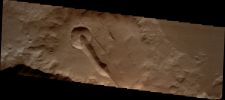
Collapse_Features-Sirenum_Fossae-20090402a-PCF-LXTT.jpgInteraction in Sirenum Fossae (Saturated Natural Colors; credits for the additional process. and color.: Dr Paolo C. Fienga - Lunar Explorer Italia)57 visiteCaption NASA:"This VIS image of part of the Sirenum Fossae shows an important interaction. The small crater in the center of the image is cut by a large fracture of the Fossae System, while the its ejecta cover a small fracture located just North-West of it.
This image indicates that the Fracture System was active both before and after the time of the impact and crater creation".
Coord.: 24,3° South Lat. and 220,0° East Long.MareKromium
(4 voti)
|
|
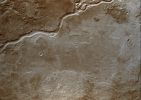
Channels-Apsus_Vallis-PIA02170-PCF-LXTT-00.jpgApsus Vallis (1 - Natural Colors; credits for the additional process. and color.: Dr Paolo C. Fienga - Lunar Explorer Italia)61 visiteThe channel in this image is called Apsus Vallis and it is located near the Elysium volcanic complex. Lava may have played a part in the formation of Apsus Vallis.
Image information: VIS instrument;
Latitude: 35,3° North;
Longitude: 134,9° East;
Resolution: 19 meter/pixelMareKromium
(4 voti)
|
|
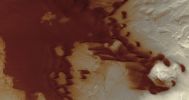
Dunes-Ganges_Chasma-2005_07.jpgThe Dark Dunes of Ganges Chasma (Eastern Valles Marineris - Saturated Natural Colors; credits for the additional process. and color.: Dr Paolo C. Fienga - Lunar Explorer Italia)91 visitenessun commentoMareKromium
(4 voti)
|
|
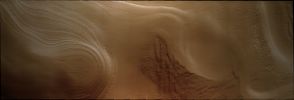
South_Polar_Regions-Layers_and_Dunes-MO-20090324a-PCF-LXTT.jpgSouth Polar Spring (Enhanced Absolute Natural Colors; credits for the additional process. and color.: Dr Paolo C. Fienga - Lunexit Team)69 visiteCoord.: 84,6° South Lat. and 315,8° East Long.MareKromium
(4 voti)
|
|
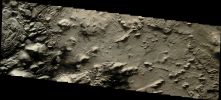
Aeolian_Features-Yardangs-Eolis_Planum-20090310a-PCF-LXTT.jpgFeatures of Eolis Planum (Natural Colors; credits for the additional process. and color.: Dr Paolo C. Fienga - Lunar Explorer Italia)58 visiteCoor.: 7,2° South Lat. and 150,8° East Long.MareKromium
(4 voti)
|
|
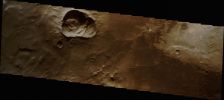
Craters-Herschel_Crater-Dunefield-20090303a-PCF-LXTT.jpgDunefield inside Herschel Crater (Extremely Enhanced Natural Colors; credits for the additional process. and color.: Dr Paolo C. Fienga - Lunexit Team)59 visiteCoord.: 15,5° South Lat. and 131,7° East Long.MareKromium
(4 voti)
|
|
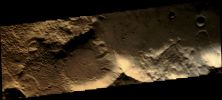
Landslide-Terra_Sirenum-20090302a-PCF-LXTT.jpgLandslide in Terra Sirenum (Enhanced Natural Colors; credits: Dr Paolo C. Fienga - Lunar Explorer Italia)68 visiteCoord.: 11,6° South Lat. and 186,9° East Long.MareKromium
(4 voti)
|
|
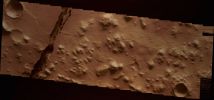
Volcanic_and_Tectonic_Features-Fissures-Cerberus_Fossae-20090213a-PCF-LXTT.jpgFeatures of Cerberus Fossae: Fissures (Saturated Natural Colors; credits for the additional process. and color.: Dr Paolo C. Fienga - Lunar Explorer Italia)57 visiteCaption NASA:"The depression seen in this image is part of the fracture system called Cerberus Fossae. The Fossae cut through hills as well as plains materials".
Coord.: 10,4° North Lat. and 159,9° East Long.MareKromium
(4 voti)
|
|
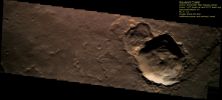
Craters-Unnamed_Crater-20080218a-PCF-LXTT.jpgNot Round... (Enhanced Natural Colors; credits for the additional process. and color.: Dr Paolo C. Fienga - Lunexit Team)60 visiteCaption NASA:"There are several reasons that an impact crater may end up not being round. Preexisting faults and fractures in the ground can control how the impact energy is distributed, resulting in corners or straight walls along the fracture trends. Very low angle impacts (from 5 up to 12°) can 'skip' along the surface, creating an elongated crater".
MareKromium
(4 voti)
|
|

Craters-Unnamed_Crater_with_Dunefield-UP-20090204a-PCF-LXTT.jpgUnnamed Crater with Dunefield in Utopia Planitia (Enhanced Natural Colors; credits for the additional process. and color.: Dr Paolo C . Fienga - Lunar Explorer Italia)56 visiteCaption NASA:"The floor of this Unnamed Crater in Utopia Planitia has the typical pattern of Northern Craters: a pattern that suggests volatiles are part of the material filling the Crater.
In this crater, sand dunes are also located on the Crater Floor".MareKromium
(4 voti)
|
|
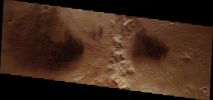
Craters-Du_Martheray_Crater-Dunefield-20090128a-PCF-LXTT.jpgDunes within Du Martheray Crater (Natural Colors; credits for the additional process. and color.: Dr Paolo C. Fienga - Lunar Explorer Italia)58 visiteCaption NASA:"This VIS image shows the Northern part of Du Martheray Crater and the smaller crater on its Rim. Both craters have floor features showing evidence of both wind erosion and wind deposition. The small, dark sand dunes are easily seen against the brighter eroded background".
Coord.: 5,8° North Lat. and 94,0° East Long.
MareKromium
(4 voti)
|
|
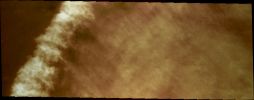
Clouds-Vastitas_Borealis_Region-PCF-LXTT-2.jpgClouds over Vastitas Borealis (Enhanced Natural Colors; credits for the additional process. and color.: Dr Paolo C. Fienga - Lunar Explorer Italia)58 visiteCaption NASA:"Dust Clouds often can obscure the Surface of Mars. When an image captures the edge of a Dust Storm Front, the loss of surface information is more than compensated for by the information that can be gleaned from analysis of the image.
As Dust Storm formation and location are unpredictable, any images of such features are priceless".
Coord.: 66,2° North. Lat. and 248,7° East Long.MareKromium
(4 voti)
|
|
| 1003 immagini su 84 pagina(e) |
 |
|
|
|
|
39 | |
|
|
|
|





