| Piú votate - Mars from Orbit (from July 2009) |

Channels-Hephaestus_Fossae-20100111a.jpgHephaestus Fossae (Natural Colors; credits: Dr Paolo C. Fienga - Lunexit Team)59 visiteThe Channels visible in this VIS image are called "Hephaestus Fossae" and were most likely formed by Lava Flows and Eolian Erosion, rather than Water Erosion.
MareKromium
(4 voti)
|
|
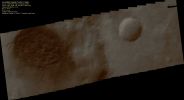
Craters-Unnamed_Crater-PIA12431.jpgDunefield (Natural Colors; credits: Dr Paolo C. Fienga - Lunexit Team)58 visitenessun commentoMareKromium
(4 voti)
|
|

Channels-Tharsis_Region-PIA12407.jpgOlympica Fossae (Natural Colors; credits: Lunexit)61 visiteCaption NASA:"Called Olympica Fossae, these channel-forms were created by Lava Flows rather than water".MareKromium
(4 voti)
|
|
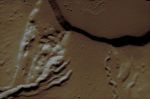
Volcanoes-Ceraunius_Tholus-00.jpgFeatures of Ceraunius Tholus (Absolute Natural Colors; credits for the additional process. and color: Dr Paolo C. Fienga - Lunexit Team)59 visiteCaption NASA originale:"This image shows part of the Summit Caldera of Ceraunius Tholus. Channels are common on the flanks of this Volcano".
Coord.: 23,9° North Lat. and 262,7° East Long.MareKromium
(4 voti)
|
|

Windstreaks-SyrtisMajor-20091125a.jpgWindstreaks (Natural Colors; credits: Lunexit)59 visitenessun commentoMareKromium
(4 voti)
|
|

Dunes-NoachisTerra-20091123a.jpgSmall Dunefield in Noachis Terra (Natural Colors; credits: Lunexit)58 visitenessun commentoMareKromium
(4 voti)
|
|
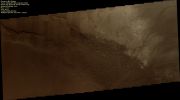
Dunes-NiliPatera-20091120a.jpgDunefield in Nili Patera (Absolute Natural Colors; credits: Lunar Explorer Italia)57 visitenessun commentoMareKromium
(4 voti)
|
|
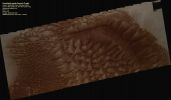
Craters-Russel_Crater-20091019a.jpgUnusually-looking Dunefield inside Russel Crater (Natural Colors; credits: Lunexit)74 visitenessun commentoMareKromium
(4 voti)
|
|
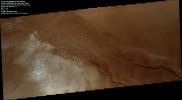
Dunes-NiliPatera-20091008a.jpgLarge Dunefield in Nili Patera (possible Natural Colors; credits: Lunexit)57 visitenessun commentoMareKromium
(4 voti)
|
|

ArcadiaPlanitia-PIA12215.jpgFresh Impact in Arcadia Planitia (Natural Colors; credits: Lunexit)61 visiteThe team operating the Context Camera (CTX) aboard NASA's Mars Reconnaissance Orbiter frequently discovers new dark spots on Mars that, upon closer examination, turn out to be brand new impact craters. Sometimes only a single crater is present, but often there is a cluster of several craters.
Depending on the patterns and size, Crater Clusters are interpreted as indicating that the incoming meteorite broke apart before it hit the Surface.
In some cases, clusters could be formed by ejecta from other, larger impact craters.
Shown above are subframes of two Context Camera images of terrain in Western Arcadia Planitia (near 46,7° North Latitude and 183,2° West Longitude). Each covers an area about 6,5 Km (about 4 miles) across.MareKromium
(4 voti)
|
|
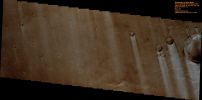
Windstreaks-Syrtis_Major-20090915a.jpgWindstreaks in Syrtis Major (Natural Colors; credits: Lunar Explorer Italia)58 visitenessun commentoMareKromium
(4 voti)
|
|
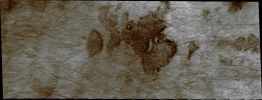
DustDevilTracks-Aonia_Terra-20090916a.jpgDust Devil Tracks in Aonia Terra (Natural Colors; credits: Lunar Explorer Italia)57 visiteCoord.: 62,7° South Lat. and 253,3° East Long.MareKromium
(4 voti)
|
|
| 1003 immagini su 84 pagina(e) |
 |
|
|
|
|
37 | |
|
|
|
|





