| Piú votate - Mars from Orbit (from July 2009) |
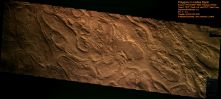
Polygons-Hellas_Basin-20080328a.jpgPolygons in Hellas Basin (Enhanced Natural Colors; credits for the additional process. and color.: Dr Paolo C. Fienga - Lunexit Team)57 visiteCaption NASA:"This interesting image shows a small portion of the Western Floor of Hellas Basin. The curved, broad ridges are separated by lower elevations filled with smaller, linear ridges". MareKromium
(5 voti)
|
|
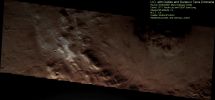
Craters-Unnamed_Crater-Terra_Cimmeria_Region-20080125a-PCF-LXTT.jpgUnnamed Crater with Gullies and Small Dunefield in Terra Cimmeria (Enhanced Natural Colors; credits for the additional process. and color.: Dr Paolo C . Fienga - Lunar Explorer Italia)56 visiteAvviso: questo frame (al pari di moltissimi altri di recente pubblicazione) è stato sottoposto a procedura correttiva del colore. Un poco alla volta, tutti i frames orbitali a colorizzazione multispettrale verranno rivisti e migliorati, usando il procedimento MULTISPECTRUM-2.MareKromium
(5 voti)
|
|
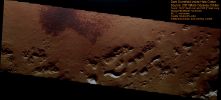
Craters-Hale_Crater-Dunes-20071210a-PCF-LXTT.jpgFeatures of Hale Crater (Darkened Absolute Natural Colors; credits for the additional process. and color: Dr Paolo C. Fienga - Lunexit Team)56 visitenessun commentoMareKromium
(5 voti)
|
|
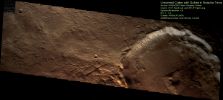
Craters-Unnamed_Crater-20080124a-PCF-LXTT.jpgUnnamed Crater in Noachis Terra (Enhanced Natural Colors; credits for the additional process. and color.: Dr Paolo C. Fienga - Lunexit Team)57 visitenessun commentoMareKromium
(5 voti)
|
|

Dunes-Terra_Sabaea-20080707a-PCF-LXTT.jpgLarge Dunefield in Terra Sabaea (Natural Colors; credits for the additional process. and color.: Dr Paolo C. Fienga - Lunexit Team)56 visitenessun commentoMareKromium
(5 voti)
|
|
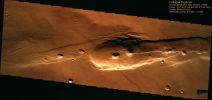
Volcanic_Features-Collapse_Pits-Alba_Patera-20080618a-PCF-LXTT-00.jpgCollapse Features near Alba Patera (Enhanced and Saturated Natural Colors; credits for the additional process. and color.: Dr Paolo C. Fienga - Lunexit Team)66 visiteCaption NASA:"Alba Patera is a very large old volcano on the surface of Mars. While still impressive in height, it no longer towers over the surrounding plains.
It is thought that after a major eruption that emptied the magma chamber beneath Alba Patera the entire volcano collapsed into the empty space below.
This collapse is marked by extensive fracturing. This VIS image shows collapse features on a much smaller scale".MareKromium
(5 voti)
|
|

Craters-Unnamed_and_Frozen_Crater-20080609a-PCF-LXTT.jpgShallow (and partially frozen) Unnamed Crater in Vastitas Borealis (Saturated Natural Colors; credits for the additional process. and color.: Dr Paolo C. Fienga - Lunexit Team)57 visiteCaption NASA:"Located at high Northern Latitude, the floor of this Unnamed Crater shows a typical surface texture - polygonal ground.
On Earth, this surface texture is found above permafrost and is believed to be caused by freeze/thaw cycle of water moving larger material upward".
Coord.: 66,4° North Lat. and 99,7° East Long.MareKromium
(5 voti)
|
|
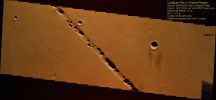
Volcanic_Features-Collapse_Pits-Tharsis_Region-20080526a-PCF-LXTT-00.jpgCollapse Pits in Tharsis Region (Enhanced and Saturated Natural Colors; credits for the additional process. and color.: Dr Paolo C. Fienga - Lunexit Team)58 visiteCaption NASA:"This chain of Collapse Pits occurs within one of the many tectonic graben of the Tharsis Region".MareKromium
(5 voti)
|
|
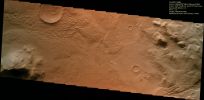
Craters-Cerulli_Crater-20080321a-PCF-LXTT.jpgFeatures of Cerulli Crater (Saturated Natural Colors; credits for the additional process. and color.: Dr Paolo C. Fienga - Lunexit Team)56 visitenessun commentoMareKromium
(5 voti)
|
|

Craters-Reynolds_Crater-20080115a-PCF-LXTT.jpgDunefield inside Reynolds Crater (Natural Colors; credits for the additional process. and color.: Dr Paolo C. Fienga - Lunexit Team)61 visiteCaption NASA:"These interesting dune-forms are located on the margin of Remnant Polar Deposits on the floor of Reynolds Crater".
Coord.: 74,3° South Lat. and 199,9° East Long.MareKromium
(5 voti)
|
|
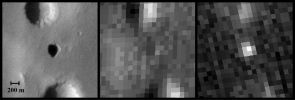
Volcanic_Features-Caverns-PIA09929-01.jpgOn the Northern Slope of Arsia Mons: candidate Cavern Entrance (Annie)57 visiteCaption NASA:"Each of the 3 images in this set covers the same patch of Martian Ground, centered on a possible cave skylight informally called "Annie" which has a diameter about double the length of a football field. The THEMIS camera on NASA's Mars Odyssey orbiter took all 3, gathering information that the hole is cooler than surrounding surface in the afternoon and warmer than the surrounding surface at night. This is thermal behavior that would be expected from an opening into an underground space.
The left image was taken in visible-wavelength light (fig. 1). The other 2 were taken in Thermal Infrared Wavelengths, indicating the relative temperatures of features in the image. The center image is from mid-afternoon. The hole is warmer than the shadows of nearby pits to the North and South, while cooler than sunlit surfaces. The thermal image at right was taken in the pre-dawn morning, about 4 M.L.T. .
At that hour, the hole is warmer than all nearby surfaces".
Nota Lunexit: ovviamente non era necessario nè uno scienziato nè un veggente per anticipare le mosse (di buon senso) della NASA, ma il fatto che i Tecnici di Pasadena abbiano effettivamente operato non solo delle riprese notturne di questa interessante Surface Feature, ma anche dei rilievi IR - come da noi suggerito ed anticipato, sebbene a proposito di un'altra (e forse più famosa) Candidate Cavern Entrance - ci ha dato, onestamente, una notevole soddisfazione!MareKromium
(5 voti)
|
|

Craters-Unnamed_Crater_with_possible_Oil_Lake-V07738009-PCF-LXTT-04.jpgMigrating Dunes, Dirty Waters or maybe Surfacing Hydrocarbons? (5 - Natural Colors; credits for the additional process. and color.: Dr Paolo C. Fienga - Lunexit Team)56 visitenessun commentoMareKromium
(5 voti)
|
|
| 1003 immagini su 84 pagina(e) |
 |
|
|
|
|
21 | |
|
|
|
|





