| Piú votate - Mars from Orbit (from July 2009) |
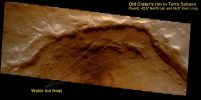
Craters-Unnamed_Crater_in_Terra_Sabaea-PCF-LXTT.jpgWhat's on the Rim? (Enhanced Natural Colors; credits for the additional process. and color.: Dr Paolo C. Fienga - Lunar Explorer Italia)56 visiteCaption NASA:"This old crater in Terra Sabaea has patterned floor material that is indicative of having a volitile component. At high latitudes the volitile is most likely ice".
MareKromium
(5 voti)
|
|

Craters-Unnamed_Crater_with_Dark_Slope_Streaks-HC-MO-PCF-LXTT.jpgDark Slope Streaks (Saturated Natural Colors; credits for the additional process. and color.: Dr Paolo C. Fienga - Lunexit Team)56 visiteSource: NASA/2001 Mars Odyssey Orbiter
Coord.: 13,6° North Lat. and 21,2° East Long. (center of the frame)
Credits: NASA/JPL/Arizona State University (ASU)
Additional process. and color.: Lunar Explorer ItaliaMareKromium
(5 voti)
|
|
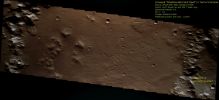
Landslides-Terra_Cimmeria-20080429a-PCF-LXTT.jpgJust a "Shadow"? (Enhanced Natural Colors; credits: Dr Paolo C. Fienga - Lunar Explorer Italia)56 visitenessun commentoMareKromium
(5 voti)
|
|

Channels-Unnamed_Channel_in_Terra_Sabaea.jpgUnnamed Channel in Terra Sabaea (Natural Colors/Tri-Chromatic Version; credits: Dr Paolo C. Fienga - Lunexit Team)58 visitenessun commentoMareKromium
(5 voti)
|
|
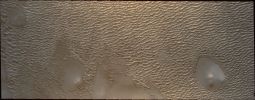
North_Polar_Features-The_Erg-PCF-LXTT-0.jpgThe "North Polar Erg" (Natural Colors; credits for the additional process. and color.: Dr Paolo C. Fienga - Lunexit Team)71 visiteCoord.: 79,3° North Lat. and 181,0° East Long.MareKromium
(5 voti)
|
|
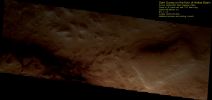
Dunes-Dunefield_in_Hellas_Basin-20080118a-PCF-LXTT.jpgDark Dunefield in Hellas Basin (Darkened Natural Colors; credits for the additional process. and color.: Dr Paolo C. Fienga - Lunexit Team)60 visitenessun commento
MareKromium
(5 voti)
|
|
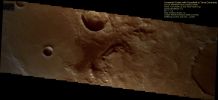
Craters-Unnamed_Crater_with_Dunefield-Terra_Cimmeria-PCF-LXTT.jpgUnnamed Crater with small Dunefield (Natural Colors; credits for the additional process. and color.: Dr Paolo C. Fienga - Lunexit Team)57 visitenessun commentoMareKromium
(5 voti)
|
|
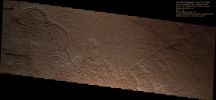
Avernus_Colles-Blocks-AC-MO.jpgAvernus Colles (Natural Colors; Credits for the additional process. and color.: Dr Paolo C. Fienga - Lunexit Team)58 visiteCaption NASA:"Called Averuns Colles, these broken blocks and arcuate fractures mark the Transition Region between the Southern Highlands and the Northern Lowlands of Mars".
MareKromium
(5 voti)
|
|

Craters-Unnamed_Crater-Utopia_Planitia-PCF-LXTT-1.jpgUnnamed Crater with Gullies and Small Dunefield in Utopia Planitia (Saturated Natural Colors; credits for the additional process. and color.: Dr Paolo C . Fienga - Lunar Explorer Italia)57 visitenessun commentoMareKromium
(5 voti)
|
|

Craters-Arkhangelsky_Crater-Dunefield-20080416a-PCF-LXTT.jpgThe Dunes of Arkhangelsky Crater (Darkened Natural Colors; credits for the additional process. and color.: Dr Paolo C. Fienga - Lunexit Team)57 visitenessun commentoMareKromium
(5 voti)
|
|
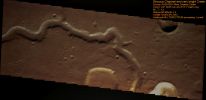
Channels-Unnamed_Channel-20071213a~0.jpgUnnamed Channel (Natural Colors/Tri-Chromatic Version; credits: Dr Paolo C. Fienga - Lunexit Team)61 visitenessun commentoMareKromium
(5 voti)
|
|

Clouds-PCF-LXTT.jpgNorth Polar Clouds and Surface (Natural Colors; credits for the additional process. and color.: Dr Paolo C. Fienga - Lunexit Team)58 visiteCaption NASA:"When winds that have swept across the North Polar Ice encounter a trough in the ice, the laminar flow slows at the base of the trough, producing a turbulent wind regime that is easily recognized in the clouds formed in the trough".
MareKromium
(5 voti)
|
|
| 1003 immagini su 84 pagina(e) |
 |
|
|
|
|
20 | |
|
|
|
|





