| Piú votate - Mars from Orbit (from July 2009) |

Landforms-PIA08505-01.jpgFeatures of the Southern Highlands (1 - Original NASA/JPL/ASU b/w Frame)55 visiteImage information: VIS instrument;
Latitude: 69,4° South;
Longitude: 8,6° East;
Resolution: 17 meter/pixel. 
(6 voti)
|
|
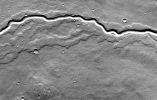
Volcanic_Features-Lava_Channel-ElysiumMons-PIA08491-00.jpgVolcanic River (1 - Original NASA/JPL/ASU b/w Frame)56 visiteImage information: VIS instrument;
Latitude: 13,9° North;
Longitude: 145,8° East;
Resolution: 18 meter/pixel.
(6 voti)
|
|
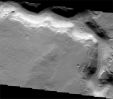
Channels-Auqakuh_Vallis-PIA08465-00.jpgFeatures of Auqakuh Vallis (Original NASA/JPL/ASU b/w Frame)73 visiteImage information: VIS instrument;
Latitude: 31,0° North;
Longitude: 60,6° East;
Resolution: 19 meter/pixel.
(6 voti)
|
|

Hills-Knob-Elysium_Planitia-PIA08079-00.jpgBizarre "Knob" in Elysium Planitia (Original NASA/JPL/ASU b/w Frame)54 visiteImage information: VIS instrument;
Latitude: 1,1° South;
Longitude: 156,0° East;
Resolution: 18 meter/pixel.
(6 voti)
|
|
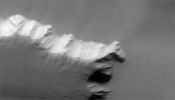
Chasmas-Echus_Chasma-PIA08022-01.jpgDust Avalanches in Echus Chasma (2)61 visitenessun commento
(6 voti)
|
|
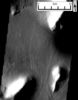
Islands.jpgThe Islands of Mars (Original NASA-2001 Mars Odyssey Orbiter b/w Frame)55 visiteNew HR images of mid-latitude Mars are revealing glacier-formed landscapes far from the Martian Poles, says a leading Mars Researcher.
Conspicuous trains of debris in valleys, arcs of debris on steep slopes and other features far from the polar ice caps bear striking similarities to glacial landscapes of Earth, says Brown University's James Head III. When combined with the latest climate models and orbital calculation for Mars, the geological features make a compelling case for Mars having ongoing climate shifts that allow ice to leave the poles and accumulate at lower latitudes.
"The exciting thing is a real convergence of these things, said Head, who will present the latest Mars climate discoveries on Sunday, 16 October, at the Annual Meeting of the Geological Society of America in Salt Lake City (Utah). "For decades people have been saying that deposits at mid and equatorial latitudes look like they are ice-created, said Head. But without better images, elevation data and some way of explaining it, ice outside of Mars' polar regions was a hard sell.
Now high-resolution images from the Mars Odyssey spacecraft's Thermal Emission Imaging System combined with images from the Mars Global Surveyor spacecraft's Mars Orbiter Camera and Mars Orbiter Laser Altimeter can be compared directly with glacier features in mountain and polar regions of Earth. The likenesses are hard to ignore.
For instance, consider what Head calls "lineated valley fill." These are lines of debris on valley floors that run downhill and parallel to the valley walls, as if they mark some sort of past flow. The same sorts of lines of debris are seen in aerial images of Earth glaciers. The difference is that on Mars the water ice sublimes away (goes directly from solid ice to gas, without any liquid phase between) and leaves the debris lines intact. On Earth the lines of debris are usually washed away as a glacier melts.
(6 voti)
|
|

Aeolian_Features-Windstreaks-Daedalia_Planum_Region-PIA03050.jpgWindstreak in Daedalia Planum (RAW and b/w NASA Original Frame)55 visiteOriginal caption:"This MGS-MOC image shows a wind streak formed in the lee of an impact crater in western Daedalia Planum".
Location near: 12,7° S; 136,6° W
Image width: width: ~3 Km (~1,9 mi)
Illumination from: lower left
Season: Southern Spring
(6 voti)
|
|

Craters-Unnamed_Secondary_Crater-PIA04106.jpgPossible Secondary Crater (Original NASA/JPL/ASU b/w Frame)54 visitenessun commento
(6 voti)
|
|

Aeolian_Features-Windstreaks-PIA03932.jpgWindstreaks near Meroe Patera (Original NASA/2001 Mars Odyssey Orbiter b/w Frame)54 visiteCaption NASA originale:"These Windstreaks are located on the Lava Flows of Meroe Patera, Syrtis Major Planum Region".
Image information: VIS instrument
Latitude 5,7; Longitude 73,2 East (286,8 West)
36 meter/pixel resolution
(6 voti)
|
|

Craters-Unnamed_Craters-PIA07330.jpg"Picasso" on Mars81 visitenessun commento
(6 voti)
|
|
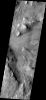
Channels-Reull_Vallis-2001MO-PIA06948_modest-02.jpgReull Vallis (Original NASA/2001 Mars Odyssey Orbiter b/w Frame)86 visiteLa terza immagine ripresa dalla Sonda 2001 Mars Odyssey non aggiunge altro a quanto già si poteva chiaramente vedere con i due frames precedenti (il secondo in particolare). E' comunque una spettacolare ripresa su cui vale la pena soffermare il nostro sguardo e la nostra attenzione.
(6 voti)
|
|

Lycus_Sulci-PIA18236-PCF-LXTT-IPF.jpgLycus Sulci in broad Daylight (Absolute Natural Colors; credits for the additional process. and color.: Elisabetta Bonora and Marco Faccin/LXTT/IPF)132 visiteIn this VIS image, taken by the NASA - Mars Odyssey Orbiter on February, 26th, 2014, and during its 54.147th orbit around the Red Planet, we can see a very small (but well illuminated) portion of the Martian Region known as Lycus Sulci: a Complex Region - mostly covered by Ridges - thst is located on the Northern Side of the largest and tallest Mountain of the Solar System: the Shield-Volcano known as Olympus Mons.
On the illuminated Slopes of the Ridges, a number of Dark Striations (perhaps Seeps, or maybe simple Dust-Slides) can be easily spotted and, furthermore, if you look carefully at the picture, you will also be able to see, in between the Ridges themselves, a complex network of tiny Sand Ripples, Out of curiosiity, the term "Sulci" (from the Latin word "Sulcus") means a System of Sub-Parallel Furrows (---> long and narrow Trenches) and Ridges.
Latitude (centered): 31,6354° North
Longitude (centered): 220,3990° East
Instrument: VIS
This image (which is a crop taken from an Original Mars Odyssey Orbiter b/w and Map-Projected frame published on the NASA - Planetary Photojournal with the ID n. PIA 18236) has been additionally processed, magnified to aid the visibility of the details, contrast enhanced and sharpened, Gamma corrected and then colorized in Absolute Natural Colors (such as the colors that a human eye would actually perceive if someone were onboard the NASA - Mars Odyssey Orbiter and then looked down, towards the Surface of Mars), by using an original technique created - and, in time, dramatically improved - by the Lunar Explorer Italia Team.MareKromium
(5 voti)
|
|
| 1003 immagini su 84 pagina(e) |
 |
|
|
|
|
12 | |
|
|
|
|





