| Piú votate - Titan: The "Foggy" Moon |

Titan-PIA14602.jpgTitan (Natural Colors; credits: NASA/JPL-Caltech/Space Science Institute)99 visiteCaption NASA:"Titan's Atmosphere makes Saturn's largest moon look like a 'fuzzy orange ball' in this Natural Color view from the Cassini Spacecraft. Titan's North Polar Hood is visible at the top of the image, and a faint blueish Haze also can be detected above the South Pole at the bottom of this view. Recent Cassini images suggest Titan's North Polar Vortex, or 'Hood', is beginning to flip from North to South (see PIA14913). This view looks toward the Anti-Saturn Side of Titan. North is up.
Images taken using red, green and blue spectral filters were combined to create this Natural Color view. The images were obtained with the Cassini Spacecraft wide-angle camera on Jan. 30, 2012 at a distance of approximately 119.000 miles (about 191.000 Km) from Titan. Image scale is roughly 7 miles (about 11 Km) per pixel".MareKromium
(4 voti)
|
|

Titan_and_Dione-PIA14910.jpgTitan and Dione (Natural Colors; credits: NASA/JPL-Caltech/Space Science Institute)104 visiteCaption NASA:"Saturn's third-largest moon, Dione, can be seen through the Haze of the Ringed-Planet's largest moon, Titan, in this Cassini Spacecraft's view of the two, just posing before Saturn and its Rings. The North Polar "Hood" of Titan can be seen appearing as a detached layer at its top
This view looks toward the sides of Titan and Dione that are facing away from Saturn. North is up on both moons. This view looks toward the Northern, sunlit side of the Rings from just above the Ring-Plane.
Images taken using red, green and blue spectral filters were combined to create this Natural Color view. The images were obtained with the Cassini Spacecraft narrow-angle camera on May 21, 2011, at a distance of approx. 1,4 MMs (such as about 2,3 MKM) from Titan and approx. 2 MMs (such as about 3,2 MKM) from Dione. Image scale is roughly 9 miles (about 14 Km) per pixel on Titan and roughly 12 miles (approx. 19 Km) on Dione".MareKromium
(4 voti)
|
|

Titan-PIA14913-1.jpgThe South Polar Atmosphere of Titan (EDM - Natural Colors; credits: NASA/JPL-Caltech/Space Science Institute)150 visitenessun commentoMareKromium
(4 voti)
|
|
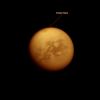
Titan-Seas-Kraken_Mare-PIA14584-PCF-LXTT.jpgKraken Mare (Enhanced Absolute Natural Colors; credits for the additional process. and color.: Dr Paolo C. Fienga - Lunexit Team)209 visiteCaption NASA:"The Cassini Spacecraft looks toward Saturn's largest moon, Titan, and spies the huge, Northern Kraken Mare. Kraken Mare, a large sea of liquid hydrocarbons and is visible as a dark area near the top of the image. This view looks toward the Saturn-facing Side of Titan. North on Titan is up and rotated 29° to the left.
The image was taken with the Cassini Spacecraft narrow-angle camera on Sept. 14, 2011 using a spectral filter sensitive to wavelengths of Near-InfraRed Light centered at 938 nanometers. The view was acquired at a distance of approx. 1,2 MMs (such as about 1,9 MKM) from Titan and at a Sun-Titan-Spacecraft, or Phase, Angle of 26°.
Image scale is roughly 7 miles (approx. 12 Km) per pixel".MareKromium
(4 voti)
|
|

Titan-Atmosphere-PIA09823-PCF-LXTT.jpgTitan's Upper Atmosphere (Enhanced Natural Colors; credits for the additional process. and color.: Dr Paolo C. Fienga - Lunexit Team)75 visitenessun commentoMareKromium
(4 voti)
|
|

Titan-Rivers-Unnamed_Rivers_and_Channels-PIA08604-1.jpgCold Titanian Rivers (Possible Natural Colors; credits for the additional process. and color.: Dr Paolo C. Fienga - Lunexit Team)258 visitenessun commentoMareKromium
(4 voti)
|
|
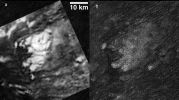
Titan-Regions-Tortula_Facula_Region-PIA13895.jpgTortula Facula (alias "Nondescript Obstacle")233 visiteCaption NASA:"These side-by-side images obtained by NASA's Cassini Spacecraft show the feature named Tortola Facula on Titan. The left image was obtained by the Visual and InfraRed Mapping Spectrometer data on Oct. 26, 2004, at a resolution of about 2 Km (1,242 mile) per pixel. This mosaic focuses on an area around 9° North Latitude and 145° West Longitude.
In 2005, scientists interpreted Tortola Facula as an ice volcano.
The right image shows the same feature, as seen by Cassini's Radar Instrument on May 12, 2008, at a much higher resolution of approx. 300 meters per pixel. Scientists now think that this feature is a "Nondescript Obstacle" surrounded by obvious wind-blown Sand Dunes, similar to those commonly found in this Region of Titan.
In radar images, objects appear bright when they are tilted toward the Spacecraft or have rough surfaces". MareKromium
(4 voti)
|
|

Titan-MF-PCF-LXTT.jpgThe "Blue Fog" of Titan (False Colors; credits for the additional process. and color.: Drr Marco Faccin & Paolo C. Fienga - Lunexit Team)125 visitenessun commentoMareKromium
(4 voti)
|
|

Titan-N00156684-85-86-87-88-89-MF-PCF-LXTT.jpgWatching through the Fog... (Absolute Natural Colors; credits for the additional process. and color.: Drr Marco Faccin and Paolo C. Fienga - Lunexit Team)64 visitenessun commentoMareKromium
(4 voti)
|
|
Titan-N00156684-85-86-MF-PCF-LXTT.jpgWatching through the Fog... (Absolute Natural Colors; credits for the additional process. and color.: Drr Marco Faccin and Paolo C. Fienga - Lunexit Team)59 visitenessun commentoMareKromium
(4 voti)
|
|

Titan-Lakes-Ontario_Lacus-01-PIA13173.jpgOntario Lacus58 visiteThis is Ontario Lacus, the largest lake on the Southern Hemisphere of Saturn's moon Titan. It is based on overlapping radar images obtained by NASA's Cassini Spacecraft on June 22, 2009, July 8, 2009 and Jan. 12, 2010. The images were synthesized into stereoscopic images by the Cassini radar team.
The Northern Shoreline features low Hills, probably about 1 Km (3000 feet) in altitude, and flooded River Valleys. A smooth, wave-sculpted Shoreline, like that seen on the South-Eastern side of Lake Michigan, can be seen on the North-Eastern side of the Lake.
The South-Eastern shore features a round-headed bay intruding into the shore. The middle part of the Western Shoreline shows the first well-developed delta observed on Titan.
Topography has been vertically exaggerated by a factor of roughly 10 times. Titan's solid Surface and Atmosphere are portrayed in shades of brown, approximating their appearance as measured by the descent imager and spectral radiometer on board the Huygens probe, which landed on Titan in 2005. Scientists surmise the liquid Methane, ethane and propane in the lake would look black to the human eye, but this is a hypothesis based on the best available data.
The Sun was placed low on the horizon, at an angle similar to where it was during the Cassini Fly-Bys.MareKromium
(4 voti)
|
|

Titan-W00064416-418-EB-LXTT.jpgTitan (Natural Colors; credits for the additional process. and color.: Elisabetta Bonora - Lunexit Team)59 visitenessun commentoMareKromium
(4 voti)
|
|
| 426 immagini su 36 pagina(e) |
 |
|
|
|
|
17 | |
|
|
|
|





