| Piú votate - Titan: The "Foggy" Moon |

Titan-Full_Disk-PIA02145-1.jpgTitan: Visual + IMS (1)56 visiteThe three mosaics shown here were composed with data from Cassini's visual and infrared mapping spectrometer taken during the last 3 Titan flybys, on Oct. 28, 2005 (1), Dec. 26, 2005 (2), and Jan. 15, 2006 (3).
These false-color images were constructed from images taken at the following wavelengths: 1,6 microns (blue), 2,01 (green), and 5 microns (red).
The viewing geometry of the December flyby is roughly on Titan's opposite Hemisphere from the flybys in October and January.
There are several important features to note in the images. The first is that the South Polar cloud system was very bright during the December flyby, while during the October and January flybys, it is barely visible, indicating that the atmosphere over Titan's South Pole is very dynamic.
(5 voti)
|
|
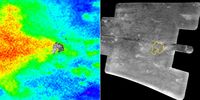
Titan-Huygens_Landing_Site-07-PIA03569.jpgHuygens' Landing Site?56 visiteOriginal caption:"On the left, in color, is a composite of the Imaging Camera and Infrared Data (red areas are brighter and blue darker, as seen in infrared). On the right is the Synthetic Aperture Radar Image. The Huygens descent images are shown inset on the left image and outlined in yellow on the right. The magenta cross in both images shows the best estimate of the actual Huygens Landing Site. This is a preliminary result, based on the best information available at the present time. In the left image, the brighter areas seen by the Huygens camera correspond to the large area depicted in red and yellow. On closer inspection, bright features within the Huygens mosaic seem to correspond to smaller features in the map composed of data from the VIS and Imaging Camera. On the right, the correspondence is less clear. In radar images bright features are usually rougher, so one would not necessarily expect an obvious connection".
(5 voti)
|
|

Titan-Dunes_and_Ridges-PIA03566.jpgPossible Tectonic fractures on Titan56 visiteOriginal caption:"This synthetic aperture radar image of Titan was taken on Oct. 28, 2005, as the Cassini spacecraft flew by at a distance of 1.350 Km (about 840 miles). This was the first pass dedicated to radar and it was the fourth time Cassini's radar honed in on the smoggy moon.
The bright, curving features are high-standing ridges, poking up above the plains of Titan. Some of the ridges extend for over 100 Km (roughly 60 miles). They are likely to be tectonic in origin, formed by deformation of Titan's icy crust. The low-lying terrain between the ridges is covered in dark streaks, which could be dunes formed by wind. The streaks, spaced 1 to 2 Km apart (0,6 to 1 mile), curve between patches of the bright terrain, which probably act as topographic barriers.
This image is 400 Km (about 250 miles) across and 275 Km-wide (about 170 miles). It is located 8° South Latitude and 215° West Longitude".
(5 voti)
|
|

Titan-PIA07565.jpgTitan's Terminator...from about 1,3 MKM54 visiteTitan's equatorial latitudes are distinctly different in character from its South Polar Region, as this image shows. The dark terrain, presumably lowland, seen here does not extend much farther south than about 30° South. The successful Huygens probe landed in such a Region. The Huygens probe is rotating into the light here, seeing the dawn of a new day. The bright region toward the right side of Titan's disk is Xanadu. This area is thought to consist of upland terrain that is relatively uncontaminated by the dark material that fills the lowland regions.
Near the South Pole, and just eastward of the terminator, is the dark feature identified by imaging scientists as the best candidate (so far) for a past or present hydrocarbon lake on Titan (see PIA06241). Farther east of the lake-like feature, bright clouds arc around the Pole. These clouds occupy a latitude range that is consistent with previously-seen convective cloud activity on Titan. The phase angle is 60° while the image scale is 7 Km per pixel.
(5 voti)
|
|

Titan-Lakes-South_Polar_Lake-00-PIA06240.jpgOntario Lacus and the South Polar Regions of Titan58 visiteThis view of Titan's South Polar Region reveals an intriguing dark feature that may be the site of a past or present lake of liquid hydrocarbons.
The true nature of this feature, seen here at left of center, is not yet known, but the shore-like smoothness of its perimeter and its presence in an area where frequent convective storm clouds have been observed by Cassini and Earth-based astronomers make it the best candidate thus far for an open body of liquid on Titan.
If this interpretation is correct, then other very dark but smaller features seen in the South Polar Region, some of which are captured in this image, may also be the sites of liquid hydrocarbon reservoirs.
In addition to the notion that the dark feature is or was a lake filled with liquid hydrocarbons, scientists have speculated about other possibilities. For instance, it is plausible that the lake is simply a broad depression filled by dark, solid hydrocarbons falling from the atmosphere onto Titan's surface. In this case, the smoothed outline might be the result of a process unrelated to rainfall, such as a sinkhole or a volcanic caldera.
(5 voti)
|
|

Titan-Cryovolcanism-00.jpgCryovolcanism on Titan? (1)57 visiteDa "NASA - Picture of the Day" del 10 Giugno 2005:" Investigators suspect the newly discovered domed feature detailed in the next frame is an ice volcano, or cryovolcano, seen in infrared light (...). Since Titan's surface temperature is around -180° C, 'lava' welling up to form the volcanic mound would be icy indeed - possibly a slurry of methane, ammonia and water ice combined with other ices and hydrocarbons. The circular feature is roughly 30 Km in diameter. If its volcanic nature is confirmed, the discovery of cryovolcanism on Titan could explain the origin of methane in Titan's atmosphere".
A nostro parere quest'idea del fenomeno crio-vulcanico (e della 'lava di ghiaccio') su Titano è solo un'altra - orrenda - 'boutade' NASA la quale, pur di riuscire a NON staccare nemmeno un mattoncino dalla Cattedrale della Scienza Consolidata, si aggrappa - tentando di spiegare in maniera rassicurante le nuove ed incredibili fenomenologie che lo Spazio ci offre quasi ogni giorno - alle ipotesi più fantasiose.
(5 voti)
|
|

Titan-PIA07876.jpgA bright Red Spot on Titan (1)54 visiteThe recently discovered infrared-bright spot on Titan is the type of enigmatic feature that is best investigated by putting together as many different types of complementary information as possible. This montage shows the spot in infrared wavelengths from the visual and infrared mapping spectrometer on the left, from the imaging science subsystem in the center and a combination of both data sets on the right. When put together, the 2 different views show more than either does separately. The visual and infrared spectrometer team noted the bright region in the image on the left after March 31, 2004, Cassini's-Titan encounter. The strange, bright feature to the southeast of Xanadu was flagged as unusual and informally dubbed "The Smile" by imaging team members in December 2004. It seems clear that both instruments are detecting the same basic feature on Titan's surface. This bright patch may be due to an impact event, landslide, cryovolcanism, or atmospheric processes. Its distinct color and brightness suggest that it may have formed relatively recently".
(5 voti)
|
|

Titan-3-PIA06229.jpgTitan in three different wavelenghts: the strange Titan (3)57 visiteCaption NASA originale:"This false-color composite was created with images taken during the Cassini spacecraft's closest flyby of Titan on April 16, 2005.
It was created by combining 2 infrared images (taken at 938 and 889 nnmts) with a visible light image (taken at 420 nnmts). Green represents areas where Cassini is able to see down to the surface. Red represents areas high in Titan's stratosphere where atmospheric methane is absorbing sunlight. Blue along the moon's outer edge represents visible violet wavelengths at which the upper atmosphere and detached hazes are better seen.
A similar false-color image showing the opposite hemisphere of Titan was created from images taken during Cassini's first close flyby of the smoggy moon in October 2004 (see PIA06139). At that time, clouds could be seen near Titan's South Pole, but in these more recent observations no clouds are seen. North on Titan is up and tilted 30° to the right".
(5 voti)
|
|

Titan-1-PIA06228.jpgTitan in three different wavelenghts: the monochrome Titan (1)58 visiteCaption NASA originale:"This image composite was created with images taken during the Cassini spacecraft's closest flyby of Titan on April 16, 2005. Cassini's cameras have numerous filters that reveal features above and beneath the shroud of Titan's atmosphere.
This monochrome view shows what Titan looks like at 938 nnmts, a near-infrared wavelength that allows Cassini to see through the hazy atmosphere and down to the surface. The view was created by combining 3 separate images taken with this filter, in order to improve the visibility of surface features. The variations in brightness on the surface are real differences in the reflectivity of the materials on Titan. North on Titan is up and tilted 30° to the right".
(5 voti)
|
|

Titan-PIA06222_modest.jpgThe Eastern Region of Titan56 visite(...) Best view to date of the Region east of Xanadu Regio. This mosaic (...) reveals new detail of dark expanses and the surrounding brighter terrain. Some of the features seen here are reminiscent of those seen elsewhere on Titan, but the images also reveal new features. In the center of the image (fig. A) lies a bright area completely surrounded by darker material. The northern boundary of the bright "island" is relatively sharp and has a jagged profile, resembling the now-familiar boundary on the western side of XanadU. The profile of the southern boundary is similar. Streamers of bright material extend southeastward into the dark terrain. At the eastern end of the bright "island" lies a region with complex interconnected dark and bright regions (see fig. B). To the south, the bright terrain is cut by fairly straight dark lines. Their linearity and apparently angular intersections suggest a tectonic influence, similar to features in seen in the bright terrain west of Xanadu. Toward the northeastern edge of the dark material a dark, circular spot in the middle of a bright feature (see figure C) is an approximately 80-kilometer-wide (50-mile) crater identified in the February 2005 radar data (see PIA07368 for the radar image).
(5 voti)
|
|

Titan_and_Saturn-PIA06225.jpgSaturn through the haze of Titan57 visiteCaption NASA originale:"Less than 20 minutes after Cassini's close approach to Titan on March 31, 2005, its cameras captured this view of Saturn through Titan's upper atmosphere. The northern part of Saturn's disk can be seen at the upper left; dark horizontal lines are shadows cast upon Saturn by its rings. Below this level, Titan's atmosphere is thick enough to obscure Saturn.
The diffuse bright regions of the image (below Saturn and at the right) are light being scattered by haze in the upper reaches of Titan's atmosphere.
This image is scientifically useful because it shows properties both of how Titan's haze transmits light (from the attenuation of light from Saturn) and of how the haze reflects light (from its brightness next to Saturn).
The image was taken in visible light with the Cassini spacecraft wide-angle camera at a distance of 7.980 Km (appx. 4.960 miles) from Titan, when Saturn was about 1,3 MKM (appx. 808.000 miles) away. Image scale is about 320 meters (1,050 feet) per pixel on Titan".
(5 voti)
|
|

Titan-PIA06220.jpgA New Continent on Titan (from 130.000 up to 146.000 Km)55 visiteCaption NASA originale:"This view of Titan uncovers new territory not previously seen at this resolution by Cassini's cameras. The view is a composite of 4 nearly identical wide-angle camera images, all taken using a filter sensitive to wavelengths of infrared light centered at 939 nnmts. The individual images have been combined and contrast-enhanced in such a way as to sharpen surface features and enhance overall brightness variations. Some of the territory in this view was covered by observations made by the Cassini synthetic aperture radar in October 2004 and February 2005. At large scales, there are similarities between the views taken by the imaging science subsystem cameras and the radar results, but there also are differences. For example, the center of the floor of the approximately 80-kilometer-wide (50-mile) crater identified by the radar team in February (near the center in this image, see PIA07368 for the radar image) is relatively bright at 2.2 centimeters, the wavelength of the radar experiment, but dark in the near-infrared wavelengths used here by Cassini's optical cameras. This brightness difference is also apparent for some of the surrounding material and could indicate differences in surface composition or roughness".
(5 voti)
|
|
| 426 immagini su 36 pagina(e) |
 |
|
|
|
|
14 | |
|
|
|
|





