| Piú votate - Phobos: the "Doomed" Moon |

x-Viking_Orbiter_1_Phobos_shadow_p101a_(1).jpgPhobos' shadow from Viking Orbiter 195 visiteTutte ombre "molto" simili (ellissoidi), eppure tutte molto diverse. Certo, le variabili in gioco sono tante, a cominciare dalla qualità intrinseca dei frame, però...MareKromium
(3 voti)
|
|

w-Phobos_shadow-7507188_Mariner_9.jpgWhat a shadow!96 visitenessun commentoMareKromium
(3 voti)
|
|

w-PIA17352-MarsMoons-PhobosPassesDeimos-RealTime.gifOld Twins...106 visitenessun commentoMareKromium
(3 voti)
|
|
|
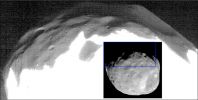
PSP_007769_9015_MarsShine.jpgIn the Mars-Shine... (credits: NASA)68 visiteThis is a close-up and enhanced part of image PSP_007769_9015. In the original image, detail in the black, un-illuminated portion is not apparent. However, seen in enhanced detail here, craters are clearly visible.
This faint illumination is from reflected light off of Mars (“Marsshine”). This is directly analogous to “Earthshine,” where reflected sunlight from our planet illuminates the dark side of the Moon.
The ability to see features on Phobos illuminated by Marsshine demonstrates the high sensitivity of the HiRISE camera.MareKromium
(3 voti)
|
|
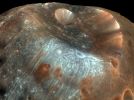
PSP_007769_9010-Stickney-0.jpgStickney Crater (Natural Colors; credits: NASA)71 visiteThe most prominent feature here is the large impact crater Stickney. With a diameter of 9 Km, it is the largest feature on Phobos. A series of grooves and crater chains is obvious on the other parts of the moon.
Although many appear radial to Stickney, previous studies show that the grooves radiate from a different point on Phobos. Hypotheses for their formation vary.
Some scientists believe the grooves and crater chains are related to the formation of Stickney, whereas others think they may have formed from ejecta from impacts on Mars that later collided with Phobos.
The lineated textures on the walls of Stickney and other large craters are landslides formed from materials falling into the crater interiors in the weak Phobos gravity (less than 1/1000th the gravity on Earth).MareKromium
(3 voti)
|
|

PHOBOS-Image016-Mariner_9_Phobos_001.jpgPhobos, from Mariner 9105 visiteIs this really Phobos?!?MareKromium
(2 voti)
|
|

PHOBOS-Image017-Mariner_9_Phobos_002.jpgPhobos, from Mariner 9108 visitenessun commentoMareKromium
(2 voti)
|
|

PHOBOS-Image018-Mariner_9_Phobos_feature.jpgPhobos, from Mariner 9108 visitenessun commentoMareKromium
(2 voti)
|
|

PHOBOS-Image015-20131016_mariner9_phobos_(1).pngIs this Phobos?103 visiteUna sequenza di immagini della "Luna Condannata", Phobos, ottenute dalla Sonda NASA Mariner 9. Bizzarro. Guardate le foto di Phobos ottenute da Sonde "recenti" (MGS su tutte). A me sembra che, fra l'oggetto ripresi dalla Mariner 9 e quello ripreso dalla MGS (come da Mars Express ed altre), vi sia solo una "vaga" somiglianza. Dunque: il "trucco" è nell'angolo di ripresa o dove? Abbiamo immagini genuine ed immagini farlocche?!?... Ditemi Voi.MareKromium
(2 voti)
|
|

PHOBOS-Image022-417-20081008-5889-6-src-01-PhobosSeries_H1.jpgStaring at Phobos' Limb69 visiteThis image of Phobos’s was obtained by the Super Resolution Channel (or SRC, a part of the High Resolution Stereo Camera experiment) on board ESA’s Mars Express on 3 August 2008 (orbit 5889).
The distance from the moon’s centre was approx. 656 Km, and the image resolution is 6 mt/pixel. The original image has been corrected for mirror distortion.MareKromium
(2 voti)
|
|
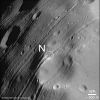
PHOBOS-Image023-417-20081008-5889-6-src-02-PhobosSeries_H1.jpgPhobos' North Polar Regions70 visiteThis image of Phobos’s surface was obtained by the Super Resolution Channel (or SRC, a part of the High Resolution Stereo Camera experiment) on board ESA’s Mars Express on 8 August 2008 (orbit 5908).
The distance from the moon’s centre was approx. 1024 Km, and the image resolution is 9 mt/pixel. The original image has been corrected for mirror distortion.MareKromium
(2 voti)
|
|
| 53 immagini su 5 pagina(e) |
 |
|
4 |
|








