| Piú votate - Phobos: the "Doomed" Moon |

Phobos-Limb-Mars_Express-01.jpgPhobos, the "Doomed Moon", from Mars Express (Absolute Natural Colors; credits for the additional process. and color.: Dr Paolo C. Fienga - Lunexit Team)199 visitenessun commentoMareKromium
(4 voti)
|
|
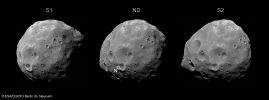
PHOBOS-Image013-411-20081008-5870-6-s12_nd-01-PhobosSeries_H1.jpgViews of Phobos71 visiteThis sequence of images was obtained by the High Resolution Stereo Camera (HRSC) on board ESA’s Mars Express on 26 July 2008 (orbit 5861), at a distance of about 2295 Km from the moon’s centre, and provides a striking impression of the encounter.
These imagee was taken using all 9 imaging channels of the camera. The resolution shown here is 92 mt/pixel for each image.
HRSC is a so-called push-broom camera, building up images in a ‘scanning’ mode while the spacecraft passes over the surface. Its nine channels, or scanning lines, are oriented in different directions that spread from 18,9° behind the nadir viewpoint (corresponding to a vertical line of sight), to 18,9° ahead of the nadir. This gives the camera its stereo-viewing capacity.MareKromium
(4 voti)
|
|
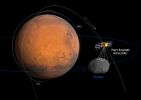
PHOBOS-Image000-409-20081008-5870-6-nd3-02-PhobosSeries_H1.jpgGeometry of the Phobos fly-by87 visitenessun commentoMareKromium
(4 voti)
|
|
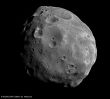
PHOBOS-Image001-409-20081008-5870-6-nd3-02-PhobosSeries_H1.jpgPhobos, from Mars Express74 visiteThis image was obtained by the High Resolution Stereo Camera (HRSC) on board ESA’s Mars Express on 28 July 2008 (orbit 5870), at a distance of 351 Km from the moon’s centre. The image was taken using the camera’s nadir channel, at a resolution of 14 mt/pixel.
The origin of Phobos is debated. While its density, lower than the density of the Martian Surface rocks, make it appear to belong to "D-Class" Asteroids, the moon appears to share many surface characteristics with the class of carbonaceous "C-Type" asteroids, which suggests it might have been captured from this population.
However, it is difficult to explain either the capture mechanism or the following evolution of its orbit into the Equatorial Plane of Mars.
An alternative hypothesis is that it formed in its present position, and is therefore a remnant from the planetary formation period.MareKromium
(4 voti)
|
|

Phobos-MEXP-1-h3909_0000_H.jpgPhobos, the "Doomed Moon", from Mars Express (False Colors; credits: Lunexit)69 visiteCaption ESA:"An image of Phobos by the High-Resolution Stereo Camera on board Mars Express taken on January 22, 2007.
The larger and inner of the two Martian Moons is seen here floating just above the Martian Limb. The image has been enhanced slightly to bring out the detail on the moon".MareKromium
(4 voti)
|
|
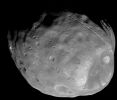
PSP_007769_9015_RED.jpgPhobos (RAW Frame; credits: NASA)67 visitenessun commentoMareKromium
(4 voti)
|
|
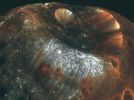
PSP_007769_9010-Stickney-1.jpgStickney Crater (Natural Colors + MULTISPECTRUM; credits: NASA & Lunexit)76 visitenessun commentoMareKromium
(4 voti)
|
|

z-Viking_1_-_444A05.jpegPhobos passing over Tharsis150 visiteSemplicemente straordinaria.MareKromium
(3 voti)
|
|

w-PIA17352-MarsMoons-PhobosPassesDeimos-RealTime.jpgPhobos and Deimos120 visitenessun commentoMareKromium
(3 voti)
|
|

z-Phobos-20130301_gusev2_f840.jpgPhobos' shadow over Gusev Crater102 visitenessun commentoMareKromium
(3 voti)
|
|

w-Phobos_Shadow_-_1.jpgPhobos' penumbral shadow99 visitenessun commentoMareKromium
(3 voti)
|
|

w-Phobos_Shadow_-_2.JPGPhobos' shadow...again!94 visitenessun commentoMareKromium
(3 voti)
|
|
| 53 immagini su 5 pagina(e) |
 |
3 | |
|








