| |

| Piú votate - 433-Eros: Pictures, Facts and Legends |

20000405.jpgOld Craters (natural colors; credits: Lunexit)59 visiteEros' many craters have a range of ages dating back to the last time the asteroid's surface was "wiped clean" by geologic processes. This NEAR Shoemaker image of the tip of the asteroid, taken March 6, 2000, from a range of 201 Km (about 125 miles), shows craters with a variety of shapes and sizes.
When small craters first form, they typically have sharp rims and round floors. As they age, progressively smaller craters are superimposed, rounding the rims and pitting the walls and floors until the original underlying crater becomes almost unrecognizable.
(Image 0127738155)MareKromium
(3 voti)
|
|

20000301.jpgThe "Profile" of 433-Eros (natural colors; credits: Lunexit)54 visiteNEAR takes several images mosaics of 433-Eros daily for purposes of navigating the Spacecraft. The one shown here was taken February 29, 2000, from a range of 289 Km (about 180 miles).
It shows features as small as 30 meters (100 feet) across. All of the mosaics show the same territory over and over, but changes in lighting plus the gradual decrease in the spacecraft's range to the surface are both constantly bringing out new details.
The very oblique illumination in this mosaic is ideal for bringing out small landforms. Many parts of the asteroid have "grooves", such as linear troughs about 100 meters (330 feet) wide and several kilometers long. Similar features have also been observed on other asteroids such as Gaspra, and they are especially numerous on Mars' moon Phobos.
Their origin isn't completely understood, but formation of the grooves probably involves fracturing of the asteroid's subsurface in some way.
(Mosaic of images 0127210446, 0127210510, 0127210574, 0127210656)MareKromium
(3 voti)
|
|
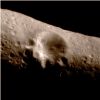
20000306.jpgLarge Crater (natural colors; credits: Lunexit)57 visiteThis image mosaic of the "Large Crater" at Eros' center was taken on March 3, 2000, during an optical navigation imaging sequence from a range of 127 miles (about 204 Km). This same area was imaged following orbit insertion at a range of approx. 210 miles (about 330 Km) on February 14th (Feb 14 G).
This picture resolves features as small as 65 feet (20 meters) across compared to the resolution of 100 feet (30 meters) in the earlier image. The shadow cast by the boulder near the floor of the crater is now visible. The walls of the crater display some distinctive variations in their albedo or reflectivity. The upper part of the walls tend to be bright, while the lower portions of the walls and the crater floor show patches of darker or less reflective materials. These albedo patterns are also visible on other crater walls. To the right of the large crater, two sets of closely spaced orthogonal grooves are visible.
(Mosaic of images 0127531846, 0127531908, 0127532094, 0127532156)MareKromium
(3 voti)
|
|

20000214g.jpgNEAR's historic first image from Eros orbit (natural colors; credits: Lunexit)54 visiteOn February 14, 2000, at 10:33 AM EST the NEAR Spacecraft was successfully inserted into orbit around 433 Eros, becoming the first artificial satellite of an asteroid. Just over an hour later, NEAR pointed its camera at the asteroid and took this picture from a range of 210 miles (330 km) above the surface.
Mission navigators and operators will use this image and others to be taken later to traingulate on landmarks on the asteroid's surface, precisely measuring position of the spacecraft to plot NEAR's course.
Features as small as a 100 feet (30 meters) across can be seen. This view shows the 3-mile (5-Km) impact crater which the Spacecraft has spied for over a week during its approach. The two smaller craters superimposed on its rim are each about 1,2 miles (approx. 2 Km) across. An enormous boulder a full 170 feet (50 meters) in size sits on the large crater's floor. Other key features of the surface are shallow subsurface layering exposed near the tops of crater walls, and shallow grooves crossing the surface and cutting the crater's rim.
(Mosaic of images 0125957025 and 0125957087)MareKromium
(3 voti)
|
|

20000217b.jpgOver Eros' horizon (natural colors; credits: Lunexit)60 visiteThis incredible picture of Eros, taken on February 14, 2000, shows the view looking from one end of the asteroid across the gouge on its underside and toward the opposite end. In this mosaic, constructed from two images taken after the NEAR Spacecraft was inserted into orbit, features as small as 120 feet (35 meters) across can be seen.
House-sized boulders are present in several places; one lies on the edge of the giant crater separating the two ends of the asteroid. A bright patch is visible on the asteroid in the top left-hand part of this image, and shallow troughs can be see just below this patch.
The troughs run parallel to the asteroid's long dimension.
(Mosaic of images 0125971425, 0125971487)MareKromium
(3 voti)
|
|

19990108.jpg433-Eros58 visiteThis pair of images of the Asteroid 433-Eros was acquired by the Near Earth Asteroid Rendezvous (NEAR) Spacecraft on December 23, 1998, as the Spacecraft flew by the night side of the Asteroid at a distance of about 2300 miles (approx. 3800 Km) at 13:43 EST. These views, taken at 13:44 and 14:05 EST, as the Spacecraft range increased from 2300 miles to 2500 miles (about 4100 Km), show only a tiny portion of the day side of Eros (Phase Angle ~119°).
The smallest resolved detail in this frame is approximately 1300 feet (400 meters) across. MareKromium
(3 voti)
|
|

20000314-PCF-LXTT-IPF.jpgThe "Saddle Region" (Absolute Natural Colors; credits for the additional process. and color.: Dr Paolo C. Fienga/Lunar Explorer Italia/Italian Planetary Foundation)105 visiteCaption NASA:"This image mosaic, showing Eros' Saddle and a shadowed feature to its left, was taken on March 3, 2000 from a distance of 204 Km (about 127 miles). In this picture features as small as 20 meters (65 feet) across are visible. This is the best view to date of this area. The Sun is coming from the North-East illuminating a shadowed feature that consists of 3 large craters situated adjacent to each other. The two largest are each about 4-5 Km (2-3 miles) across.
Because the Sun is very low with respect to these craters, even small topographic features cast long shadows, making them easier to see. As a result, several boulders on the crater walls can be distinguished, ranging from about 50 to 100 meters in diameter. The Saddle (on the right of the mosaic) is relatively smooth with few impact craters, and has several grooves running across it. At the top of the saddle are several curved grooves that are brighter than the surrounding surface. Unusual brightness patterns are also visible in the crater at the top left of the mosaic. The walls of the crater appear to be more reflective and its floor less reflective than nearby parts of the asteroid.
(Mosaic of images 0127504836, 0127504898, 0127505146, 0127505208,0127505394, 0127505456)MareKromium
(2 voti)
|
|

20000225.jpgThe "Two Faces" of Eros... (natural colors; credits: Lunexit)55 visiteOn February 23, 2000, the NEAR spacecraft obtained a sequence of image mosaics showing Eros' surface as the asteroid rotated under the Spacecraft. At that time the range to the surface was approx. 355 Km (about 220 miles). These two mosaics, part of that sequence, show the stark beauty of the two opposite hemispheres.
The smallest detail visible is 35 meters (120 feet) across. The top mosaic shows wavy brightness banding exposed in the interior walls of the Saddle. In the bottom mosaic, similar banding is visible in one of the craters near the limb at left. To the right, the angle of the illumination accentuates the quasi-linear troughs near the Terminator.
Successful firing of NEAR's thrusters yesterday, February 24, placed the Spacecraft on course for insertion into the next lower orbit, at a 200 Km (about 120 miles) altitude. Images from that orbit, commencing in early March, will have nearly twice the spatial resolution of data returned so far.
(Product compiled from images 0126712790, 0126713054, 0126713230, 0126723526, 0126723790, 0126723878)
MareKromium
(2 voti)
|
|

19981105.jpgThe "First Image" of Eros56 visiteThis first image of the Asteroid 433 Eros was acquired by the Multispectral Imager on the Near Earth Asteroid Rendezvous (NEAR) Spacecraft on November 5, 1998, at a distance of 2,5 MMS (about 4 MKM) from the Asteroid.
Eros, located at the center of the image and circled, appears against the star background in a single illuminated pixel.
At the time of the image, NEAR was located 200 MMs (about 321 MKM) from Earth, and the radio signal which transmitted the image from the Spacecraft, took nearly 18 minutes to reach Earth.
The image is a part of a 5,3-hour sequence of images that show Eros over one full rotation.
Repeated imaging of Eros through January, 1999, were used to refine knowledge of NEAR's trajectory relative to the Asteroid and to plan firings of the Spacecraft's engines to slow the craft and place it into orbit.
At the time, NEAR was approaching Eros at a rate of 2100 mph (945 meters per second). Three firings of NEAR's engines, which begun on December 20, 1998, slew the Spacecraft velocity relative to the Asteroid to approx. 10 miles per hour (such as 5 meters per second), until the orbit insertion, which occurred on January 10, 1999.MareKromium
(2 voti)
|
|
|
|
|
| 45 immagini su 4 pagina(e) |
|
4 |
|
|
|





