| |

| Piú votate - 433-Eros: Pictures, Facts and Legends |

N-M0137674104f4_2p_cif_dbl.jpgThe way they come...58 visiteSu richiesta dell'Amico François ("Gurosao"), ecco - da parte del nostro Marco Faccin (Titanio44) - un esempio di come appaiono i frames NEAR all'atto dello scaricamento.
Onestamente, non si percepiscono - rectius: noi/io non vediamo/vedo - distorsioni su alcuno degli assi. MareKromium
(4 voti)
|
|

20000428.jpgGroovy!... (natural colors; credits: Lunexit)57 visiteNEAR Shoemaker returns images that reveal not only what makes Eros distinctive, but also what it shares with other asteroids. This image, taken April 8, 2000, from an orbital height of 210 Km (about 131 miles), shows several of the linear troughs or "grooves" that mark the Asteroid's surface.
The largest one in this image, just to the right of the shadowed crater in the lower central part of the frame, is nearly 200 meters (656 feet) across. Grooves are also found on other asteroids and small asteroid-like moons, especially the Martian moon Phobos. They are thought to form when regolith - the loose surface material thrown out of impact craters - drains into subsurface cracks.
(Image 0130614349)MareKromium
(4 voti)
|
|

20000222.jpg54 visiteThis image mosaic of Eros was taken by the NEAR Spacecraft on Feb. 18, 2000 from a range of 224 miles (about 361 Km). The smallest detail visible on the surface is about 115 feet (35 meters) across.
At the time the Spacecraft was over the shadowed Southern Hemisphere, looking North at a crescent Eros.
Although this view of Eros is similar to others that have been returned, the coverage at different illumination and viewing geometries provides important information on the shapes of landforms.
(Mosaic of images 0126286145, 0126286419, 0126286483)MareKromium
(4 voti)
|
|

20000217c.jpg433-Eros From orbit: the Giant Gouge (natural colors; credits: Lunexit)60 visiteThis picture was taken from NEAR on February 15, 2000, while the Spacecraft was passing directly over the large gouge that creates Eros's characteristic peanut shape.
It is a mosaic of individual images showing features as small as 120 feet (35 meters) across. Although most of the asteroid is in shadow, we are able to see inside the gouge. Many narrow parallel troughs closely follow the shape of the gouge. Although they appear curvilinear from this view, they are most likely oriented parallel to the length of the asteroid.
The strong lighting contrast along the terminator (the line separating day from night on Eros) makes it easy to see that most of the surface is saturated with impact craters. Inside the gouge, however, only smaller craters are present, indicating that the area within the gouge is younger than the surface along the terminator.
This implies that the event that caused the gouge must have happened more recently than the formation of the rest of the surface of Eros.
(Mosaic of images 0126023473, 0126023535, 0126023721, 0126023783, 0126023845, 0126023907, 0126024093, 0126024155)MareKromium
(4 voti)
|
|

19981223.jpgViews of 433-Eros55 visiteThis montage of images of the asteroid Eros was assembled from images acquired by the Near Earth Asteroid Rendezvous (NEAR) Spacecraft on December 23, 1998, as the Spacecraft flew by the asteroid at a distance of 2300 miles (3800 Km) at 1:43 PM EST. Shown are nine early views out of 29 that were obtained during the flyby. These images were taken between 10:44 AM and 12:44 PM EST, as the Spacecraft range closed from 7300 miles (such as abou 11.100) Km, to 3300 miles (such as approx. 5300 Km).
During that time, the Asteroid completed nearly half of a rotation. The smallest resolved detail is approximately 1650 feet (500 meters) across.
A firing of the main engine at 17:00, EST, on December 20, 1998, designed to slow the Spacecraft for insertion into orbit around the Asteroid, was aborted by the Spacecraft. Contact with ground controllers was temporarily lost, but was regained at 20:00 EST on December 21, when autonomous Spacecraft safety protocols took over and transmitted a signal to the ground. All spacecraft systems were determined to be healthy and operational.
Within hours, a flyby observation sequence was developed and uploaded to the Spacecraft.
1026 images were acquired by the Multispectral Imager, to determine the size, shape, morphology, rotational state, and color properties of Eros, and to search for small moons.
The Infrared Spectrometer measured spectral properties of the Asteroid to determine what minerals were present, and the Magnetometer searched for a natural Magnetic Field.
Analysis of the Spacecraft radio signal were also used to determine the asteroid's mass and density.
The main engine was fired successfully on January 3, 1999, placing NEAR on-course for a February 2000 rendezvous.
Eros is NEAR's second asteroid encountered. On June 27, 1997, NEAR flew by the Main-Belt Asteroid Mathilde at a range of approx. 1212 Km (750 miles).MareKromium
(4 voti)
|
|
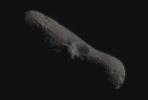
20000217a-PCF-LXTT-IPF.jpgOrbiting 433-Eros (Absolute Natural Colors; credits for the additional process. and color: Dr Paolo C. Fienga/Lunar Explorer Italia/Italian Planetary Foundation)149 visiteCaption NASA:"This picture of 433-Eros, the first of an Asteroid taken from an orbiting spacecraft, is a mosaic of 4 images obtained by NEAR on February 14, 2000, immediately after the Spacecraft's insertion into orbit. We are looking down over the North Pole of Eros at one of the largest craters on the surface, which measures 4 miles (about 6 Km) across. Inside the crater walls are subtle variations in brightness that hint at some layering of the rock in which the crater formed. Narrow grooves that run parallel to the long axis of Eros cut through the South-Eastern part of the crater rim. A house-sized boulder is present near the floor of the crater; it appears to have rolled down the bowl-shaped crater wall. A large number of boulders is also present on other parts of the Asteroid's surface. The surface of the Asteroid is heavily cratered, indicating that 433-Eros is relatively old.
(Mosaic of images 0125956839, 0125957025, 0125957087, 0125957273)MareKromium
(3 voti)
|
|

20000410.jpgDifferent Lights, Different Visions59 visiteDuring the 28 days the NEAR Shoemaker Spacecraft circled Eros in a 200-Km (such as approx. 124-mile) altitude orbit, it imaged parts of the surface under a variety of lighting and viewing conditions.
The different views of the surface allow study of small-scale morphology, analysis of albedo and color variations, and construction of topographic models from stereo images.
This image, taken April 2, 2000, from a range of 199 Km (about 123 miles), shows the effects of lighting changes. At the bottom of the frame, sunlight illuminates the surface at a grazing angle. The strong shadows bring out subtle landforms like the gentle undulations in the surface, visible at the lower center.
At the top of the frame, sunlight strikes the surface at a high angle and shadows become subdued, bringing out brightness variations like those on the wall of the large, 5,5-Km (3,4-mile) diameter crater at left.
(Image 0130112939)MareKromium
(3 voti)
|
|

20000411.jpgEros' North Polar Region (natural colors; credits: Lunexit)56 visiteFor much of the past five weeks, imaging activities on the NEAR Shoemaker Spacecraft have focused on the high Northern Latitudes of Eros.
The point at which the Sun is directly overhead - known as the "subsolar point" - has been steadily moving from Eros' Northern Regions toward the Equator as the Asteroid's seasons progress.
As this happens, the Northern Hemisphere is illuminated less and less, and previously dark Southern Latitudes progressively come into view.
In this image, taken March 19, 2000, from a range of 205 Km (approx. 127 miles), the asteroid's North Pole is in the upper right of the frame. The whole scene is 7,4 Km (4,6 miles) across.
(Image 0128883708)MareKromium
(3 voti)
|
|

20000418.jpgUp-close and personal (natural colors; credits: Lunexit)54 visiteSince April 11, 2000, the NEAR Shoemaker Spacecraft has orbited Eros at an altitude of about 100 Km (approx. 62 miles) from the Asteroid's Center. Images acquired from this orbit will be used to make a HR map of the illuminated portion of the Asteroid. Each spot on the surface will be imaged under a variety of lighting and viewing conditions to bring out different features.
In this image, taken April 17, 2000, from a height of 101 Km (approx. 63 miles), the shadows highlight small-scale surface features. The surface is pockmarked with craters ranging in size up to the 2,8-Km (1,74-mile) diameter crater in the center of the image. The smallest craters which can be resolved are about 20 meters (65 feet) across.
In lower right corner of the image, 20-meter boulders can be seen that were not evident in images from higher altitudes.
(Image 0131288775)MareKromium
(3 voti)
|
|

20000309.jpgOblique view of the "Large Crater" (natural colors; credits: Lunexit)54 visiteThis image, showing an oblique view of Eros' "Large (central) Crater", was taken at a resolution of about 20 meters (65 feet) per pixel. The brightness or albedo patterns on the walls of this crater are clearly visible, with the brighter materials near the tops of the walls and darker materials on the lower walls. Boulders are seen inside this crater and the smaller nearby craters. The higher density of craters to the left of the large crater implies that this region is older than the smoother area seen associated with the Saddle Region on the opposite side of the asteroid.
(Image 0127591846)MareKromium
(3 voti)
|
|

20000320.jpgThe North Polar Region of 433-Eros (natural colors; credits: Lunexit)56 visiteOn March 11, 2000, this image of Eros' North Polar Region was acquired by the imager on the NEAR Shoemaker Spacecraft, from a range of 206 Km (127 miles).
The area shown in the image is 10 Km (6,2 miles) across. Most of the North Polar Region is heavily cratered but the region to the left (part of the "Saddle") has a lower crater density, indicating that the surface has been modified since it first formed.
Eros' rotational axis lies nearly parallel to its orbital plane, much as with the planet Uranus, giving the asteroid exaggerated "seasons".
Now, it is Northern Summer and the North Pole is in continuous sunlight. The Sun will set there this June, at Eros' equivalent of Earth's Autumnal Equinox. At that time, Eros' South Pole will begin 12 months of continuous illumination while the North Pole shall remain in darkness.
(Image 0128166012)MareKromium
(3 voti)
|
|

20000322.jpg433-Eros in HR (True Colors; credits: NASA)62 visiteAs the NEAR Shoemaker spacecraft descends into lower orbits around Eros, it continually returns higher spatial resolution images of the asteroid. The true color image at left was taken February 12, 2000, from a range of 1748 Km (about 1083 miles), and shows details only as small as 180 meters (590 feet) across.
It was taken two days before orbit insertion, as part of an image sequence designed to provide moderate-resolution color mapping of Eros at a near-constant viewing geometry.
The true color image inset at right was taken February 29 from a range of 283 Km (about 175 miles) and shows much smaller details only 27 meters (89 feet) across.
The higher spatial resolution (by a factor of 6) brings out a whole class of surface details that were either invisible or at the margin of visibility in the earlier images. For example, the bright material on the wall of the large crater in the inset image is barely evident in the lower-resolution image at left, but by virtue of its limited spatial coverage the inset image lacks information on the crater's regional geologic setting. NEAR Shoemaker's imaging strategy makes use of both types of images, with lower-resolution images providing "context" for higher-resolution images that bring specific features into sharper focus.
(Product of images 0125748893, 0125748895, 0125748897, 0127229466, 0127229468, 0127229470)
MareKromium
(3 voti)
|
|
| 45 immagini su 4 pagina(e) |
|
3 |
|
|
|





