| Piú votate - Mars, Deimos and Phobos: Maps |

015-Mars_Altitudes.jpgMars "Ups and Downs"... (shaded version)64 visiteHere, the MOLA Altimetry is cast as a 3-D model, a shaded relief map illuminated from the upper right.
BEWARE: this lighting can not ever happen on Mars!
The large volcanos stand out beautifully, as do the impact basins of Hellas and Argyre. Also clear here is how flat the Northern Plains really are (remnants of an ocean basin?), the incredible number of craters on the Highlands, and the distinct difference in elelvations between the Highlands and the Lowlands.MareKromium
(6 voti)
|
|
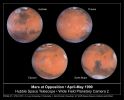
MARS-001.jpgMars from Hubble Space Telescope64 visiteThe Hubble Space Telescope has taken lovely images of Mars, which complement the MOC Atlas Mercator Projection. This image montage is from Mars' 1999 oppoxition.MareKromium
(6 voti)
|
|

016-Mars_Altitudes.jpgMars "Ups and Downs"...64 visiteTo complement the MOLA Laser Altimeter Mercator maps of Mars' elevations and topography, the MOLA Team also produced views of selected hemispheres.
These views emphasize specific interesting areas or angles. These maps show altitude data coded into colors - blue is low and red/white are high.
These two hemispheres are centered on the Tharsis Plateau (including the Valles Marineris and the large volcanos) and on the Isidis Impact Basin (with the Hellas Basin to the South).MareKromium
(6 voti)
|
|
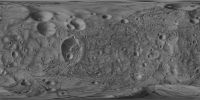
Phobos_Map.jpgPhobos (credits: NASA - USGS)65 visitenessun commentoMareKromium
(6 voti)
|
|

029-Mars-16-PIA09224_fig1.jpgThe "Thickness" of Mars' South Polar Layered Deposits (Map 1)66 visiteThis map shows the thickness of the South Polar Layered Deposits of Mars, an ice-rich geologic unit that was probed by the Mars Advanced Radar for Subsurface and Ionospheric Sounding (MARSIS). The MARSIS radar is an instrument on the European Space Agency's Mars Express orbiter. The thickness of the layered deposits was determined by measuring the time delay between radar echoes from the surface and those from the lower boundary, or "bed", of the deposits.
The radar data indicate that the deposit, larger than Texas in area, is more than 3,7 Km (about 2,3 miles) thick in places, and that the material consists of nearly pure water ice with only a small component of dust.
(6 voti)
|
|

024-Iani_Chaos_and_Ares_Valles.jpgMargaritifer Terra78 visiteCaption ESA originale:"This map shows that the Iani Chaos depression – 180 Km long and 200 Km wide – is connected to the beginning of Ares Vallis by a 100-Km wide Transition Zone, centred around 342,5º East and 3º North".
(6 voti)
|
|

Mars014-Water_Map-1.jpgMartian Water211 visiteInteressante...
"Tracce di acqua su Marte.
Ce ne dà conto una nuova mappa realizzata a partire dai dati raccolti nel corso di un decennio dal Mars Express di ESA e dalla Sonda MRO della NASA. Entrambe le Sonde sono in orbita intorno al pianeta rosso e grazie alle informazioni che ci hanno trasmesso negli anni – quella europea, ad esempio, è stata lanciata il 2 giugno 2003 dal Cosmodromo di Baikonur in Kazakistan – gli scienziati hanno creato la mappa più completa di cui disponiamo relativa ai giacimenti minerari marziani.
Si tratta di depositi di minerali idratati, ossia quelli che in un passato remoto sono stati alterati dalla presenza di acqua (p.e.: Argille e Sali). Sapevamo che ce n’erano e li abbiamo anche osservati abbastanza da vicino grazie al Rover Curiosity. Tuttavia, come spiega Scien-Alert, una mappa più ampia di dove poterle trovare ci concede “un’immagine più comprensiva della storia dell’acqua su Marte e ci aiuterà a pianificare future esplorazioni di un pianeta oggi asciutto e polveroso”. Ma che in passato era sensibilmente diverso: secondo la mappa, infatti, ovunque ci si diriga su Marte si scova qualcosa di interessante.
Il nuovo lavoro, guidato dallo scienziato planetario John Carter dell'Università di Parigi-Saclay e dell'Università di Aix Marsiglia in Francia, ha identificato più depositi e aree d’interesse di minerali acquosi di quante se ne conoscessero. Se fino a dieci anni fa conoscevamo un migliaio di affioramenti, come spiega Media INAF (Istituto Nazionale di Astrofisica), la nuova mappa ha ribaltato la situazione, rivelando centinaia di migliaia di tali aree nelle parti più vecchie del pianeta. L’acqua ha insomma svolto un ruolo essenziale nel plasmare la Geologia di un pianeta che oggi ci appare davvero così distante da un posto ricco d’acqua.
Ma la presenza dell’acqua fu persistente o episodica, limitata a una fase della storia del pianeta? Non lo sappiamo ancora perché il quadro risultante dalla nuova mappa è particolarmente complesso, fra sali che sembrano più antichi di alcune argille e zone argillose in cui vi è appunto una stretta mescolanza dei due minerali. Di certo la fase umida fu più lunga di quanto si immaginasse fino a pochi anni fa.
“L’evoluzione da molta acqua a niente acqua non è così netta come pensavamo. L’acqua non si è fermata in una notte - spiega infatti Carter - vediamo un’enorme diversità di contesti geologici, così che nessun processo o semplice sequenza temporale può spiegare l’evoluzione della mineralogia di Marte. Questo è il primo risultato del nostro studio. Il secondo è che se si escludono i processi vitali sulla Terra, Marte mostra una diversità di mineralogia in contesti geologici proprio come succede sulla Terra”.
Un altro articolo, pubblicato come la mappa sulla rivista Icarus e con prima firmataria Lucie Riu dell’Institute of Space and Astronautical Science (Isas), Japanese Aerospace eXploration Agency (JAXA), in Giappone, entra invece nel vivo della pianificazione delle missioni future su Marte sempre sulla base della stessa mappa. In particolare, per l’individuazione dei siti di atterraggio: i minerali acquosi contengono ancora molecole d’acqua e insieme al ghiaccio d’acqua sepolto possono costituire risorse da utilizzare in loco, magari per i futuri insediamenti umani. Intanto, prima delle prospettive fantascientifiche, si tratta di minerali molto interessanti da studiare: basti pensare al cratere di Jezero, dove lo scorso anno è atterrato il rover Perseverance, sito di Oxia Planum, dove atterrerà il Rover dell’ESA "Rosalind Franklin", costituito di antiche argille piene di minerali ricchi di Ferro e Magnesio, Smectite e Vermiculite".MareKromium
(5 voti)
|
|

020-Mars_South_Pole.jpgThe South Pole of Mars (Mercator Projection - credits: NASA/MOLA)65 visitenessun commentoMareKromium
(5 voti)
|
|

030-Mars-17-PIA09225_fig1.jpgThe "Lower Boundary" of the Icy Layers Covering Mars' South Polar Region (Map 2)71 visiteThis map shows the topography of the South Polar Region of Mars, including topography buried by thick deposits of icy material. The map is a combination of surface elevation data acquired by the Mars Orbiter Laser Altimeter aboard NASA's Mars Global Surveyor orbiter, and subsurface elevation data acquired by the Mars Advanced Radar for Subsurface and Ionospheric Sounding (MARSIS) aboard the European Space Agency's Mars Express orbiter.
The black line shows the boundary of the South Polar Layered Deposits, an ice-rich geologic unit that was probed by MARSIS. Elevation values within the black outline, as measured by MARSIS, show the topography at the boundary between the layered deposits and the underlying material, an interface known as the "bed" of the deposits. The elevation of the terrain is shown by colors, with purple and blue representing the lowest areas, and orange and red the highest. The total range of elevation shown is about 5 Km.
The radar data reveal previously undetected features of topography of the bed, including depressions as deep as 1 Km (0,6 miles) shown in purple in the near-polar region.
The boundary of the layered deposits was mapped by scientists from the U.S. Geological Survey. The dark circle in the upper center is the area poleward of 87° South Latitude, where MARSIS data cannot be collected.
The map covers an area of 1670 by 1800 Km (about 1035 by 1115 miles).
(5 voti)
|
|

Mars-015-Water_Map-2.pngMartian "Water-rich" Minerals188 visitesi veda il commento al frame che precedeMareKromium
(4 voti)
|
|

034-Methane_of_Mars.jpgMap of the "Martian Methane"83 visiteCaption NASA:"Why is there Methane on Mars? No one is sure.
An important confirmation that Methane exists in the Atmosphere of Mars occurred last week, bolstering previous controversial claims made as early as 2003. The confirmation was made spectroscopically using large ground-based telescopes by finding precise colors absorbed on Mars that match those absorbed by Methane on Earth.
Given that Methane is destroyed in the open martian air in a matter of years, the present existence of the fragile gas indicates that it is currently being released, somehow, from the Surface of Mars.
One prospect is that microbes living underground are creating it, or created in the past. If true, this opens the exciting possibility that life might be present under the Surface of Mars even today. Given the present data, however, it is also possible that a purely geologic process, potentially involving volcanism or rust and not involving any life forms, is the Methane creator.
Pictured above is an image of Mars superposed with a map of the recent Methane detection".
Nota Lunexit: se la Mappa NASA è realmente accurata ed il quantitativo di Metano presente in Atmosfera è quello "suggerito" dalla Mappa stessa, allora - sempre seguendo la "Logica NASA" - ci troveremmo davanti a due possibili scenari:
1) Scenario Geologico (Metano come prodotto di processi geologici): Marte è ancora soggetto attivo di fenomeni vulcanici tutt'altro che minori e residuali, visti i quantitativi e la distribuzione del Metano nell'Atmosfera del Pianeta Rosso, oppure
2) Scenario Biologico (Metano come sottoprodotto di attività biologiche attuali): Marte è, letteralmente, "brulicante di Vita" - altro che batteri e micro-organismi - visti, come sopra, i quantitativi e la distribuzione del Metano nell'Atmosfera del Pianeta Rosso.
SOTTOLINEIAMO che queste nostre congetture DERIVANO LOGICAMENTE DALL'ANALISI DEI DATI NASA e NON da nostre speculazioni!
Vi suggeriamo, inoltre, di notare la posizione dei maggiori quantitativi di Metano nell'Atmosfera Marziana...MareKromium
(4 voti)
|
|

Q-viking_1_gallery.pngMoments of Phobos and Deimos124 visitenessun commentoMareKromium
(3 voti)
|
|
| 54 immagini su 5 pagina(e) |
 |
|
4 |
|








