| Piú votate - Mars, Deimos and Phobos: Maps |
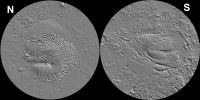
021-Mars_Poles.jpgThe Poles of Mars64 visiteThe Mercator Projection distorts Polar Regions beyond recognition, so Polar Projection Maps are commonly made separately. These MOLA shaded topography images of Mars's North and South Polar Regions are stereographic projections, from Latitudes 72° N and S towards the respective Poles. The line of 0° Longitude is to the bottom of the North Pole images, and toward the top of the South Pole image.
Both Poles are covered by layered ice caps with smooth undulating surfaces. The North Polar Cap sits of a flat plain, while the South Polar Cap sits on heavily cratered land.MareKromium
(8 voti)
|
|
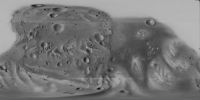
O-Deimos_Map.jpgDeimos (credits: NASA - USGS)65 visitenessun commentoMareKromium
(8 voti)
|
|
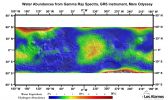
023-Mars_Water-2.jpgWhere is the "Water" of Mars? (Equatorial and Middle Latitude Regions)66 visiteA Neutron Spectrometer on the Mars Odyssey Spacecraft measures the abundances of neutrons of various energies emitted from Mars' Surface.
The ratio of low- to high-energy neutrons is a sensitive test of water abundances within a meter of Mars' surface.
There is LOTS of water. No one had expected any where near this much water near the Martian Surface.
All this is BETTER described in a press release from the Los Alamos National Laboratory, home of the Neutron Spectrometer and the scientists who run it (http://www.lanl.gov/news/releases/archive/03-101.shtml). MareKromium
(7 voti)
|
|

013-Mars_Visual_Albedo_.jpgMars Visual Albedo through a RED Filter65 visiteThis image of Mars is from the Mars Orbiter Camera (MOC) on the Mars Global Surveyor (MGS) Spacecraft.
The image means the "Visual Brighness" of Mars, meaning how Mars would appear to the human eye through a red filter.
The mosaic is from a short time in 1999, when there was a significant dust storm in Hellas Basin (brigh spot on right side near bottom).
There is no data from the South Pole, because it was in total darkness at the time - and Mars' North Pole was pointed towards the Sun.MareKromium
(7 voti)
|
|
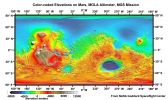
014-Mars_Altitudes.jpgMars "Ups and Downs"...64 visiteThe MOLA Laser Altimeter produced detailed topographic maps and profiles of Mars, and really revolutionized our understanding of Mars.
So much from elevation alone!
These maps show the MOLA altitude data coded into colors - blue is low and red/white are high.MareKromium
(7 voti)
|
|

022-Mars_Water-1.jpgWhere is the "Water" of Mars? (Polar Regions)67 visiteWater abundances in the Martian Polar Regions, from the Neutron Spectrometer on Mars Odyssey, are shown here to complement the Mercator Projections of Equatorial Regions.
The North Pole is nearly pure water ice, while the South Pole is water iced mixed with other stuff, most likely dry ice (CO2) and mineral dust.
More details are available in the Los Alamos National Lab press release.MareKromium
(7 voti)
|
|

019-North_Pole.jpgThe North Pole of Mars (Mercator Projection - credits: NASA/MOLA)64 visitenessun commentoMareKromium
(7 voti)
|
|

018-Mars_Magnetic_Anomalies.jpgThe Magnetic Anomalies of Mars64 visiteThe Magnetic Anomalies found by the MAG/ER experiment on the Mars Global Surveyor spacecraft are inconveniently bisected by the 180° Longitude line, and so appear at both ends of the standard Mars Mercator Projection.
Here, the MAG/ER team have made hemispheric projections centered on the area of strongest anomalies.
The 3 hemispheres show the 3 components of the Magnetic Field: B(r) is the Radial Field, which is perpendicular to Mars' Surface; B(Θ) is the Polar Field, oriented along lines of Longitude; and B(Φ) is the Circumferential Field, oriented along lines of Latitude. MareKromium
(7 voti)
|
|
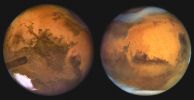
MARS-000.jpgMars: the Orange, Greenish, Bluish, Gray and White Planet (True Colors; credits: NASA)76 visitenessun commentoMareKromium
(7 voti)
|
|

031-Mars-18-PIA09226_fig1.jpgThe "Upper Surface" of the Icy Layers Covering Mars' South Polar Region (Map 3)65 visiteThis map shows the topography of the South Polar Region of Mars. The data were collected by the Mars Orbiter Laser Altimeter aboard NASA's Mars Global Surveyor orbiter between 1997 and 2001. The elevation of the terrain is shown by colors, with purple and blue representing the lowest areas, and orange and red the highest. The total range of elevation shown is about 5 Km. The black line shows the boundary of the South Polar Layered Deposits, an ice-rich geologic unit that was probed by the Mars Advanced Radar for Subsurface and Ionospheric Sounding (MARSIS) aboard the European Space Agency's Mars Express orbiter.
The radar data indicate that the deposit is more than 3,7 Km (about 2,3 miles) thick in places, and that the material consists of nearly pure water ice, with only a small component of dust. The MARSIS team also determined that the total volume of ice in the layered deposits is equivalent to a water layer 11 mt (36 feet) deep, if spread evenly across the Planet. The boundary of the Layered Deposits was mapped by scientists from the U.S. Geological Survey. The dark circle in the upper center is the area poleward of 87° South Latitude, where MARSIS data cannot be collected.
The image covers an area of 1670 by 1800 Km (about 1035 by 1115 miles).
(7 voti)
|
|
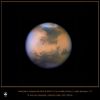
MARS-008.jpgGreen Patches on Mars (Earth View, from Pic-du-Midi)145 visiteLa NASA può, giustamente, sostenere quello che vuole (o, come ha fatto oggi, nella caption dedicata a questo frame, può non dire assolutamente nulla), ma le "macchie di verde" che si vedono con estrema chiarezza sulla Superficie di Marte in questa recentissima immagine ottenuta dall'Osservatorio Astronomico Francese "Midi-Pyrénées" NON SONO, a nostro modo di vedere e di interpretare, il prodotto di una semplice - ancorchè curiosa - aberrazione cromatica.
Anche nei nostri (certo non "fantascientifici", ma sicuramente accurati e professionali) color-processing il "verde" appare, su Marte, sempre più spesso: sia nei frames superficiali, sia nei frames orbitali.
Forse sarebbe il caso di fare, ai livelli di competenza più opportuni, qualche seria riflessione sulla Natura ed, eventualmente, la portata di questo fenomeno...
Caption NASA:"It's Spring for the Northern Hemisphere of Mars and Spring on Mars usually means Dust Storms. So the dramatic brown swath of dust (top) marking the otherwise white North Polar Cap in this picture of the Red Planet is not really surprising.
Taking advantage of the good views of Mars currently possible near opposition and its closest approach to planet Earth in 2010, this sharp image shows the evolving Dust Storm extending from the large dark region known as Mare Acidalium below the Polar Cap. It was recorded on February 2nd, 2010, with the 1 meter telescope at Pic Du Midi, a mountain top observatory in the French Pyrenees".
Nota Lunexit: BIZZARRO! Gli Amici di Pasadena hanno visto la "Striscia Marrone" che taglia la Calotta Nord Polare (marrone che poi è, secondo noi, un bel color arancione vivace...), ma non vedono il Verde che si stende, dalla Pianura di Acidalia, sino alla Regione di Vastitas Borealis e poi "scende", attraversando le Regioni Equatoriali (con una parte di Meridiani Planum), per quindi giungere sino alle porte della Terra di Noachis, nelle profondità dell'Emisfero Australe di Marte.
Certo, è possibile che il Verde che vediamo sia il prodotto - comunque - di un'aberrazione di un qualche tipo: noi ne siamo PERFETTAMENTE consapevoli. Ma, alle volte, quello che ci lascia perplessi, è il silenzio da parte di Coloro che sanno (o che dovrebbero sapere), anche davanti a fenomenologie di indubbia curiosità, se non di "interesse scientifico" in senso stretto.
Insomma: il brown (marrone) è una cosa, il green (che si vede qui), un'altra.
Perchè si sceglie DELIBERATAMENTE di ignorare SEMPRE l'eventualità che "qualcosa di nuovo e di inatteso", su Marte, come forse su Plutone o - chissà - su Titano ed Encelado, stia realmente accadendo?
Ma di che cosa hanno paura "Coloro che sanno"? Forse di dover riscrivere qualche libro?
O forse di dover pubblicamente riconoscere la loro COLOSSALE ignoranza ed arroganza intellettuale?
... Pensateci sopra...MareKromium
(6 voti)
|
|

001-Mars.jpgMars, according to Schiaparelli64 visiteDal nostro Amico Roberto Tremolada, una bellissima (e "datata"!) Mappa del Pianeta Rosso realizzata dal Grande Schiaparelli.
E quindi, se volete VEDERE e SAPERE di più, Vi invitiamo a consultare la Sezione a Lui dedicata - ed intitolata "Per Ricordare" - dal bellissimo Sito Lunar Explorer Italia (Sez. Liguria e Piemonte), curato dal nostro Grandissimo Amico e Collega, il Dr Gianluigi Barca.
Vi basterà andare su http://www.lunarexplorer.it/, Sez. "Storia", sub-Sezione "Per Ricordare" e poi...Buona Lettura!MareKromium
(6 voti)
|
|
| 54 immagini su 5 pagina(e) |
 |
3 | |
|








