| Piú votate - Mars, Deimos and Phobos: Maps |

033-Mars_Rotation.jpgMars' Rotation and Orbit Dynamics142 visiteMars rotation around its pole causes a signature in the data with a daily minimum, when the Lander is closest to the Earth. Changes in such a daily signature may reveal information about the interior of Mars, through its effect on Mars' precession and nutation.
The signature is also sensitive to variations in Mars' Rotation Rate, as the mass of the atmosphere increases and decreases along with the Polar Caps increase and decrease (obviously the Polar Caps increase during the Martian Fall and Winter and then, due to the higher heating of the Planet - and subsequent evaporation phoenomena - they decrease in Spring and Summer).
Long term signatures in the range to the Lander are caused by asteroids perturbing Mars' orbit; an analysis of these perturbations may allow us to also determinate the masses of these asteroids.
(11 voti)
|
|

009-Mars_North_East.jpgThe North-Eastern Region of Mars109 visitenessun commento
(11 voti)
|
|

008-Mars_South_West.jpgThe South-Western Region of Mars120 visitenessun commento
(11 voti)
|
|

008-Mars_South_East.jpgThe South-Eastern Region of Mars116 visitenessun commento
(11 voti)
|
|

005-Surface_Ages.jpgMars Global Map: Age of Main Surface Features107 visitenessun commento
(11 voti)
|
|

004-Mars_Nomenclature.jpgMars Global Map: Main Albedo Features and Nomenclature141 visitenessun commento
(11 voti)
|
|
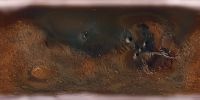
028-Mars_Colors-MF-LXTT2.jpgFull Map of Mars (Approximate Natural Colors; credits: Dr Marco Faccin - Lunexit Team)95 visite...E anche questa è ARTE...MareKromium
(9 voti)
|
|

017-Mars_Crustal_Magnetism.jpgMars Crustal Magnetism64 visiteThe Mars Global Surveyor spacecraft carried a Magnetometer, the MAG/ER.
During MGS's aerobraking procedure, the MAG/ER found that Mars does not have a global Magnetic Field like the Earth does, but large areas are strongly magnetic.
There are few good ideas of what this magnetism means, although plate tectonic processes do not seem likely. The area of Magnetic Anomalies seems to make a girdle around Mars, and this is (at least partly) because that's where MGS's orbit took it closest to Mars during aerobraking.MareKromium
(9 voti)
|
|

002-Mars_Map.jpgMars Global Map (Mariner 9): Main Regions and Landing Sites186 visitenessun commento
(9 voti)
|
|
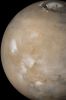
MARS-009.jpgThe "Brown Face" of Mars - Wintertime330 visitenessun commento
(9 voti)
|
|

027-Mars_Super_Advanced_Map.jpgExtremely Advanced Mars Geologic Global Map64 visitePublisher: U.S. Geological Survey
Scale: 1:25.000.000
Projection: Mercator
MareKromium
(8 voti)
|
|
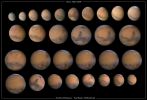
MARS-002.jpgMars in Time63 visiteCaption NASA, da "NASA - Picture of the Day" del 14 Luglio 2008:"Does Mars always appear the same? No.
As both Earth and Mars orbit the Sun, the apparent angular size of Mars changes as viewed from the Earth. Pictured above from Enschede, Holland, Mars was captured in 2007 and 2008 with 30 separate images, all taken with the same magnification.
When Earth and Mars are on opposite sides of the Sun, Mars appears relatively small. Conversely, when Earth and Mars are near each other, Mars looms large and bright. The largest Mars has appeared in recent history was the opposition of August 2003.
Since Mars is always more distant from the Earth from the Sun, Mars never shows a crescent phase to Earthlings. Visible also in the above images are the North Polar Cap of Mars, dark and light soil, clouds, and, in the early images, a Global Dust Storm.
The next opposition, when Earth again passes near to Mars, will occur in early 2010".MareKromium
(8 voti)
|
|
| 54 immagini su 5 pagina(e) |
2 |  |
|
|








