| Piú votate - Mars, Deimos and Phobos: Maps |
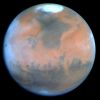
000-Mars.jpgMars: the Red Planet with "Blue Limbs"...266 visiteMars Data and Statistics
Mass (kg) = 6.421e+23
Mass (Earth = 1) = 1.0745e-01
Equatorial radius = 3.397,2 Km
Equatorial radius (Earth = 1) = 5.3264e-01
Mean density (gm/cm^3) = 3,94
Mean distance from the Sun = 227.940.000 Km
Mean distance from the Sun (Earth = 1) = 1,5237
Rotational period (hours) = 24,6229
Rotational period (days) = 1,025957
Orbital period (days) = 686,98
Mean orbital velocity = 24,13 Km per second
Tilt of axis = 25,19°
Orbital inclination = 1,850°
Equatorial surface gravity (m/sec^2) = 3,72
Equatorial escape velocity = 5,02 Km per second
Magnitude (Vo) = - 2.01
Minimum surface temperature = - 140°C
Mean surface temperature = - 63°C
Maximum surface temperature = + 35°C
Atmospheric pressure (bars) = 0,007
Atmospheric composition: Carbon Dioxide (C02) 95,2%; Nitrogen 2,7%; Argon 1,6%; Oxygen 0,13%; Carbon Monoxide 0,07%; Water 0,03%; Neon 0,00025%; Krypton 0,00003%
(21 voti)
|
|

MARS-007.jpgMars from Earth243 visiteUna visione solo apparentemente identica alla precedente: in questo secondo caso, infatti - anche se stentiamo a crederlo... - l'immagine arriva da Terra! L'inclinazione dell'asse del Pianeta Rosso è diversa; la calotta Sud-Polare ci appare un pò più sviluppata rispetto a quanto si vedeva nell'immagine HST ed anche la circonferenza del Pianeta sembra leggermente più grande. La definizione è addirittura migliore rispetto al frame HST; il colore della superficie di Marte è più intenso ed i bordi azzurri (blue limbs) sono spariti.
Domanda: ma quale delle due immagini è più veritiera?
(18 voti)
|
|

MARS-005.jpgMars from the Hubble Space Telescope241 visiteI riflessi azzurri che apparivano evidentissimi nel frame precedente (immagine ripresa da Terra) sono ancora visibili, sia pure in forma meno marcata, in questo fotogramma HST. Che ne dite? Si tratta di segni evidenti che il cielo di Marte è azzurro (magari non sempre, ma comunque abbastanza di frequente)? Oppure sono "scherzi" dello sviluppo delle fotografie? Oppure sono "effetti speciali" creati per confondere le idee?
(18 voti)
|
|

MARS-006.jpgMars from the Hubble Space Telescope213 visiteAncora al disco di Marte, come appare agli occhi dell'Hubble Space Telescope: da notare ancora la caratteristica colorazione aranciata del Pianeta ed i riflessi azzurri lungo i bordi. Molto ben sviluppata e definita, in questa immagine come nella precedente, la calotta Sud-Polare.
(16 voti)
|
|

025-Mars_Global_with_Nomenclature.jpgMars Map for Beginners68 visiteUna Mappa semplice ed immediata non guasta mai...MareKromium
(14 voti)
|
|

010-Mars_North_West.jpgThe North-Western Region of Mars131 visitenessun commento
(14 voti)
|
|

012-Thermal_Inertia.jpgMars Global Map: Thermal Inertia110 visitenessun commento
(13 voti)
|
|

MARS-010.jpgThe "Brown Face" of Mars - Springtime355 visitenessun commento
(13 voti)
|
|
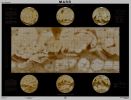
026-Mars_Advanced_Map.jpgAdvanced Mars Global Map68 visitePublisher: Aeronautical Chart and Information Center
Scale: 1:35.000.000
Projection: Mercator MareKromium
(12 voti)
|
|

032-Mars_Interior.jpgWhat's inside Mars?199 visiteMars interior is simply modeled as a core and mantle with a thin crust, similar to Earth. Mars' size and total mass are known. Given four parameters, the core size and mass and mantle size and mass can be determined.
The combination of Pathfinder Doppler data with earlier data from the Viking Landers has determined a very important parameter, the "Moment of Inertia", through measurement of Mars' precession rate. A fourth measurement is needed to complete the interior model. This may be achieved through future Doppler tracking of Pathfinder, since the presence of a fluid core may be detectable through its effect on Mars' nutation. The determination of the moment of inertia is a significant constraint on possible models for Mars' interior. If the core is as dense as possible (i.e. completely iron) and the mantle is similar to Earth's (or similar to the SNC meteorites thought to originate on Mars) then the minimum core radius is about 1300 Km. If the core is made of less-dense material (i.e. a mixture of iron and sulfur) than the core radius is probably no more than 2000 Km.
(12 voti)
|
|
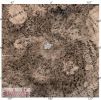
007-Mars_South_Pole.jpgThe South Polar Region of Mars116 visitenessun commento
(12 voti)
|
|

006-Mars_Topography.jpgMars Global Map: Topography113 visitenessun commento
(12 voti)
|
|
| 54 immagini su 5 pagina(e) |
1 |
 |
|
|








