| Piú votate - From Ashes to Eternity: the Phoenix Mars Mission |

PHOE-SOL003-lg_609-1.jpgPhoenix and the Landscape in True Colors! - Sol 3 (Superdefinition + MULTISPECTRUM; credits: Dr Marco Faccin & Lunexit)79 visiteQuesta immagine? Un capolavoro! (altro che gli "Approximate Colors" della NASA....)MareKromium
(5 voti)
|
|

PHOE-SOL002-lg_542-543-3.jpgLandscape... Sol 2 (Natural Colors + MULTISPECTRUM; credits: Dr G. Barca & Lunexit)71 visitenessun commentoMareKromium
(5 voti)
|
|

PHOE-SOL000-HIRISE.jpgThe Descent of Phoenix, from MRO - Sol 072 visiteCaption NASA:"NASA's Mars Phoenix Lander can be seen parachuting down to Mars, in this image captured by the High Resolution Imaging Science Experiment (HiRISE) camera on NASA's Mars Reconnaissance Orbiter. This is the first time that a spacecraft has imaged the final descent of another spacecraft onto a planetary body.
From a distance of about 310 Km (193 miles) above the surface of the Red Planet, Mars Reconnaissance Orbiter pointed its HiRISE obliquely toward Phoenix shortly after it opened its parachute while descending through the Martian Atmosphere. The image reveals an apparent 10-meter-wide (30-foot-wide) parachute fully inflated. The bright pixels below the parachute show a dangling Phoenix. The image faintly detects the chords attaching the backshell and parachute. The surroundings look dark, but correspond to the fully illuminated Martian surface, which is much darker than the parachute and backshell.
Phoenix released its parachute at an altitude of about 12,6 Km (7,8 miles) and a velocity of 1.7 times the speed of sound".MareKromium
(5 voti)
|
|

PHOE-SOL001-PIA10693.jpgMartian Surface (Approximate Colors; credits: NASA/JPL-Caltech/University of Arizona/Texas A&M )68 visitenessun commentoMareKromium
(5 voti)
|
|

E-PIA10633.jpgDust Devils and Frozen Craters at Phoenix Landing Site (MULTISPECTRUM; credits: Lunexit)72 visiteNASA's Phoenix Mars Lander is scheduled to land on the Martian Northern Plains near 68° North Lat. and 127° West Long. on May 25, 2008. In preparation for the landing, NASA's Mars Reconnaissance Orbiter has been monitoring weather in the Region around the Landing Site.
On April 20, 2008, the orbiter's Context Camera captured this view showing two active DD within the Phoenix Landing Ellipse.
This is a subframe covering an area about 26 Km (approx. 16 miles) on each side (...). It shows two Dust Devils and their shadows. Based on measurement of the shadows cast by the DD, one of the vortices towered about 590 meters (about 1930 feet) with a dust plume extending 920 meters (about 3020 feet) above the surface. The other reached about 390 meters (1280 feet) high, with a dust plume extending to 790 meters (2590 feet). The resolution here is 6 meters (19,7 feet) per pixel.
When the Context Camera acquired this image, the season in Mars' Northern Hemisphere was late Spring. A few weeks earlier, the Phoenix Landing Site was still covered with seasonal frost left over from the previous Winter. White patches in small craters near the center of the picture are areas where the Winter frost remained, even as late as April 20, 2008.
As Spring gives way to Summer, DD are likely to occur more frequently, as local temperatures rise. These two DD observed in late April are among the first of the season. The cameras on the Phoenix Lander might be able to spot additional Dust Devils after the spacecraft arrives, as the Mars Exploration Rover Spirit has been able to do at its Southern Hemisphere Landing Site.
Dust Devils are whirling vortices that have picked up dust from the ground. Such vortices can occur even when no dust is present, but then they are not visible to the cameras onboard the Mars Reconnaissance Orbiter. Such vortices commonly form as hot air rises from the surface on an otherwise generally calm day with little or no breeze. Dust Devils will travel across the surface on the gentle breezes that do occur. Sometimes, DD have been observed by cameras orbiting Mars to create streaks on the ground as they disrupt and pick up dust, though no streaks are observed in this image.
The Mars Orbiter Camera onboard NASA's Mars Global Surveyor orbiter observed Dust Devils — and streaks created by them — throughout its 1997 to 2006 mission. During that time, scientists at Malin Space Science Systems observed more than 12.000 active Dust Devils. They were seen over the full range of elevations and nearly all latitudes on Mars. Dust Devil Streaks were found in Mars Orbiter Camera images as far North as the edge of the North Polar Residual Cap and the dune fields that surround the Region.
However, the northernmost active DD captured by that camera was at 62,2° North Latitude, which is further South than the Phoenix Landing Site.
Another camera on the Mars Reconnaissance Orbiter, the Mars Color Imager, captured a simultaneous, wider-field, color view of the area included in this Context Camera image. That view can be seen at PIA10634.MareKromium
(5 voti)
|
|

B-PIA09948.jpgSweet Spot for Landing on Mars81 visiteCaption NASA:"This view shows scattered rocks and a polygonal ground texture within the "sweet spot" of the planned landing area for NASA's Phoenix Mars Lander.
This is a subframe, covering a patch of ground about 250 meters (820 feet) across, from a larger image taken by the High Resolution Imaging Science Experiment (HiRISE) camera on NASA's Mars Reconnaissance Orbiter on Jan. 1, 2007.
The full image, catalogued as HiRISE image PSP_002170_2485, is centered at 68,3° North Latitude and 232,9° East Longitude".MareKromium
(5 voti)
|
|

C-Phoenix-PolarTexture.jpgPossible Northern Scenarios (2) - Layers76 visitenessun commentoMareKromium
(5 voti)
|
|

A-Phoenix-000.jpgThe (fully assembled) Phoenix Mars Lander72 visitenessun commentoMareKromium
(5 voti)
|
|
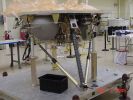
A-Phoenix-001.jpgThe Phoenix Lander: Hot-Fire Test Mock-Up69 visitenessun commentoMareKromium
(5 voti)
|
|

A-Phoenix-002.jpgThe Phoenix Lander and its Solar Panels in the "Clean Room"77 visitenessun commentoMareKromium
(5 voti)
|
|

PHOE-SOL150-365048main_phx17062-516_edited.jpgVastitas' Horizon - Sol 15079 visiteNota Lunexit:"Se veramente Marte fosse il mondo perennemente rosso "monocromatico" descritto dalla NASA, avremmo una bella rogna tecnica: praticamente, in mancanza di - effettiva - luce bianca, qualora il cielo marziano fosse davvero PERENNEMENTE arrossato dalle micropolveri in costante sospensione nella sua (presunta) rarefatta atmosfera, qualsiasi veicolo presente al suolo (dotato di pannelli solari) avrebbe avuto una vita breve.
Molto breve, anzi: brevissima! Perchè? Perchè i Pannelli Solari necessitano di captare i fotoni dell'intero spettro visibile se si vuole che ogni cosa funzioni a modo, specie considerando il fatto che la frequenze della luce rossa è meno della metà di quella della luce violetta. I Pannelli Solari, Cari Amici, si chiamano così proprio perchè funzionano...Ad Energia Solare e cioè, a Spettro Pieno (Full Spectrum)! Spettro Pieno e quindi...usando la vecchia e cara luce bianca (che alla NASA proprio non piace".MareKromium
(4 voti)
|
|

PHOE-SOL020-lg5259-5260-5261-2_copia.jpgIce in the Trench - Sol 20 (True Colors; credits: Dr G. Barca & Lunexit)68 visitenessun commentoMareKromium
(4 voti)
|
|
| 399 immagini su 34 pagina(e) |
 |
|
|
|
|
23 | |
|
|
|
|








